Book Reviews
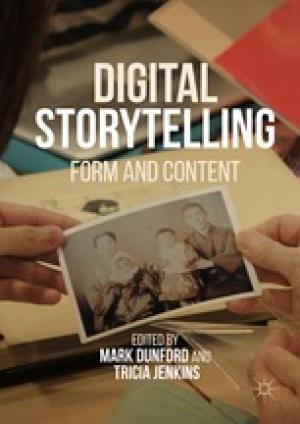
Upon reading the varied chapters that constitute Digital Story Telling: Form and Content, I could not help but be reminded of Salman Rushdie’s comments on the power of story. Those who do not have the power over the story that dominates their lives, the power to retell it, rethink it, deconstruct it, joke about it, and change it as times change, truly are powerless, because they cannot think new thoughts. (1991, Dec. 12, New York Times) Rushdie’s words illustrate the demands the postmodern world places on all individuals. It is a world replete with a multiplicity of stories in a myriad of forms… stories of domination and liberation, state narratives and personal accounts, corporate media renderings, and cellphone videos. In this world, the personal and political are not easily divorced. It is a world eager for new mediums which can offer the individual tools for agency and a space in which to tell, retell, rethink, deconstruct, joke about, and change their story. Digital Storytelling (DS) appears to be one such medium. What is DS? This volume’s editors, Mark Dunford and Tricia Jenkins, describe it as “a simple, creative process whereby people with little or no experience of computers gain the skills needed to tell a personal story as a two minute video using predominately still images combined with recorded voice-over, and often including music and/or other sounds” (3). The end products are “self-representational stories which emerge from a collaborative workshop process using a ‘Story Circle,’ in which a range of writing stimuli and other activities are used to develop trust within the group and ‘find’ the story” (3). Much of this definition comes from a pioneer in the field of DS, Joe Lambert, whose Digital Storytelling workshops, terminology, and methods have shaped the DS movement. DS is a form of participatory media in which political activism is embedded in its very practice. Lambert describes how in the 1990s he and those he was working with “thought of the Internet, new low-cost digital media production tools, and the distribution opportunities of the web as major advances that could promote global democracy and liberation” (22). The advent of the Internet for such a medium is tantamount to the proliferation of the printing press in sixteenth-century Europe. One need only look to social media platforms such as Facebook, YouTube, and Instagram to see how the Internet and low-cost media production tools have changed what we watch and how we watch it. DS is a precursor to this platform proliferation and the motivations driving it as a process appear to have been less fiscally motivated. One of the paramount intentions of DS is to provide the voiceless the means to be heard. Of course, DS workshops have facilitators and funders, both of which, intentionally or not, are intimately involved in the creation and dissemination of these personal stories. The volume is segmented into four elements or parts: Practice (five case studies from Kenya to the UK of DS in action); Content (pieces addressing the role content, especially content of a political [Simsek] or socially provocative [Kuga Thas] nature, plays in how that content is created, collected, received, parsed, and disseminated [Lewis and Matthews] and licensed [Spurgeon]); Form (insights garnered from when the cultural specificity of the DS model requires modification such as in Japan, Romania, and Ireland); and Understanding (three essays honing in on the limits and potential of DS as a political and personal force in the world). The volume culminates with Nancy Thumim’s chapter “Therapy, Democracy, and the Creative Practice of Digital Storytelling” in which she reflects on the unifying themes of the book (DS as democratizing work, DS as therapy, DS as meaning-making, reflection, presentation, and representation) as well as the logistical and ethical challenges DS faces (issues of ownership in regard to co-created media, the afterlife of created materials, restructuring workshops to accommodate participants of disparate backgrounds and differing needs). DS, in its varied iterations, straddles the personal and public and opens up a space for creativity among communities created by the DS workshops and those affected by their material output (artifacts). Perhaps the most compelling aspects of this volume are the stories (as found in Rainbird, Henry, Hardy and Sumner, Lewis and Matthews, Ogawa and Tsuchiya, Alexandra, and Brushwood Rose) of those persons challenged with mediating and assisting others (often those whose voices go unheard) through the process of narrating their own stories. As an academic advisor, the power of storytelling for self-actualization is readily apparent to me. Like the DS workshop facilitators in this book, academic advisors are involved in a co-creative narrative process. Advisors help students reflect on their goals and values and provide them with tools and mechanisms for authoring their own academic life story. The examples of DS workshop facilitators agonizing over how active to be in the creation of these personal stories should resonate with any reader who works in a co-creative capacity (advisors, administrators, teachers, parents, therapists, and so forth). The stories presented in each of these chapters are rather remarkable and, indeed, powerful. Anyone interested in modern media, narrative, social activism, communication studies, film, as well as those versed in DS scholarship, will find this a compelling read.

Teaching the World is a welcome volume on online theological education that seeks to ground educational practice with a theological foundation. The work is a critically needed guide that directs leaders and administers in developing online education programs. Readers will find practical insight on program development on three levels: framework, faculty, and classroom. An introductory chapter entitled, “Past Patterns and Present Challenges in Online Theological Education,” describes the delivery of theological education from the early days of correspondence in the eighteenth century to the current practice of providing multimedia curricula fully online. After advocating the legitimacy of online theological education, the authors maintain that educational institutions have often not built their online programs on theological foundations. Instead, they have unwittingly overlooked this step in their rush to launch programs for primarily pragmatic reasons – increased enrollment and profitability. The balance of the book is divided into three sections. Section I, “Better Foundations for Online Learning,” examines the role of the Pauline Epistles in theological education, ministry preparation, and spiritual formation from a distance. The authors argue that Paul's Epistolary practice provides biblical support for theological education from a distance and an example of how to deliver it. Subsequent pages integrate “social presence theory” with Paul's epistolary practice, resulting in a conceptual framework for online program development. Section II, “Better Faculty for Online Learning,” provides theological guidance for faculty roles in online programs. Here the authors argue for faculty who: (1) emphasize the spiritual formation of students over the mere transfer of knowledge, (2) demonstrate the ability to leverage the medium of online education to accomplish the desired outcomes for students, and (3) model the theological and professional standards for ministry. In such an environment, online faculty members embody the values of the institution and effectively facilitate the desired outcomes of programs. Section III, “Better Practices in the Classroom,” maintains that the students’ ministry contexts make effective online learning possible. Students in online programs are typically older and engaged in some form of ministry. Consequently, online programs should incorporate adult learning theory and facilitate learning in the student’s ministry context – the local church serving as an active partner in ministry preparation. A concluding chapter, “To Teach, to Delight, and to Persuade,” argues that online programs are not a replacement for residential programs, but are a means for developing stronger partnerships for ministerial preparation. This book’s emphasis on using theology as a conceptual framework for online theological education is its conspicuous strength. Teaching the World: Foundations for Online Theological Education presents a grand vision for online theological education that is particularly valuable for leaders of theological schools who seek to develop online programs that are effective in fulfilling the educational outcomes of their institutions.

This brief handbook and reference work was designed for college and university students interested in doing research. Charity Hudley, Dickter, and Franz present scholarly research as an exciting way for undergraduates to make the transition from students who learn to scholars who join an ongoing conversation as “masters of knowledge and challengers of the status quo” (5). The authors purposely construct the guide to serve not only as a resource but also as a model of a research-based approach to scholarly writing; they frequently comment on their own working methods and the research process that went into the composition of this text. The resulting book effectively demystifies the world of academia and the work of scholars, making research approachable and appealing. Throughout the guide, the authors encourage students to pursue their academic and personal interests by becoming researchers, and they provide an impressively comprehensive roadmap for the research process. The book takes a special interest in guiding first-generation college students and students from historically underrepresented populations. The tone is collegial, and the text abounds with concrete advice about navigating the concomitants of scholarly research, from how to email a potential research mentor (80) to how to identify and access campus resources that can assist with time and energy management (49). Chapter 2, devoted to getting started, describes what research looks like across several academic disciplines and details ways different schools support and reward undergraduate research. Personal accounts from student scholars provide additional relatable voices and create the sense of a broad academic community into which readers are invited. The authors also emphasize the importance of sharing research results with a variety of audiences; Chapter 5, “Writing and Presenting Research” (91-116), describes different venues for written and oral communication that increase the impact of a student’s project, including conferences, articles, books, and social media. A particularly valuable contribution of this book is its focus on empowering students from underrepresented populations. In addition to devoting a chapter to describing challenges that students from minority populations face and some tools for overcoming those challenges (“Underrepresented Scholars in the Academy: Making a Way,” [117-142]), the authors consistently highlight the value of diverse voices and backgrounds, and especially of the new questions such diverse viewpoints can generate. They frame the importance of greater academic inclusiveness and equity in a larger conversation about the powerful impacts researchers can have on their communities, emphasizing the value of interdisciplinary scholarship and community-based research. Although the book is addressed directly to an audience of undergraduates who are or who seek to become researchers, the authors also model numerous ways to offer such students practical support. Therefore the text may also serve as a valuable resource for teachers, mentors, and advisors who assist student researchers and ensure their success.
Robert Talbert’s Flipped Learning: A Guide for Higher Education Faculty is intended for three separate categories of instructors engaged in the process of flipped learning in higher education. He intends his monograph to appeal to “the curious,” “the newbies,” and “the veterans,” otherwise known as those first investigating flipped learning, those experimenting with flipped learning and looking to fix or expand on their early forays into it, and those who have taught at least one fully flipped class and want to “hone their craft” (xviii-xix). He divides the monograph into three sections. The first, “What Is Flipped Learning?” offers definitions and histories of flipped learning, and models of what flipped learning looks like in the classroom. The second section, “Flipped Learning Design” provides guidelines for designing a syllabus, lessons, and classroom activities using flipped learning. Finally, the third section, “Teaching and Learning in a Flipped Learning Environment” addresses variations on the flipped classroom and common student complaints about the method. While Talbert intends his book for use by all higher education instructors, it is probably most useful for those in STEM, business, or social science classrooms. Talbert uses his initial chapter, “What Is Flipped Learning, and Why Use It,” to work through definitions and misunderstandings of flipped learning. While flipped learning is commonly believed to consist of assigning videos of lectures for students to watch before class time, Talbert explains that flipped learning is a methodology rather than a specific technique. Flipped learning, he asserts, aims to ensure that students first encounter the new material on their own, outside of class, and then work to nuance their understanding and build skills around that material in the classroom. In this way, students develop the ability to access new material independently and then do the more challenging work of integrating and developing that information in the classroom with assistance from both classmates and the professor, or “expert.” The second chapter, “The History and Theory of Flipped Learning,” traces the method’s history to establish that it is neither new nor a fly by night fad, but rather a sensible pedagogical strategy built on a solid base. Chapter three, “Models of Flipped Learning,” offers a range of examples from math, business, and economics to demonstrate flipped learning approaches. In each example, Talbert draws from largely mathematics-based courses, suggesting that students read and watch videos about concepts before coming to class to work together on problem sets, the opposite of a traditional STEM course in which concepts are introduced in lecture and students then depart to work on problem sets on their own. (It is noteworthy that although Talbert argues in the earlier chapters that flipped learning is more than watching videos before class, this is, in fact, a primary method that he demonstrates.) As a religious studies professor, it was hard to see how this method would change the basic format of my humanities classes, in which student read material ahead of time, usually guided by discussion questions, and then come to class for a brief lecture that fills in details and group conversations or a class discussion, informed by their reading. While I have no objection to a book providing instruction on pedagogy for the STEM/business classroom, Talbert’s apparent inability to acknowledge the different structure of the humanities is significant. In failing to recognize that his methods would not significantly change the traditional structure of humanities classes, he has failed to properly acknowledge his book’s disciplinary scope and to correctly identify the audience to whom it would be the most useful. In these fields, flipped learning makes a notable difference from traditional pedagogical methods in which students first encounter new concepts in class. In the humanities, however, students traditionally encounter new material through reading assignments before class. That material is then elaborated upon and explored in classroom lectures, discussions, small groups, and activities. It is difficult, even with one or two humanities-based examples, to see how Flipped Learning dramatically would change my humanities classroom. Chapters four, five, and six address the nuts and bolts of how to flip a class. Here, Talbert offers both many more specific guidelines and, in a couple of instances, he draws examples from the humanities classroom. For instance, in chapter four, he suggests providing students with a list of reading questions that guide students toward increased complexity of thinking, gradually moving from reading comprehension and synthesis questions to conceptual and analytic questions. Chapter five offers insight into how to construct the activities. Throughout this chapter, Talbert offers cogent summaries of key theories on learning and course design, and while he rarely suggests a technique with which I am unfamiliar, his explanations of how and why they are effective are certainly likely to help me refine my technique. Chapter seven provides adaptations to the flipped learning model, primarily for low technology educational environments. It also addresses a number of student objections to the flipped classroom, ranging from student complaints about having to teach themselves to gripes that flipped learning takes too much time outside of class. On a practical note, Talbert also addresses the risks of participating in a flipped-learning classroom while untenured or in a contingent position. In each of these situations, he offers concrete advice for mitigating the risk of pedagogical experimentation, particularly reactions from students who are adjusting to a new line of teaching. These chapters were, perhaps, the most useful, as they provided language for addressing student dissatisfaction with new methods and were, perhaps, the most applicable to non-mathematically oriented classrooms. Throughout the book, I was struck by Talbert’s dry tone. Although I am accustomed to academic writing I found this to be a bit of a slog, which is a less than ideal model for a book dedicated to methods of teaching and learning. More importantly, while the author claims the book will be useful for all of the divisions of higher education, it is constrained by the author’s primary orientation and expertise, and most (though not all) of his examples are drawn from STEM, business, and mathematically oriented social sciences such as economics. Nonetheless, Talbert provides background research that will allow readers to refine and justify some of their existing techniques, helping them engage student learning both within the classroom and beyond it.
Arguably, due to suspicion, skepticism, and the entrenchment of classroom teaching practices, the most scrutinized, assessed, and evaluated pedagogy in theological schools in the last two decades has been online learning (“distance education”). Fortunately, the skepticism that fueled a demand for more rigorous evaluation of student learning in the online environment has yielded hard evidence that online learning is as effective, and sometimes more effective, than traditional classroom teaching. The goal of this work by Catalano, an associate professor of teaching and learning at Hofstra University, is “to assist researchers of distance education, both novice and expert, in finding well-developed and value measures to suit their research questions” (2). The focus of the book is “on properly validated measures, thereby relieving the researcher from having to develop his or her own instrument” (2). Catelano provides a concise guide to seventy selected assessment instruments (surveys, scales, and methods) that have been used to evaluate the effectiveness of online learning programs. The instruments can be applied to evaluate key metrics and pedagogical, as well as programmatic, elements such as: student engagement, student and faculty satisfaction, information retention, self-efficacy, student and teacher readiness, the online learning environment, cooperative learning, competencies for online learning, student attitudes, student retention and attrition, critical thinking, and achievement. Several instruments focus on specific pedagogical approaches such as constructivism and andragogy. Five chapters provide nine categories of evaluations. Specifically, Chapter 1 provides eleven instruments on student engagement and satisfaction. Chapter 2 contains sixteen instruments on student readiness to learn and self-efficacy. Chapter 3 offers a selection of seventeen instruments focusing on the online teaching and learning environment. Chapter 4 provides twelve instruments on student learning behaviors. Chapter 5 contains five instruments to assess student achievement, retention, and attrition. Obviously, there are enough offerings in these chapters to meet just about any evaluation need an assessor may have. Each chapter includes a brief overview of each instrument covered. Each instrument entry includes a summary of the tool, a description of how the measure is used, and a description of its development and validity. Some of the instruments described are complete tools (for example, a fully developed satisfaction questionnaire, a complete survey on student evaluation of online web-based instruction, and one on the online learning environment. Other instruments are described with information about their sources should an assessor wish to use them. In the Introduction Catalano provides helpful background on the criteria for inclusion of the instruments selected for the compendium. The author describes the search process used in identifying the instruments, including applying the criteria of ensuring reliability and validity. For those needing to continue to assess online learning through disciplined and rigorous evaluations, whether as part of formative curricular assessment or to satisfy accreditation requirements, Amy Catalano’s brief compendium of assessment instruments, scales, and approaches is a handy and accessible tool. Indeed, it should be on every evaluator’s desk.
Enhancing Learning and Teaching with Technology: What the Research Says Rosemary Luckin, editor London, UK: UCL Institute of Education Press, 2018 (xxxv + 334 pages, ISBN 978-1-78277-226-2, $41.95) The overarching conclusion one might draw from this research-oriented review of current studies regarding education and technology is that we simply do not know enough about the effects of digital resources on teaching and learning. As the authors of this edited volume repeatedly point out, media reports about educational technology typically highlight negative findings and ignore positive associations. Technology champions and detractors rely primarily on face-value benefits or concerns in making their cases for or against educational use. Few studies have empirically considered the interplay among specific learning theories, educational contexts, embodied practices, and various technologies that might enhance learning. Without such research, we cannot draw defensible conclusions about the educational effectiveness of technology resources for formal and informal learning. Organized in six parts – two that focus on learning factors and four related to educational challenges that might benefit from technological resourcing – the text is at times jargon heavy, particularly for readers unfamiliar with computer programming lingo or European educational policies and practices. A six-page glossary offsets some of this difficulty. Diagrams described as color-coded are printed in black and white, which complicates interpretation. Chapters are short (averaging seven or eight pages), so topics are covered succinctly with little detail to bolster analytic claims. Seven evidence-based learning principles are introduced (2-8) and referenced throughout the text, as are a list of nineteen learning approaches (see Table 2.1, 36). These frameworks serve to tie different case studies together. At the end of each section, the editor summarizes key findings in a bulleted list that can serve as a quick reference for readers. The case studies provided focus primarily on school-age children and Science, Technology, Engineering, and Math (STEM) subjects or language development, although some chapters address adult learners. Most helpful for Reflective Teaching readers would be the discussions of video production recommendations (chapter 2.4), location-triggered learning (chapter 2.5), gaming and unintentional learning (chapter 3.1), digital access and cheating (chapter 3.2), engaging learning environments (chapter 3.3), and the use of tablets and smartphones in education (chapter 4.2). For those interested in assessment and professional development issues, the last section of the text covers learning analytics and technology-enhanced coaching for teachers. Readers in institutions experimenting with Massive Open Online Courses (MOOCs) might find the presentation of MOOC development priorities (chapter 5.2) useful as a discussion resource in policy-making conversations. On a more general education level, the short discussion of self-testing and the value of asking students to indicate how certain or uncertain they are about their answers as a strategy to encourage self-reflection on learning (chapter 1.2) may prompt educators to consider whether right answers are sufficient measures of deep knowledge acquisition. Institutional assessment plans often seek to ascertain how well students are integrating and transferring knowledge from one context to another, which depends on deeper forms of understanding. Using this chapter to spark departmental or faculty-wide conversation about what constitutes deep, transferable knowledge could inform assessment design work as well as individual course grading schemes.
Concerned by ongoing debates about higher education that talk past one another, the authors of this book show how to move beyond these and other obstacles to improve the student learning experience and further successful college outcomes. Offering an alternative to the culture of compliance in assessment and accreditation, they propose a different approach which they call the Learning System Paradigm. Building on the shift in focus from teaching to learning, the new paradigm encourages faculty and staff to systematically seek out information on how well students are learning and how well various areas of the institution are supporting the student experience and to use that information to create more coherent and explicit learning experiences for students. The authors begin by surveying the crowded terrain of reform in higher education and proceed from there to explore the emergence of this alternative paradigm that brings all these efforts together in a coherent way. The Learning System Paradigm presented in chapter two includes four key elements—consensus, alignment, student-centeredness, and communication. Chapter three focuses upon developing an encompassing notion of alignment that enables faculty, staff, and administrators to reshape institutional practice in ways that promote synergistic, integrative learning. Chapters four and five turn to practice, exploring the application of the paradigm to the work of curriculum mapping and assignment design. Chapter six focuses upon barriers to the work and presents ways to start and options for moving around barriers, and the final chapter explores ongoing implications of the new paradigm, offering strategies for communicating the impact of alignment on student learning. The book draws upon two recent initiatives in the United States: the Tuning process, adapted from a European approach to breaking down siloes in the European Union educational space; and the Degree Qualifications Profile (DQP), a document that identifies and describes core areas of learning that are common to institutions in the US. Many of the examples are drawn from site visit reports, self-reported activities, workshops, and project experience collected by the National Institute for Learning Outcomes Assessment (NILOA) between 2010 and 2016. In that six-year window, NILOA witnessed the use of Tuning and/or the DQP in hundreds of institutions across the nation.(From the Publisher)

As a twenty-plus year veteran professor in a face-to-face classroom environment, I know to expect adjustments due to technological advances. These adjustments typically include learning to use new technologies and including them in your established and comfortable pedagogical practices. These adjustments are additions to your teaching norm. Now, with entire programs being converted to online interface, the norm shifts continually. With shifting norms in mind, I chose to review this book and actually apply its approach while converting one of my own classes to online delivery. The brevity of Jump-Start Your Online Classroom should not be underestimated. Based on practical application of the content and concepts, its organization contains helpful hints on various aspects of successfully constructing a learner-centered, virtual classroom experience. The organization of the book is its greatest strength. Its five-day approach is based on five challenges: (1) Making the transition to online teaching, (2) Building online spaces for learning, (3) Preparing students for online learning, (4) Managing and facilitating the online classroom, and (5) Assessing learner outcomes. One to three chapters are devoted to each of the five tasks and guide in confronting, conquering, and mastering each challenge. Embedded in the chapters are the almost clairvoyant voices of novice online instructors as well as online learners. Additionally, each chapter includes highlighted “Points to Remember” and ends with a section “For Reflection.” This reflection portion, if done in depth, makes the five-consecutive-day plan less realistic. The reflections may include assignments such as developing a communication or time management plan, an assessment of technology tools, or a careful consideration of your own teaching philosophy or pedagogical approach. The fourth challenge, on classroom management, was especially helpful, as it contemplates interpersonal interaction and community building with people that may never meet. The section on teaching presence was especially helpful and thought-provoking. The authors use the analogy of the working parts of a car. For example, teaching presence is described as the “transmission component that allows us to set the pace, sequence, and activities that support and encourage students to work with materials and build their understanding of the content,” and also as the “timing belt that helps us manage learners, the dialogue, and the conditions for learning” (78). I understood those analogous functions even though I could not pick out either of those parts on an actual car! Challenge four also looks at dealing with group work and disgruntled students. The perspective of the novice online instructor underscored the importance of modeling the behavior that is required of the students. Although this book is marketed toward the novice online instructor, its approach, organization, and content make it a foundational tool that could have long-term value in troubleshooting and future course design.
This book captures the frustration of many faculty who are witnessing the decline of faculty governance against the rise of administrative fiat, particularly in areas that impact pedagogical choice. In seven main chapters, the authors provide a detailed view of the systems and decisions that are so often thrust upon faculty. They do a superb job describing the landscape of MOOCs, FLOSS, and LMS in everyday language. They deal with a broad range of issues to show the ways in which faculty are being (sometimes willingly) deskilled through technology. These authors are not dismissive of technological innovation, but they are wary of some aspects of it. They are aware that this book will quickly become outdated but teachers will find that the evidence and core arguments presented here remain worthy of attention. Education is Not an App is a manifesto of sorts, calling faculty to embrace their freedom to make pedagogical choices, a freedom that is often smothered by administrative decree. For instance, the authors argue, new learning management systems are often presented to faculty as across-the-board, time-saving solutions for all, not as the political flashpoints they should be. For these authors, educational technology tends to “seek constrained truth for the advantage of specific powers that be” (3), just as the simplest app constrains as it empowers. Several key assumptions and at least one conclusion here might irk some readers. First is the assumption that face-to-face education is superior to online education, with very limited exceptions. The authors assert that the work that happens between people in classrooms produces more critical thinking, and therefore more meaningful learning than most experiences online. This reader agrees, but not all will. Another assumption is that faculty will have the ability (or the interest) to keep current with new technologies and will have institutional support in using the ones they choose, a lofty goal on both counts. Few faculty have the time to school themselves on emerging technologies, and pressures such as student evaluations reward conformity. These authors conclude, quite rightly, that faculty jobs are in danger because of the “the kind of university governance that makes this kind of [edtech] abuse possible” (37). This book highlights many issues that raise concern (not least, the rise of “instructional designers”), but we do not yet know that student learning suffers in this tech-heavy environment. The authors focus more on academic freedom and far less on student learning. Poritz and Rees are correct that educational technology – with its unbundling and deskilling and administrative oversight – threatens academic freedom and the autonomy of thought we hope to teach our students. It invites monitoring and assessment that faculty should resist; at the very least, teachers should consider at length the costs of simplifying their teaching lives through technology. “At the risk of sounding alarmist” (74), faculty in all disciplines should read this book. Even those who resist as much as possible should be aware of the changing landscape. We gain and lose in the decisions that we make, but we stand to lose more from decisions made for us.

This book is one among fifty others within the Multicultural Education Series. According to the series editor James A. Banks, these books “[summarize and analyze] important research, theory, and practice related to the education of ethnic, racial, cultural, and linguistic groups in the United States and education of mainstream students about diversity” (xiii). Özelm Sensoy and Robin DiAngelo’s book focuses on social justice. For distinction from the commonplace notion of social justice, Sensoy and DiAngelo use the alternative term “critical social justice.” By critical social justice, they mean: (1) recognition of unequal social power relations at the individual and group levels in society; (2) understanding of one’s place within these relations of unequal power; (3) critical thinking on what knowledge is and how it is produced and acquired; and (4) action informed by the best understanding of what social justice is and sound methods for its realization in society (xxi). Sensoy and DiAngelo provide guidelines for teaching and learning social justice. The book consists of twelve chapters. The chapters include: pictures; charts; figures; vocabulary lists; boxes for definitions of key terms and reminders of ideas and concepts if discussed in a previous chapter; questions for discussion; and instructions for learning activities. The authors intend for persons to read the chapters in their numerical order. The content of the book is cumulative, with each chapter building upon the one that precedes it. There is an underlying logic in the linear progression of the chapters. Chapters 1 and 2 deal with instructional matters, providing students with guidelines for learning social justice course content (6-18), instructors with guidelines for grading student performance (19-21), and both with an overview of critical theory in social justice courses (25-27). Chapters 3 to 5 define the concepts and operations of culture, socialization, prejudice and discrimination, and oppression and domination (36-40, 51-57, 61-73). Chapters 6 to10 define ableism, sexism, racism, and classism and describe how they pervade social institutions (82-86, 104-115, 123-129, 142-144, 156-162, 177-182). Chapter 11 refutes 13 common statements that are used to discredit social justice education (186-197). Based on Sensoy and DiAngelo’s definition of critical social justice, Chapter 12 specifies four learning outcomes for social justice education and crafts possible scenarios for illustration of the kinds of actions for each outcome (200, 203-204, 207, 211). Though written primarily for white readers, Sensoy and DiAngelo’s book merits consideration by all readers interested in social justice education in pluralistic society. The series editor notes that “most of the nation’s teachers are white, female, and monolingual” (xii). Using the terms “we” and “us” throughout the book, Sensoy and DiAngelo acknowledge their associations with this demographic group (120). Given the fact of intersectionality – that any one person has multiple associations – race or ethnicity cannot be a person’s only identification (138, 175). The complexity of human subjectivity warrants the concern of all persons with social justice in a world characterized by ever-increasing diversity.