Resources

The Aspen Institute's Forum on Communications and Society (FOCAS) is a group of chief executive officers or their equivalents from business, government and the nonprofit sector who meet annually to suggest innovative ways that business, government, and the nonprofit sector can collaborate to use communications and information goods and services for the betterment of society. This report incorporates the work of FOCAS members and their representatives to address specific issues of technology in the K-12 classroom, as well as broader issues of lifelong learning and technology outside the classroom. In particular, the report offers a range of initiatives for overcoming the barriers to funding the implementation of technology in schools and training teachers how to integrate technology in the classroom. Emphasis is placed on the creation of incentives for students and educators to use technology to enhance learning. The body of the report is divided into three main sections. The first section discusses learning and technology; the changing paradigm for learning; the challenge of universal access; the potential of educational technology; technology needs of American schools; barriers to equitable access; and the need for collaboration. The second section focuses on promoting equitable access to technology in the classroom; critical issues of funding; networking the classroom; creating a responsive local technology demand and delivery system; teacher support and training; and promoting public support. The third section discusses technology and learning outside the classroom; the need for a new learning environment; barriers to lifelong learning; public attitudes toward education/learning; the role of technology; developing community-based resources for learning; and building a society that values lifelong learning. Appendices include Societal Goals Working Group Report, FOCAS representatives and resources, and the Aspen Institute Communications and Society Program. (From the Publisher)
This book is a conversation between Antonio Faundez and Paulo Freire. They discuss their work in the Portugese speaking countries of Africa (Guinea-Bissau, Mazambique, Angola) and their attempts to apply the principles of empowerment through literacy that is their trademark. (From the Publisher)

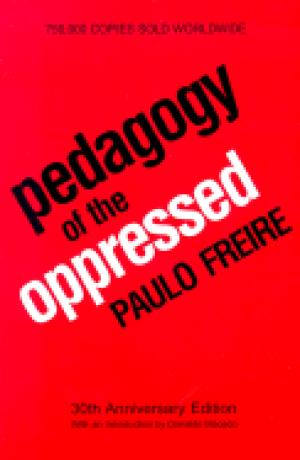
This text argues that the ignorance and lethargy of the poor are the direct result of the whole economic, social and political domination. By being kept in a situation in which it is practically impossible to achieve a critical awareness and response the disadvantaged are kept "submerged". The book suggests that in some countries the oppressors use the system to maintain this "culture of silence". Through the right kind of education, the book suggests, avoiding authoritarian teacher-pupil models and based on the actual experiences of students and on continual shared investigation, every human being, no matter how impoverished or illiterate, can develop a new awareness of self, and the right to be heard. (From the Publisher)

Black Teachers on Teaching is a riveting and honest portrait of the politics and philosophies of the education of black children over the last fifty years. Foster, a leading expert on black educators and the history of black education, has interviewed pioneering teachers from across the country. In presenting their experiences, black teachers go on the record about mixed-race classrooms, the losses and gains accompanying desegregation, repeated cycles of attempted and abandoned reform efforts, and the differing attitudes toward and perceptions of black students among black and white teachers. (From the Publisher)

Farley points to a series of developments in theological education which have led to the loss of a defining theological vision. Theology used to be, and still ought to be "not just objective science, but a personal knowledge of God and the things of God." (From the Publisher)

In a sequel to his 1983 work, Theologia, Farley develops a conceptual apparatus for re-thinking the structure of theological education in church, seminary, and university which is unified by a hermeneutical approach. He defines this approach as acts of interpretation which yield understanding, and argues that it requires ordered learning and critical thinking. (From the Publisher)

Four leading philosophers of education offer a sophisticated but accessible introduction to the central debates about the role of gender in educational practice, policymaking, and theory. (From the Publisher)

This volume is structured to provide practical assistance to those engaged in the review of faculty reward systems on their campuses and to provide guidelines to academic administrators, deans, and chairs who are leading these efforts. Chapters have been designed to address major issues relating to promotion, tenure, and merit pay. The different ways in which campuses have approached the process of clarifying their missions and modifying their faculty reward structures are illustrated. Reference materials from scholarly associations and accreditation agencies are included to demonstrate disciplinary perspectives. A model for change is presented along with criteria for assessing a promotion and tenure system. A professional portfolio to document the work of faculty is also described. (From the Publisher)

A rich compendium of classroom-tested strategies and suggestions designed to improve the teaching practice of beginning, mid-career, and senior faculty members. Forty-nine teaching tools cover both traditional tasks, writing a course syllabus, delivering a lecture and newer, broader concerns, such as responding to diversity, and using technology. (From the Publisher)

Two decades after the first Women's Studies courses appeared on campuses in the US, feminist research and teaching are now thriving around the world. The editors of this book provide a rich sample of theoretical and practical reflections on classroom experience by teachers of Women's Studies over the past ten years, raising provocative questions which apply broadly to many areas of progressive teaching. The collection features new, unpublished and original work as well as a selection of the best articles to have appeared in recent years. (From the Publisher)
Wabash Center Staff Contact
Rachelle Green, Ph.D.
Associate Director
Wabash Center
greenr@wabash.edu