Resources
Life at the end of the twentieth century presents us with a disturbing reality. Otherness, the simple fact of being different in some way, has come to be defined as in and of itself evil. Miroslav Volf contends that if the healing word of the gospel is to be heard today, Christian theology must find ways of speaking that address the hatred of the other. Reaching back to the New Testament metaphor of salvation as reconciliation, Volf proposes the idea of embrace as a theological response to the problem of exclusion. Increasingly we see that exclusion has become the primary sin, skewing our perceptions of reality and causing us to react out of fear and anger to all those who are not within our (ever-narrowing) circle. In light of this, Christians must learn that salvation comes, not only as we are reconciled to God, and not only as we "learn to live with one another," but as we take the dangerous and costly step of opening ourselves to the other, of enfolding him or her in the same embrace with which we have been enfolded by God. (From the Publisher)
In the modern university, religion is often taken to school--primarily in the sense of being critiqued, disciplined, and domesticated. In this provocative book, Stephen Webb steps into the middle of current controversies about the place of religion in secular high schools and colleges. Speaking explicitly as a Christian theologian, but also as one who accepts the reality of religious pluralism, Webb argues that the teaching of religion is itself a religious activity, that teachers of religion should not disguise their own faiths in the classroom, and that high schools and universities should allow more--not less--space for religious voices. Taking Religion to School, rather than rehearse tired debates, bursts with creative insight and strategic reframings of the crucial questions about religion and pedagogy. Webb's penetrating analysis and vivid autobiographical reflections will benefit professors of religious studies, high school teachers of religion, students, seminary-and university-based theologians, and all others concerned with the many points of contention over religious education in our day. (From the Publisher)
In large chain bookstores the "religion" section is gone and in its place is an expanding number of topics including angels, Sufism, journey, recovery, meditation, magic, inspiration, Judaica, astrology, gurus, Bible, prophesy, evangelicalism, Mary, Buddhism, Catholicism, and esoterica. As Wade Clark Roof notes, such changes over the last two decades reflect a shift away from religion as traditionally understood to more diverse and creative approaches. But what does this splintering of the religious perspective say about Americans? Have we become more interested in spiritual concerns or have we become lost among trends? Do we value personal spirituality over traditional religion and no longer see ourselves united in a larger community of faith? Roof first credited this religious diversity to the baby boomers in his bestselling A Generation of Seekers (1993). He returns to interview many of these people, now in mid-life, to reveal a generation with a unique set of spiritual values--a generation that has altered our historic interpretations of religious beliefs, practices, and symbols, and perhaps even our understanding of the sacred itself. The quest culture created by the baby boomers has generated a "marketplace" of new spiritual beliefs and practices and of revisited traditions. As Roof shows, some Americans are exploring faiths and spiritual disciplines for the first time; others are rediscovering their lost traditions; others are drawn to small groups and alternative communities; and still others create their own mix of values and metaphysical beliefs. Spiritual Marketplace charts the emergence of five subcultures: dogmatists, born-again Christians, mainstream believers, metaphysical believers and seekers, and secularists. Drawing on surveys and in-depth interviews for over a decade, Roof reports on the religious and spiritual styles, family patterns, and moral vision and values for each of these subcultures. The result is an innovative, engaging approach to understanding how religious life is being reshaped as we move into the next century. (From the Publisher)
This important book examines the ways in which politics and religion have interacted with each other in the United States from the days of the early colonial period through the 1990s. Unique in the way it sets the contemporary discussion of politics and religion in the larger context of the entire scope of U.S. history, this book traces significant themes over time showing students how the events of the 1990s have their roots in a long process of development. In addition, this volume offers students and teachers an excellent means of keeping up with contemporary developments virtually as rapidly as they occur. The authors have developed their own World Wide Web site to be used in conjunction with the book. This site offers a large variety of relevant links and includes an update area in which important new developments will be posted. Moreover, each chapter of the book has references to several relevant Web sites. (From the Publisher)
Gender and Teaching provides a vivid, focused, and interactive overview of the important gender issues in education today. This is accomplished through conversations among experts, practitioners, and readers that are informed by representative case studies and by a range of theoretical approaches to the issues. Gender and Teaching is the third volume in the "Reflective Teaching and the Social Conditions of Schooling" series edited by Daniel P. Liston and Kenneth M. Zeichner. It follows the same format as previous volumes in the series. Part I includes four cases dealing with related aspects of gendered experiences in schools (nonsexist elementary school curricula, gender and race implications of special education assignment practices, homophobia in high schools and classrooms, and teaching as a woman's profession), followed by a set of teachers', administrators', and professors' reactions to each case. Part II is an elaboration of four "public arguments"--conservative, liberal, women-centered, and radical multicultural--pertaining to the issues raised in the cases in Part I. These arguments exemplify clusters of orientations, organized around general values rather than hard and fast principles. Part III presents the authors' own interpretations of the issues raised throughout the work and provides activities and topics for reflection and an annotated bibliography of additional resources. Content and Pedagogical Features: *Readers are encouraged throughout to interact with the text. They can respond to each case and compare their responses to those of others in the field. *The cases and discussions that follow help students begin to evolve their own "practical theories"; explore and perhaps modify some of their basic beliefs and assumptions; become acquainted with other points of view; and look further into the connections and intersections of gender with other structural dynamics and practices--those of race, class, and culture--as intrinsic to their explorations into the social conditions of schooling. *The major strands in feminist theory about women and education are presented so that students can analyze the differences among them, come up with positions of their own, and learn to defend them. *Although the authors draw on historical and sociological frameworks that show how women have historically been discriminated against in our schools and in our society, their goal is an education that is equally fair to everyone, boys as well as girls. Gender and Teaching is pertinent for all prospective and practicing teachers at any stage of their training. It can be used in any undergraduate or graduate course that addresses issues of gender and teaching. (From the Publisher)
This book covers the fields of religion, philosophy, epistemology, ethics, and education. The very practical nature of the problem examined, and Thiessen's straightforward and non-technical presentation, will be of interest to parochial and public school boards, teachers, and parents, as well as religious groups, educationalists, and philosophers of education. (From the Publisher)
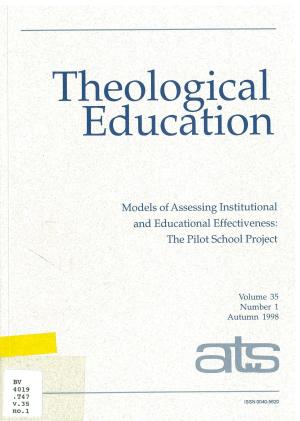
Journal Issue. Full text is available online.

A study of the work which theological schools do in the preparation of persons for the parish ministry. (From the Publisher)
Grant Coaching
The Wabash Center understands our grants program as a part of our overall teaching and learning mission. We are interested in not only awarding grants to excellent proposals, but also in enabling faculty members to develop and hone their skills as grant writers. Therefore we offer grant coaching for all faculty interested in submitting a Wabash Center Project Grant proposal.
Sarah Farmer, Ph.D.
Associate Director, Wabash Center
farmers@wabash.edu