Resources

At the end of the twentieth century, the ongoing battle between religion and public education is once again a burning issue in the United States. In this book, James Fraser shows that though these battles have been going on for as long as there have been public schools, there has never been any consensus about the proper relationship between religion and public education. Looking at the most difficult question of how private issues of faith can be reconciled with the very public nature of schooling, James Fraser paints a picture of our multicultural society that takes our relationship with God into account. (From the Publisher)
Journal Issue.
Until now, though seasoned practitioners know of the problems and have implemented solutions, a practical compendium of advice on teaching and learning in large classes has not appeared in the literature. This volume is an attempt to remedy that omission. It is intended to provide faculty who are teaching a large course for the first time practical advice that will ease the transition from small to large classes. It is the sort of volume every department head should hand out along with teaching assignments for large sections and pass on to colleagues who labor hard and conscientiously in these difficult instructional situations. (From the Publisher)
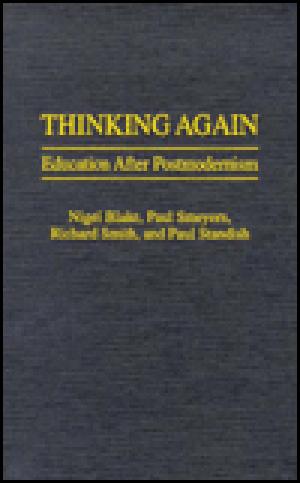
The postmodern condition, in which instrumentalism finally usurps all other considerations, has produced a kind of intellectual paralysis in the world of education. The authors of this book show how such postmodernist thinkers as Derrida, Foucault, and Lyotard illuminate puzzling aspects of education, arguing that educational theory is currently at an impasse. They argue that we need these new and disturbing ideas in order to "think again" fruitfully and creatively about education. (From the Publisher)
In honor of the new century and the twentieth anniversary of New Directions for Teaching and Learning, this issue reviews the past and current research on teaching, learning, and motivation, and envisions where the field is headed in the next century. (From the Publisher)

Tenth in the Service-Learning in the Disciplines Series, this book shows how both peace studies and service-learning have been developing new ideas of how social learning takes place as a community process in conflict situations and what the dynamics of peace building are. The process has created a new niche in academia for preparing students to become social change agents. The enthusiasm of the contributors in this book gives the reader a new vision of what is possible on college campuses in community-based peace and service-learning at a time when there is a critical need for peace-building skills. (From the Publisher)
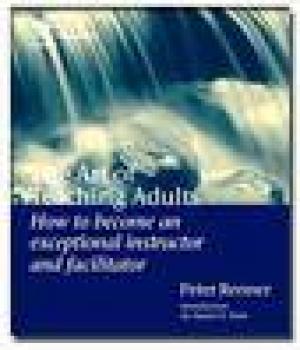
The Art brims with practical tips on a range of need-to-know topics, including how to plan sessions; set up a class room; facilitate group work; deliver lively lectures; ask questions effectively; generate participation; assign projects; design tests and quizzes; use visual aids; assess courses; and more. (From the Publisher)
What if what we know about our brains and the way humans think was applied to the way we nurture each other in faith? Would we do it differently? What if we let cognitive science inform our educational strategies and the ways we help each other form our spirits? What if we began to believe that brain research and scientific investigation could reveal something of our spiritual nature and destiny?" These questions are at the heart of Jerry Larsen's fascinating and sure-to-be-talked-about book. Writing in a clear, accessible style, Larsen offers a model and methods for joining the discoveries of brain science with the work of religious education. He touches on the discoveries about the left and right brain thinking styles, multiple intelligence, memory mechanisms, meaning-making strategies and on the nature of consciousness. And he reflects on the belief that we can do religious education better if we take cues from what we know about the God-given network between our ears. This book is unique. There are no other books on the market on the subject of religious education and the brain. Enhanced with practical charts and illustrations, and with great ecumenical appeal, it will make useful reading for religious educators, religious professionals, and teachers. (From the Publisher)
Drawing upon 17 years of experience in theology, Dr. Kinast describes a step-by-step approach to help students and experienced ministers learn what their ministers teaches. Through examples, practical suggestions, and principles grounded in process theology, readers of this book explore the full range of resources needed for meaningful theological reflection. (From the Publisher)
Illustrates problems with free speech encountered by today's college and university administrators with fictional cases based on real life incidents involving inflammatory speakers, hate e-mail, art, and the Internet, and suggests guidelines. (From the Publisher)
Wabash Center Staff Contact
Rachelle Green, Ph.D.
Associate Director
Wabash Center
greenr@wabash.edu