Resources
1. They are value-driven. 2. They are connected to the world around them. 3. They require solitude and quiet. 4. They pace themselves. 5. They have contact with nature. 6. They are creative and playful. 7. They are adaptive to change. 8. They learn from down-time. 9. They are always in training. 10. They are future-oriented.

Shows how to make learning and teaching by discussion more effective by using an approach that promotes the enhanced creativity of those involved in discussion groups of all types. Explains how to design discussion tasks to teach problem solving, decision making, and interpersonal skills, drawing on modern cognitive psychology and group dynamics. For university teachers, industry trainers, and those in human resources. Distributed by ISBS. Bligh is recognized as a pioneer in university staff development, and maintains consultancies on staff appraisal, training, and professional development. (From the Publisher)
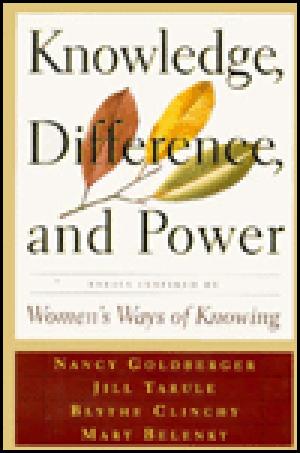
Ten years ago, Mary Belenky, Blythe Clinchy, Nancy Goldberger, and Jill Tarule wrote Women's Ways of Knowing, a book The New York Times Book Review called "a framework for future research on women, knowledge, and identity." In the decade that followed, their theory of women's psychology, development, and ways of knowing has been applied in several fields, from the social sciences to the humanities, women's studies, education, psychology, and law. But even as it was embraced by readers, Women's Ways of Knowing also became the center of a fierce debate within academic circles. Now, in 14 illuminating new essays, the original authors and invited contributors explore how the theory introduced in Women's Ways of Knowing has developed and shifted over the years and how it has been received, applied, used, and abused. The authors, and others, respond to critics of the original theory. The essays also expand the original argument beyond gender and knowing to address the complicating factors of race, class, and culture. (From the Publisher)

If contemporary culture were a school, with all the tasks and expectations meted out by modern life as its curriculum, would anyone graduate? In the spirit of a sympathetic teacher, Robert Kegan guides us through this tricky curriculum, assessing the fit between its complex demands and our mental capacities, and showing what happens when we find ourselves, as we so often do, in over our heads. In this dazzling intellectual tour, he completely reintroduces us to the psychological landscape of our private and public lives. A decade ago in The Evolving Self, Kegan presented a dynamic view of the development of human consciousness. Here he applies this widely acclaimed theory to the mental complexity of adulthood. As parents and partners, employees and bosses, citizens and leaders, we constantly confront a bewildering array of expectations, prescriptions, claims, and demands, as well as an equally confusing assortment of expert opinions that tell us what each of these roles entails. Surveying the disparate expert "literatures," which normally take no account of each other, Kegan brings them together to reveal, for the first time, what these many demands have in common. Our frequent frustration in trying to meet these complex and often conflicting claims results, he shows us, from a mismatch between the way we ordinarily know the world and the way we are unwittingly expected to understand it. In Over Our Heads provides us entirely fresh perspectives on a number of cultural controversies - the "abstinence vs. safe sex" debate, the diversity movement, communication across genders, the meaning of postmodernism. What emerges in these pages is a theory of evolving ways of knowing that allows us to view adult development much as we view child development, as an open-ended process born of the dynamic interaction of cultural demands and emerging mental capabilities. If our culture is to be a good "school," as Kegan suggests, it must offer, along with a challenging curriculum. (From the Publisher)

A multicultural conference has convened. Everything is in place, and the participants arrive brimming with goodwill and even better intentions. Surely this time...! But, no. Halfway through the meetings, communication grinds to a halt, and people retreat to the safety of their own groups. What happened? And how can we keep it from happening again? Those are the questions this book proposes to answer. (From the Publisher)

American higher education was transformed between the end of the Civil War and the beginning of World War I. During this period, U.S. colleges underwent fundamental changes--changes that helped to create the modern university we know today. Most significantly, the study of the sciences and the humanities effectively dissolved the Protestant framework of learning by introducing a new secularized curriculum. This secularization has long been recognized as a decisive turning point in the history of American education. Until now, however, there has been remarkably little attention paid to the details of how this transformation came about. Here, at last, Jon Roberts and James Turner identify the forces and explain the events that reformed the college curriculum during this era. The first section of the book examines how the study of science became detached from theological considerations. Previously, one of the primary pursuits of "natural scientists" was to achieve an understanding of the workings of the divine in earthly events. During the late nineteenth century, however, scientists reduced the scope of their inquiries to subjects that could be isolated, measured, and studied objectively. In pursuit of "scientific truth," they were drawn away from the larger "truths" that they had once sought. On a related path, social scientists began to pursue the study of human society more scientifically, attempting to generalize principles of behavior from empirically observed events. The second section describes the revolution that occurred in the humanities, beginning in the mid-nineteenth century, when the study of humanities was largely the study of Greek and Latin. By 1900, however, the humanities were much more broadly construed, including such previously unstudied subjects as literature, philosophy, history, and art history. The "triumph of the humanities" represented a significant change in attitudes about what constituted academic knowledge and, therefore, what should be a part of the college curriculum. The Sacred and the Secular University rewrites the history of higher education in the United States. It will interest all readers who are concerned about American universities and about how the content of a "college education" has changed over the course of the last century. (From the Publisher)
Wabash Center Staff Contact
Rachelle Green, Ph.D.
Associate Director
Wabash Center
greenr@wabash.edu