Home » Resources » Scholarship on Teaching » Reinventing Ourselves: Interdisciplinary Education, Collaborative Learning, and Experimentation in Higher Education
Scholarship
March 29, 2017
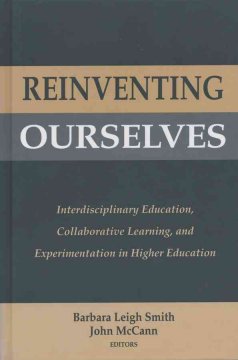
Reinventing Ourselves: Interdisciplinary Education, Collaborative Learning, and Experimentation in Higher Education
- Author
- Smith, Barbar Leigh and John McCann, eds.
- Publisher
- Anker Publishing, Bolton, MA
- ISBN
- 1882982355
- Table of Contents
-
About the Editors
About the Contributors
Preface
Foreword
Section I: Historical Perspectives and Institutional Examples
ch. 1 Dangerous Outposts: Progressive Experiments in Higher Education in the 1920s and 1930s (Steven R. Coleman)
ch. 2 The Innovative Colleges and Universities of the 1960s and 1970s: Lessons from Six Alternative Institutions (Joy Rosenzweig Kliewer)
ch. 3 Interdisciplinary Education at Hampshire College: Bringing People Together Around Ideas (Ann P. McNeal, and Frederick Stirton Weaver)
ch. 4 Evergreen at Twenty-Five: Sustaining Long-Term Innovation (Barbara Leigh Smith)
ch. 5 Bridging Theory and Practice: Public Service at The Evergreen State College (Magda Costantino, Emily Decker, Jeanine L. Elliott, Tina Kuckkahn, and Helen Lee)
Section II: Powerful Pedagogies
Part One: Learning Communities
ch. 6 Learning Communities: A Convergence Zone for Statewide Educational Reform (Barbara Leigh Smith)
ch. 7 Integration and Assessment of Service-Learning in Learning Communities (Karen Kashmanian Oates, and Laura Gaither)
ch. 8 Uncommon Sense: Liberal Education, Learning Communities, and the Transformative Quest (Les K. Adler)
ch. 9 Toward an Interdisciplinary Epistemology: Faculty Culture and Institutional Change (Grant H. Cornwell, and Eve W. Stoddard)
ch. 10 Voices in Seminar: Ideologies and Identities (Susan Fiksdal)
Part Two: Rethinking Teaching and Learning
ch. 11 Powerful Pedagogies (William H. Newell)
ch. 12 Should the Teacher Know the Answer? Two Ways to Organize Interdisciplinary Study Around Inquiry (Donald L. Finkel)
ch. 13 Jenny's Painting: Multiple Forms of Communication in the Classroom (Mark Pedelty)
ch. 14 Student-Active Science in Interdisciplinary Studies: Problems and Solutions (Janet F. Ott)
ch. 15 Increasing Access in the Sciences Through Interdisciplinary Feminist Perspectives (Gary L. Bornzin)
ch. 16 Building an Organization that Reflects Interdiscplinarity (Anne G. Scott, and Celestino Fern√°ndez)
ch. 17 The Academic Department in a Multidisciplinary Context: An Argument for the Administrative Holding Company Amidst Communities of Learners (Joseph J. Comprone)
ch. 18 Alternative Ways of Organizing: The Importance of Organizational Culture (Sandra J. Sarkela)
ch. 19 Reconceptualizing the Faculty Role: Alternative Models (James R. Chen, Michael V. Fortunato, Alan Mandell, Susan Oaks, and Ducan RyanMann)
Section III: Taking Stock and Looking Ahead
ch. 20 Interdisciplinary Assessment for Interdisciplinary Programs (Karl L. Schilling)v ch. 21 Students on Interdisciplinary Education: How They Learn and What They Learn (John McCann)
ch. 22 Learning to See Academic Culture Through the Eyes of the Participants: An Ethnographic/Folkloristic Approach to Analyzing and Assessing the Cultures of Alternative Institutions (Peter Tommerup)
ch. 23 The Interdisciplinary Variable: Then and Now (Julie Thompson Klein)
ch. 24 Joining the Conversation: An Essay in Guiding Images for College Teaching and Learning (Robert H. Knapp, Jr.)
ch. 25 After the Revolution: New Directions for Alternative Education (Robert Benedetti)
ch. 26 Knowledge, Politics, and Interdisciplinary Education (Charles W. Anderson)
Index
Reinventing Ourselves examines the experiences of and lessons learned from a variety of institutions that pioneered new approaches for more effective teaching and learning. Many of the colleges included in this volume began as both educational and social experiments, representing new ways of thinking about educational goals, curricular organization, institutional governance, and faculty roles and rewards. With new calls for both rethinking our approaches to teaching and learning, and for reviewing the traditional boundaries within institutions and between disciplines, this book offers a rich store of ideas from which to draw. (From the Publisher)