Resources
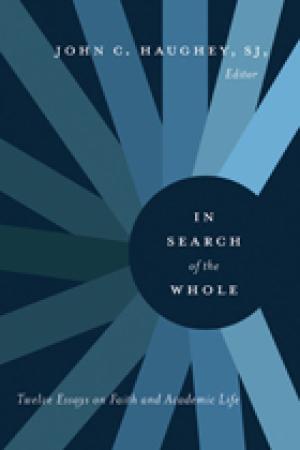
The contributors to this inspiring anthology meet the challenge that everyone faces: that of becoming a whole person in both their personal and professional lives. John C. Haughey, SJ, has gathered twelve professionals in higher education from a variety of disciplines—philosophy, theology, health care, business, and administration. What they have in common reflects the creative understanding of the meaning of "catholic" as Haughey has found it to operate in Catholic higher education. Each essay in the first six chapters describes how its author has assembled a unique whole from within his or her particular area of academic competence. The last six chapters are more autobiographical, with each author describing what has become central to his or her identity. All twelve are "anticipating an entirety" with each contributing a coherence that is as surprising as it is delightful. (From the Publisher)
• A faculty member publishes an article without offering coauthorship to a graduate assistant who has made a substantial conceptual or methodological contribution to the article. • A professor does not permit graduate students to express viewpoints different from her own. • A graduate student close to finishing his dissertation cannot reach his traveling advisor, a circumstance that jeopardizes his degree. This book discusses these and other examples of faculty misconduct—and how to avoid them. Using data collected through faculty surveys, the authors describe behaviors associated with graduate teaching which are considered inappropriate and in violation of good teaching practices. They derive a normative structure that consists of five inviolable and eight admonitory proscriptive criteria to help graduate faculty make informed and acceptable professional choices. The authors discuss the various ways in which faculty members acquire the norms of teaching and mentoring, including the graduate school socialization process, role models, disciplinary codes of ethics, and scholarship about the professoriate and professional performance. Analyzing the rich data gleaned from the faculty surveys, they track how these norms are understood and interpreted across academic disciplines and are influenced by such factors as gender, citizenship, age, academic rank, tenure, research activity, and administrative experience. (From the Publisher)
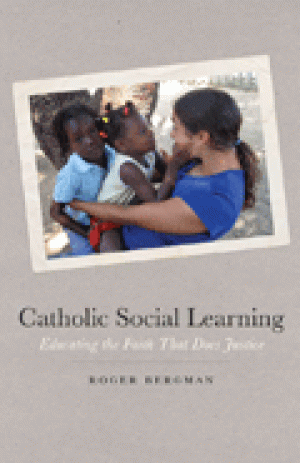
The canon for Catholic social teaching spreads to six hundred pages, yet fewer than two pages are devoted to Catholic social learning or pedagogy. In this long-needed book, Roger Bergman begins to correct that gross imbalance. He asks: How do we educate ("lead out") the faith that does justice? How is commitment to social justice provoked and sustained over a lifetime? To address these questions, Bergman weaves what he has learned from thirty years as a faith-that-does-justice educator with the best of current scholarship and historical authorities. He reflects on personal experience; the experience of Church leaders, lay activists, and university students; and the few words the tradition itself has to say about a pedagogy for justice. Catholic Social Learning explores the foundations of this pedagogy, demonstrates its practical applications, and illuminates why and how it is fundamental to Catholic higher education. Part I identifies personal encounters with the poor and marginalized as key to stimulating a hunger and thirst for justice. Part II presents three applications of Catholic social learning: cross-cultural immersion as illustrated by Creighton University's Semestre Dominicano program; community-based service learning; and the teaching of moral exemplars such as Dorothy Day, Rev. Martin Luther King Jr., and Archbishop Oscar Romero. Part III then elucidates how a pedagogy for justice applies to the traditional liberal educational mission of the Catholic university, and how it can be put into action. Catholic Social Learning is both a valuable, practical resource for Christian educators and an important step forward in the development of a transformative pedagogy. Roger Bergman is the founding director of the Justice and Peace Studies Program at Creighton University, where he is also Associate Professor in the Department of Sociology and Anthropology. (From the Publisher)
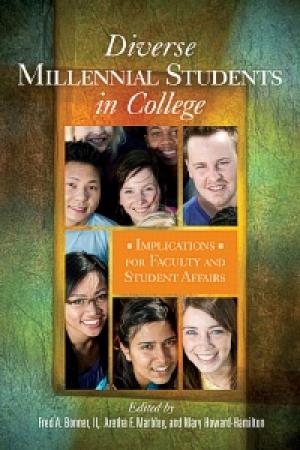
While many institutions have developed policies to address the myriad needs of Millennial college students and their parents, inherent in many of these initiatives is the underlying assumption that this student population is a homogeneous group. This book is significant because it addresses and explores the characteristics and experiences of Millennials from an array of perspectives, taking into account not only racial and ethnic identity but also cultural background, sexual orientation, and socioeconomic status differences—all factors contributing to how these students interface with academe. In providing a “voice” to “voiceless” populations of African American, Asian American, Bi/Multi-Racial, Latino, Native American, and LGBT millennial college students, this book engages with such questions as: Does the term “Millennial” apply to these under-represented students? What role does technology, pop culture, sexual orientation, and race politics play in the identity development for these populations? Do our current minority development theories apply to these groups? And, ultimately, are higher education institutions prepared to meet both the cultural and developmental needs of diverse minority groups of Millennial college students?” This book is addressed primarily to college and university administrators and faculty members who seek greater depth and understanding of the issues associated with diverse Millennial college student populations. This book informs readers about the ways in which this cohort differs from their majority counterparts to open a dialogue about how faculty members and administrators can meet their needs effectively both inside and outside the classroom. It will also be of value to student affairs personnel, students enrolled in graduate level courses in higher education and other social science courses that explore issues of college student development and diversity, particularly students planning to work with diverse Millennial college students in both clinical or practical work settings. (From the Publisher)

This project proposes to look at the emergence of Black theology as a discipline within the academy and how Black theology may serve as a resource for excellence in teaching. (From the Publisher)
From the Publisher Understanding college students' intellectual development is at the heart of effective educational practice. How do college students learn? How can educators maximize intellectual development in the college environment for both sexes—both in and out of the classroom? In this book Marcia B. Baxter Magolda demonstrates how educators can use a deeper understanding of the way students learn to teach more effectively. Drawing on a unique longitudinal study of more than one hundred college students, both male and female—and presenting information not available in single-gender studies—the author explains surprising gender-related patterns that affect the way students develop. Baxter Magolda uses data gathered from in-depth interviews over a five-year period to reveal four distinct "ways of knowing." The book provides useful real-life examples of how instructional approaches, class expectations, peer interaction, evaluation methods, and other factors affect intellectual development in the classroom. Similarly, the author demonstrates how peer relationships, student organizations, educational advising, internships, employment, and international and cultural exchange can support and develop complex learning beyond the classroom. "Knowing and Reasoning in College" provides practical recommendations on how to respond to each of the four ways of knowing. It shows how, by designing instruction and interaction to reach students at every level, educators can maximize learning, promote skill acquisition and development of complex reasoning, and enrich students' overall college experience. (PsycINFO Database Record (c) 2012 APA, all rights reserved)
Wabash Center Staff Contact
Sarah Farmer, Ph.D.
Associate Director
Wabash Center
farmers@wabash.edu