Resources
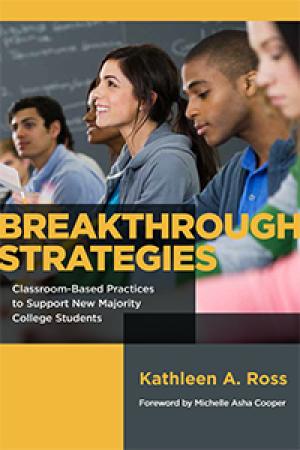
Click Here for Book Review Breakthrough Strategies identifies effective strategies that faculty have used to help New Majority students—those from minority, immigrant, or disadvantaged backgrounds—build the necessary skills to succeed in college. As the proportion of New Majority students rises, there is increased attention to helping them gain access to college. Once enrolled, however, these students often face significant challenges of adjustment, with few resources for support. Specifically, there is little attention to students’ experiences within their college classrooms and their relationships with professors. At the same time, faculty who work with these students have little guidance on how to help them adjust to new expectations and identities as they engage with college-level work. Sister Kathleen A. Ross, a MacArthur fellow and president emerita of Heritage University, has devoted three decades to helping New Majority students get college degrees. Based on an action-research project undertaken at Heritage University and Yakima Valley Community College in Washington State, the book highlights eleven strategies to encourage student success, including: asking questions in class; navigating the syllabus; and developing an academic identity. Written in a warm, down-to-earth voice, Breakthrough Strategies is infused with the belief that faculty can become a powerful resource for students, and that classroom instruction can be an important vehicle for supporting these students’ development and success. (From the Publisher)
This volume focuses on SoTL, the scholarship of teaching and learning. It discusses how collaborations among and between disciplines can strengthen education and the ways in which students are taught. The community of scholars at an institution can provide a fertile ground for interdisciplinary collaboration that can enliven the educational process and the research that supports it. The authors here come from many different disciplines where they teach and use SoTL to inform their own practice and share what they have done with others. This is the 139th volume of the quarterly Jossey-Bass higher education series New Directions for Teaching and Learning. It offers a comprehensive range of ideas and techniques for improving college teaching based on the experience of seasoned instructors and the latest findings of educational and psychological researchers. (From the Publisher)
This issue uses the powerful narrative of autoethnography to make visible the existence of international professors and teaching assistants who speak English as a Second Language. These important, but often invisible, individuals contribute daily to the education of students within the US postsecondary educational system. This volume covers a variety of experiences, such as: - Faculty of color teaching intercultural communication - International teaching assistants’ attitudes toward their US students - The challenges to existing cultural assumptions in the US classroom. These experiences - in the form of challenges and contributions - are foregrounded and highlighted in their own right. This is the 138th volume of the quarterly Jossey-Bass higher education series New Directions for Teaching and Learning. It offers a comprehensive range of ideas and techniques for improving college teaching based on the experience of seasoned instructors and the latest findings of educational and psychological researchers. (From the Publisher)
Gain a greater understanding of the academic, cultural, and social experiences of first-generation college students (FGS). Fascinating, heart-touching, and important, the research and the stories presented here enlighten what FGS often have to overcome to successfully complete their degrees. With an emphasis on improving FGS' college success, retention, and graduation rates, this volume first covers common obstacles and the trend of FGS continuing on for graduate degrees. Section Two discusses the complex interplay of social, academic, emotional, and financial influences on academic performance. The chapters collectively affirm that the commitment of university resources is critical to college success. This is the 127th volume of the Jossey-Bass higher education quarterly report New Directions for Teaching and Learning, which offers a comprehensive range of ideas and techniques for improving college teaching based on the experience of seasoned instructors and the latest findings of educational and psychological researchers. (From the Publisher)
The Scholarship of Teaching and Learning (SoTL) should be an integral part of every academic’s life, representing not only the pinnacle of effortful teaching, but also standing side by side with more conventional disciplinary scholarship. Although practiced by many instructors for years, SoTL has garnered national attention resulting in a spate of new journals to publish pedagogical research. SoTL helps students, fosters faculty development, and has been integrated into higher education. This volume provides readers with challenges that will motivate them to engage in SoTL and take their pedagogical research further. We include many key features aimed to help both the teacher new to research and SoTL and also researchers who may have a long list of scholarly publications in non-pedagogical areas and who have not conducted research. This is the 136th volume of this Jossey-Bass higher education series. It offers a comprehensive range of ideas and techniques for improving college teaching based on the experience of seasoned instructors and the latest findings of educational and psychological researchers. (From the Publisher)
The complexities of 21st-century life- personal, social, cultural, and environmental - demand thoughtful responses, responses fostered and enhanced through contemplative experience. Contemplative education includes studies of the history, psychology, and socialcultural context of such experience, as well as the development of experiential knowledge through one or more personal practices. Contemplative education has recently emerged in the academy. Although there has been significant published discussion of postsecondary courses and programs that incorporate contemplative views and practices, there have been few studies of relevant curricula and pedagogy. This volume integrates research, theory, and practice through a fusion of perspectives and approaches, giving readers the opportunity to review contemplative educational concepts and applications in academic, social, and institutional domains. This is the 134th volume of this Jossey-Bass higher education series. New Directions for Teaching and Learning offers a comprehensive range of ideas and techniques for improving college teaching based on the experience of seasoned instructors and the latest findings of educational and psychological researchers. (From the Publisher)

Journal Issue.
Sensitive issues, rife in religious studies and in theology, present a pedagogical challenge when teaching students to nuance their thinking around positions that are often sharply defined and elicit strong feelings. I developed a learning tool that I call the “Agency Paradigm.” The purpose of this tool is to help students comprehend diversity within religious traditions, particularly regarding the agencies of women who are committed to them. Drawing on the open and critical dialogue of emancipatory pedagogy, the Agency Paradigm encourages students to explore a range of ways women in world religions choose to act in varying contexts. This approach to teaching world religions increases students’ cognitive knowledge base and expands their understanding of each of the religions studied in the course, as examined through the perspective of differing women; it also assists them in developing their own agency through thoughtful reflection.
Sexual violence on campus is a major issue facing students, faculty, and administrators, and institutions of higher education are struggling to respond. This forum brings together three responses to the problem, with a focus on the religious studies classroom. The responses move from the institution to the faculty to the classroom, exploring three separate but linked spaces for responding to sexual violence. The first contribution (Graybill) critiques common institutional responses to sexual violence. The second contribution (Minister) advocates for long-term, classroom-based responses to sexual violence and describes a faculty/staff workshop response. The third contribution (Lawrence) emphasizes the classroom, examining the issues that arise when perpetrators of sexual assault are part of the student body. Read together, the pieces offer a comprehensive view of the complicated intersections of sexual violence, the university, and pedagogical issues in religious studies.
Wabash Center Staff Contact
Sarah Farmer, Ph.D.
Associate Director
Wabash Center
farmers@wabash.edu