Home » Resources » Scholarship on Teaching » Seminary Formation: Recent History-Current Circumstances-New Directions
Scholarship
March 29, 2017
Seminary Formation: Recent History-Current Circumstances-New Directions
- Author
- Schuth, Katarina
- Publisher
- Liturgical Press, Collegeville, MN
- ISBN
- 9780814648001
- Table of Contents
-
List of Tables
Foreword by Archbishop Blase J. Cupich
Acknowledgments
Frequently Used Documents, Abbreviations and Terms
Part I Context
Introduction
ch. 1 The Effects of Vatican II on the Present State of Seminaries and Theologates
Part II Organization and Personnel
ch. 2 Mission, Vision, and Structures
ch. 3 Leadership: Boards, Administration, and Faculty
Part III Students Preparing for Ministry: Enrollment and Programs
ch. 4 Seminarians and Lay Students
ch. 5 Human and Spiritual Formation Developments
ch. 6 Intellectual and Pastoral Formation Programs
Part IV Conclusion and Commentaries
ch. 7 New Directions in the Future
Toward a Spirituality of Ecclesial Leadership (Ronald Rotheiser, OMI)
General Differences: A Crucial Key (Thomas Walters)
Human Formation: Fostering Happy, Healthy, and Holy Ministers to Be a Bridge to Christ in Service to God’s People (Leon M. Hutton)
Trends in Scripture Study and Preaching Preparation in Roman Catholic Seminaries (Barbara E. Reid)
The Culture of Encounter: The Future of Seminary Formation (Msgr. Peter Vaccari)
Appendices
Bibliography
Index
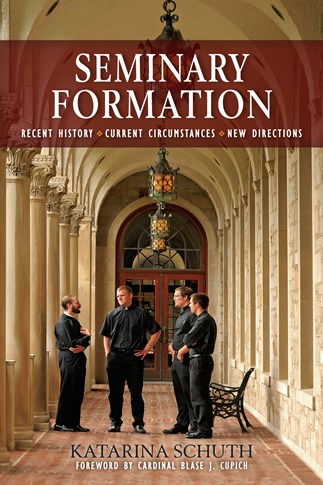
The past thirty years have witnessed tremendous societal and ecclesial changes that continue to inform ministry education in the 21st century. In Seminary Formation, Katarina Schuth, OSF, examines the many aspects of theologate-level schools including their structures and missions, organization and leadership, student enrollment, backgrounds of both seminarians and lay students, and the evolution and development of degree programs, including human and spiritual, intellectual and pastoral formation. Seminary Formation also helpfully includes substantial commentaries on Schuth's research by Ronald Rolheiser, Thomas Walters, Leon M. Hutton, Barbara Reid, and Peter Vaccari.
An exploration of the changes in seminaries and schools of theology, with statistical analysis, from 1985 to the present, Seminary Formation anticipates the challenges ahead and considers new directions for the future. (From the Publisher)
An exploration of the changes in seminaries and schools of theology, with statistical analysis, from 1985 to the present, Seminary Formation anticipates the challenges ahead and considers new directions for the future. (From the Publisher)