Resources
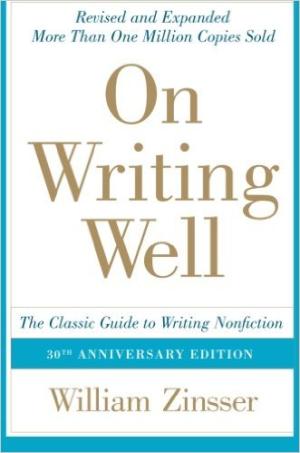
On Writing Well has been praised for its sound advice, its clarity and the warmth of its style. It is a book for everybody who wants to learn how to write or who needs to do some writing to get through the day, as almost everybody does in the age of e-mail and the Internet. Whether you want to write about people or places, science and technology, business, sports, the arts or about yourself in the increasingly popular memoir genre, On Writing Well offers you fundamental priciples as well as the insights of a distinguished writer and teacher. With more than a million copies sold, this volume has stood the test of time and remains a valuable resource for writers and would-be writers. (From the Publisher)

Writing is a solitary sport—but none of us can do it without good company at crucial moments. This spirited collection of inspiring and useful essays and exercises on the craft of writing is the next best thing to having an experienced writer at your side. These twenty-nine pieces, more than half of which have never been published in book form, include selections as unusual and diverse as behaviorist B. F. Skinner's "How to Discover What You Have to Say"; Brett Candlish Millier's investigation of the seventeen drafts of Elizabeth Bishop's poem "One Art"; Ursula Le Guin's "Where Do You Get Your Ideas From?"; Anne Eisenberg's "E-Mail and the New Epistolary Age"; and Nancy Mair's "The Writer's Thin Skin and Faint Heart." Other contributors include Gloria Naylor, Stanley Kunitz, Bernard Shaw, Natalie Goldberg, Anne Tyler, Rita Dove, Peter Elbow, and Gail Godwin. (From the Publisher)
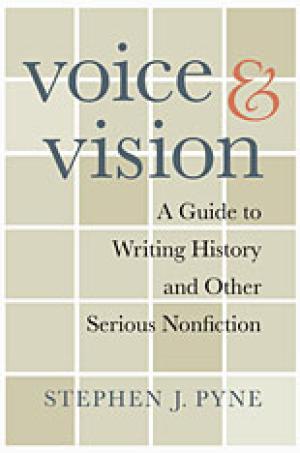
It has become commonplace these days to speak of “unpacking” texts. Voice and Vision is a book about packing that prose in the first place. While history is scholarship, it is also art—that is, literature. And while it has no need to emulate fiction, slump into memoir, or become self-referential text, its composition does need to be conscious and informed. Voice and Vision is for those who wish to understand the ways in which literary considerations can enhance nonfiction writing. At issue is not whether writing is scholarly or popular, narrative or analytical, but whether it is good. Fiction has guidebooks galore; journalism has shelves stocked with manuals; certain hybrids such as creative nonfiction and the new journalism have evolved standards, esthetics, and justifications for how to transfer the dominant modes of fiction to topics in nonfiction. But history and other serious or scholarly nonfiction have nothing comparable. Now this curious omission is addressed by Stephen Pyne as he analyzes and teaches the craft that undergirds whole realms of nonfiction and book-based academic disciplines. With eminent good sense concerning the unique problems posed by research-based writing and with a wealth of examples from accomplished writers, Pyne, an experienced and skilled writer himself, explores the many ways to understand what makes good nonfiction, and explains how to achieve it. His counsel and guidance will be invaluable to experts as well as novices in the art of writing serious and scholarly nonfiction. (From the Publisher)

Immensely helpful and illuminating to any aspiring writer, this special edition of Stephen King’s critically lauded, million-copy bestseller shares the experiences, habits, and convictions that have shaped him and his work. “Long live the King” hailed Entertainment Weekly upon publication of Stephen King’s On Writing. Part memoir, part master class by one of the bestselling authors of all time, this superb volume is a revealing and practical view of the writer’s craft, comprising the basic tools of the trade every writer must have. King’s advice is grounded in his vivid memories from childhood through his emergence as a writer, from his struggling early career to his widely reported, near-fatal accident in 1999—and how the inextricable link between writing and living spurred his recovery. Brilliantly structured, friendly and inspiring, On Writing will empower and entertain everyone who reads it—fans, writers, and anyone who loves a great story well told. (From the Publisher)
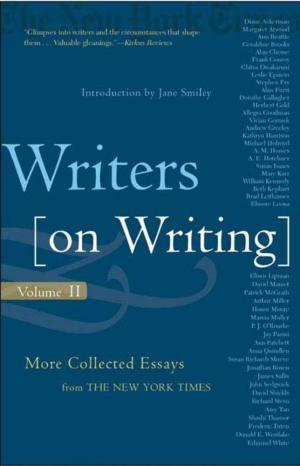
In a second volume of original essays drawn from the long-running New York Times column, Writers on Writing brings together another group of contemporary literature's finest voices to muse on the challenges and gifts of language and creativity. The pieces range from taciturn, hilarious advice for aspiring writers to thoughtful, soul-wrenching reflections on writing in the midst of national tragedy. William Kennedy talks about the intersecting lives of real and imagined Albany politics; Susan Isaacs reveals her nostalgia for a long-retired protagonist; and Elmore Leonard offers pithy rules for letting the writing, and not the writer, take charge. With contributions from Diane Ackerman, Margaret Atwood, Frank Conroy, Mary Karr, Patrick McGrath, Arthur Miller, Amy Tan, and Edmund White, Writers on Writing, Volume II offers an uncommon and revealing view of the writer's world. (From the Publisher)
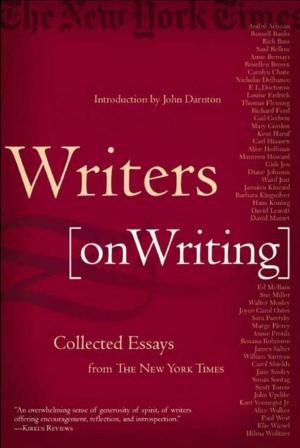
By turns poignant, hilarious, and practical, Writers on Writing brings together more than forty of contemporary literature's finest voices. Pieces range from reflections on the daily craft of writing to the intersection of art's and life's consequential moments. Authors discuss what impels them to write: creating a sense of control in a turbulent universe; bearing witness to events that would otherwise be lost in history or within the writer's soul; recapturing a fragment of time. Others praise mentors and lessons, whether from the classroom, daily circumstances, or the pages of a favorite writer. For anyone interested in the art and rewards of writing, Writers on Writing offers an uncommon and revealing view of a writer's world. Contributors include Russell Banks, Saul Bellow, E. L. Doctorow, Richard Ford, Kent Haruf, Carl Hiaasen, Alice Hoffman, Jamaica Kincaid, Barbara Kingsolver, Sue Miller, Walter Mosley, Joyce Carol Oates, Annie Proulx, Carol Shields, Jane Smiley, Susan Sontag, John Updike, Kurt Vonnegut Jr., Alice Walker, and Elie Wiesel. (From the Publisher)
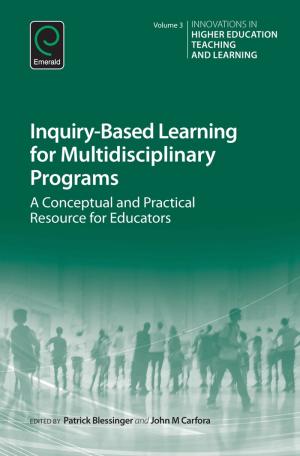
Inquiry-Based Learning for Multidisciplinary Programs is the third volume in this series that addresses inquiry-based learning (IBL). Appropriate to its subject of multidisciplinarity, this book’s contributors are from a wide variety of academic disciplines, work in different institutional contexts, and approach IBL in different ways. The strength of collecting together such variety is that almost any teacher interested in IBL can find inspiration and practical resources for teaching that empowers students and connects to their experiences outside the classroom. In introducing IBL, Blessinger and Carfora write, “IBL, as an approach instead of a specific method, is a cluster of teaching and learning strategies where students inquire into the nature of a problem(s) or question(s). The problem or question scenario thus serves as a mechanism and catalyst to engage actively and deeply in the learning process” (5). Ways to implement IBL include “case analysis or case creation, research projects, field word investigations, laboratory experiments, and role-play scenarios” in which students collaborate and become self-regulated learners (7). Readers who are unfamiliar with IBL can quickly grasp the concept, thanks to the editors’ opening chapter and to the other authors who explain the meaning of IBL in relation to other pedagogical concepts and movements. Readers who are familiar with IBL will find the case studies interesting because they show a common approach used in different countries, in undergraduate and graduate education, and in online and face-to-face education. Instructors of religion will find several ideas of interest here, especially but not only if they teach in interdisciplinary programs. For instance, William E. Herman and Michele R. Pinard point to how IBL connects with environmental and gender issues (51). The perspective on folknography illustrated by David M. Lucas and Charles W. Jarrett will be relevant for some courses in religious studies (67). Nicholas J. Shudak develops an approach of resonances for students learning about another culture, which would be applicable to learning in religious studies. He explains how finding connections between students’ own context and another helps them to develop a deeper understanding but also may water down some differences (91-98). Alia Sheety and Nicholas Rademacher, from departments of education and religious studies, describe their use of a flipped classroom, off-campus experiences, and student research projects for a collaborative course on social justice (124-130). After reading about the variety of approaches to IBL in different contexts, it is striking how many different learning activities fall under IBL. The editors point out that the case studies show how IBL in multidisciplinary programs enhances both student learning and instructor teaching (9). Indeed this book gives the impression that IBL is very appropriate for multidisciplinary teaching and learning, since its use of real world or multi-faceted problems necessarily asks students to learn outside the confines of one discipline. The book would have been enhanced by adding a conclusion in which the authors respond to each others’ analyses since, despite their different contexts, they offer an interlinking set of insights for contemporary higher education.
One week after the November 2016 election, the Faculty Senate at Drake University convened. For almost an hour we debated a resolution a small group of faculty had drawn up in the days after voters across the nation chose for their president a man who regularly uses vitriolic and vile language to talk about people of color, immigrants, women, and an array of other marginalized groups. At the end of the debate, we were tired. Not everyone was in full agreement. Some faculty left worried about the implications for Drake as an institution. But, I was proud. Less than a week after the election Drake faculty approved a resolution that our President quickly formally endorsed declaring Drake a “sanctuary institution.” There’s much to be said about the limits and merits of such a resolution. One the one hand, such resolutions don’t legally accomplish all that much for students who are at risk of deportation. As faculty opposed to the resolution pointed out, Drake University has to comply with federal law. On the other hand, setting aside the reality that law is tricky and we have others to appeal to (for example, FERPA might be used to challenge any federal law insisting we release students’ immigration status), one of the most insightful arguments made in support of sanctuary was that such stances now help to proactively frame the terms of public debate through which any such federal directives might be later made. Acting early was important. But, the point of this post isn’t actually about Sanctuary resolutions themselves. It’s to suggest that to the extent to which we see the political times we are living in as raising unique questions about classroom pedagogies, we must recognize these pedagogies as utterly inseparable from faculty activism and institutional organizing. I teach a broad array of courses, but my training is in Christian Social Ethics. I live, write, and teach deeply rooted in liberationist traditions. I believe in education in the terms about which Paulo Freire wrote. I’m an educator because of a profound commitment to humanity. I believe education’s role is to cultivate in students critical consciousness in which they learn to unmask and then challenge the conditions of existence that suppress freedom and flourishing. I believe pedagogy should be designed to enable all involved to more powerfully push back against any systems (material, ideological, confessional) that numb us into conformity with a radically unjust and too-often death-dealing status quo. If there was ever a time in which a nation that conceives of itself as a democracy needed education to do its work, that time is now. For this reason, pedagogy committed to education must happen at the institutional level, and faculty who believe ourselves to be educators must lead the way in such institutional pedagogy. Let me show you why. I had two intellectually gifted, hard-working, female students in one of my classes this year. Both happened to be undocumented. These students had been DACAmented (as they called it) by Obama’s executive order in support of Dreamers. They were both beyond traumatized by the election. They came to class regularly in the spring naming the most recent movements of Immigration and Customs Enforcement (ICE) in Des Moines. Constantly during the semester, I wrestled: What does teaching these students look like right now? What does teaching the non-immigrant students in my classes right now mean? As I know it has meant for many colleagues over the last nine months, it ended up meaning many days of altering “planned content.” It looked like a lot of time engaging the most recent newspaper reports alongside our assigned class reading—making this interrogation the center of our education. We engaged in difficult moral, ethical, and political deliberations; emotions ran strong most days. But it also meant taking activism as a faculty member to a new level. How could I have shown up as an educator in my classroom, a place where the violence of the new administration’s practices put my students well-being at risk in fundamental ways, if I wasn’t involved in pushing Drake as an institution to declare Sanctuary? Without having helped to organize to move this statement through? Without using my institutional power to insist Drake declare solidarity with members of our campus community now living with unspeakable risk? Two weeks ago Nancy Lynne Westfield wrote on this blog about a ritual she performs yearly to remind herself she has “choice and freedom” in an austere and rigid academy that allows –isms of every type to flow. She described her relationship with the academy in these terms: “Challenged to navigate this strange reality and stymied to negotiate with persons who would see us fail, there is little sanctuary for us unless we create it for ourselves.” I can scarcely imagine a time in which it was more clear that those of us who are the most insulated (and I realize that’s not all of who are reading this post)—the white, the tenured, the documented, the physically abled, the men—must become activists. We must act to create and extend “sanctuary” in a myriad of ways, and by insisting our institutions do the same. Accomplishing this requires engaging institutional work faculty often don’t or don’t think we know how to do. But we can learn and we can do. Drake’s “Sanctuary” resolution didn’t happen without strategizing, phone calls, making arguments, putting political capital on the line, without organizing. In the months and years to come, we must come to recognize such action as institutional pedagogy and take it every bit as seriously as we take the classroom pedagogies we need to create to teach the students in our classrooms.
The contributors to this volume of the AAR Teaching Religious Studies series take different approaches to writing about teaching Buddhism. As the subtitle suggests, many of the essays focus on bringing teachers up-to-date on recent developments in scholarship. In their preface, the editors propose that the volume can be used “to revisit some of the key frontiers of knowledge in Buddhist studies, new arenas of study and application, and numerous topics that [instructors] should certainly revise in their presentations to students” (xiv). The volume thus endorses the idea that good teaching depends on familiarity with the best and most current scholarship in the field. There is little interaction with the extensive scholarship of teaching and learning. Throughout the book more emphasis is put on what teachers themselves need to learn than on how they can present that material to students. The contrast is sometimes striking. In the final section on Buddhism in new academic fields, for example, the interesting essay on the history of Buddhist-Christian dialogue only broaches the topic of teaching with a short list of “recommended course books,” without any commentary, after the bibliography of references used in the essay (see 294-5). But the next essay, on teaching Buddhist bioethics, follows a brief adumbration of the field with a detailed analysis of a particular course on that topic, including a clear delineation of learning goals, analysis of a particular case study on abortion that features a detailed scenario that can be used in class, a list of pedagogical considerations for such a course, and a brief annotated bibliography of resources. Readers will need to use this volume in different ways. Although it appears to be aimed primarily at teachers who have already devoted substantial effort to the study of Buddhism, many authors point out intersections with other academic fields, including ethics, environmental studies, economics, politics, gender studies, and philosophy. Three essays address Buddhism and the American context, with Charles Prebish offering a succinct history of the expansion of that sub-field and the concomitant growth of resources appropriate for the classroom. One essay, by Gary DeAngelis, focuses on teaching about Buddhism in the World Religions course, which, despite the persuasive critiques levelled at the concept, is still one of the most widely taught religion courses for undergraduates. Two essays offer distinctive takes on the familiar insider-outsider problem. Jan Willis offers a compelling account of teaching about Buddhism as a Buddhist scholar-practitioner, including sample assignments and her Buddhist rationales for them (155). She also notes the negative perceptions of her standing as a “real” scholar caused by her religious commitments. Rita Gross explores the flip side of that situation, recounting the resistance to her introduction of academic understandings of Buddhist history into her work as a dharma teacher for Buddhist students at a meditation center. Teaching Buddhism offers a rich array of resources for teachers, along with some specific suggestions about how to use those resources effectively in the classroom.

What’s a Catholic College? I grew up agnostic and converted to Islam when I was eighteen. A lifetime later, I now teach at a Catholic, Jesuit, liberal arts college. Like many religious studies educators, I continue to mull over questions about the intersections of identity, metaphysics, and socio-politics. So, when I began working at Le Moyne College, I wondered what kinds of encounters with religion my new position would have in store. I was especially curious because before coming to Le Moyne, I had taught only at state institutions (in California and Tennessee). Since joining the faculty at Le Moyne, I have engaged in a number of on- and off-campus mission-related programs, and these programs have raised a number of questions for me about what it means to teach where I teach: What is Catholic education? What is Jesuit education? To what extent can non-adherents of a tradition teach or study within an institutional context that espouses a particular tradition? My experience has shown me that by deepening my engagement with the Jesuit mission of the college I am better able to serve my students, and even better understand my own location in the pluralistic landscape of higher education. As Amir Hussain (Loyola University, Marymount), former editor of the Journal of the American Academy of Religion (JAAR) and current faculty member at a Jesuit institution writes in his “Editor’s Note” for the JAAR in 2011: “I wonder what the members of the National Association of Bible Instructors (the forerunner of the AAR) would have thought of their journal one day being edited by a Canadian Muslim scholar of Islam teaching at a Catholic university.” I appreciate Hussain’s playful gesture here because it underscores how intermingled religious studies pedagogy can be. That his self-conscious reflection on the context of religious and national pluralism makes its way into the flagship journal of the field is a positive sign for me, especially in a world of growing Islamophobia. As someone who studies and teaches about a particular religious tradition (Islam), I acknowledge the value of assigning categories, but this has its limitations and one’s religious identity is frequently a poor indicator of what people actually believe. (I write more on this in “Muslim in the Classroom: Pedagogical Reflections on Disclosing Religious Identity,” published in Teaching Theology and Religion [2016].) To illustrate this, I often invite my students to dig deep by asking ten Catholics to describe what their traditions mean to them, or to describe Who or What God is. Will they find ten different answers? I think so. As I’ve tried to figure out what Catholic education means to people, I too have encountered a range of voices. Engaging the Jesuit Mission Because my undergraduate and Ph.D. programs were both at state schools, I didn’t know to what extent I might engage Jesuit-related professional development opportunities at Le Moyne; I had no context to compare. Fortunately, I’ve been encouraged by the impact of mission-related workshops, conferences, and study groups on my intellectual development as a teacher, scholar, and citizen. In the broadest sense, teaching as a Muslim at a Catholic college reminds me of the importance of interreligious encounters and helps me, I hope, model and live the kinds of interreligious encounters that I encourage for my students. Conferences like “Collegium”—an annual weeklong colloquy on Catholic higher education—and “Islam at Jesuit Colleges and Universities,” at the University of San Francisco in 2015, have offered me a window into live questions and challenges that diverse educators at Catholic institutions face. I have the opportunity to reflect further on the topic at an upcoming conference at Seattle University, where I’ll participate in a panel entitled “Islam at Jesuit Institutions: Inter-religious Dialogue, Social Justice, and Campus Life.” Despite my own positive experiences encountering and engaging Jesuit education on and off campus, challenges of language and stereotypes still pervade the minds of students as well as faculty; think, for example, about the debates on the relationship of religious studies to theology. My department offers religious studies as well as theology courses, so my attention to these debates has heightened in many ways. To illustrate the disparities in thinking about religiously affiliated institutions, let me conclude this blog post with two brief anecdotes—one about faculty and one about students. Confusing Categories Faculty story: A job candidate for a position at Le Moyne once expressed to me that the school attracted her because it was “faith-based.” As I learned more about what she meant, it became clear that the candidate did not fully understand the context of Jesuit education or the particular institution at which she sought employment. It would be untrue to say that Jesuit education didn’t have a “faith-based” component, but looking around the United States, for example, what this component means to Jesuit schools and their faculty, broadly speaking, is quite different than what it means for, say, Liberty University or any number of “faith-based” institutions. Regarding my argument about religious identity as a poor indicator of, well, a lot of things, I think this becomes straightforward when one examines the range of “faith-based” institutions across the country. (She didn’t get the job.) Student story: A linguistic trope that I often press my students to explain is when they refer to someone as “super-Catholic.” Many of my students, apparently, have a “super-Catholic” member of their family. “Is what you mean,” I try to gently provoke them, “that your uncle is kind of obnoxious and not too interested in learning about diverse opinions?” Although students may not have this blunt characterization in mind when explaining their family member, they often agree with my interpretation. I’ll follow up: “Well, what about your Jesuit professors at Le Moyne—who spent over a decade training to enter the order? Do you consider them super-Catholic?” (If anyone connected to the Le Moyne community is super-Catholic, I should think it would be the Jesuits.) At this point, I suspect I succeed in slightly confusing students and problematizing the imprecision of “super-Catholic” code language. Indeed the institutional context aids me here in guiding students through a teachable moment about word choice and the assumptions we hold about various traditions. Making Context work for Students To help students understand the mission of their institution, I incorporate Le Moyne’s mission statement into some course assignments to invite student reflection on the raison d’etre of their liberal arts experience. Unsurprisingly, I encounter a range of responses. Some students, for example, don’t know that Jesuit means Catholic. At the other end of awareness, a Catholic religious studies major once shared something very perceptive with me: It’s easy to be a student at Le Moyne and pretty much ignore its Catholic-ness, but at the same time it’s also easy to engage with that part of the school if you choose to go that route. To further help my students reflect on institutional context and best appreciate the purpose behind their required courses (all Le Moyne students must take any religious studies class as part of the core curriculum), I briefly share at the beginning of the semester that I’m a convert, but that our course will ask us—professor included—to approach material from a position of epoche (suspension or bracketing of personal convictions). I find that flagging my positionality (while leaving its particulars undefined) as well as our methodological approach signals to my students that no one is out to convert them. (Although if I were out to convert them, wouldn’t it be odd that a Catholic hired someone to convert its students to Islam? What would that even mean—theologically, logistically?) Although I rarely make reference to my own Muslim identity after the first week of class, my courses on Islam focus on issues of race and privilege, so I know my students cannot escape the fact that their teacher is a white convert. As one student recently wrote in an anonymous feedback activity, “When I tell my sisters I have a White professor for this class, they are mind blown.” In conclusion, I consistently find that my typical 18-22-year-olds students appreciate the vibe of the institution, but they’re not necessarily convinced it’s because of its Jesuit Catholic heritage—even if I’m convinced that the institution’s affiliation affects students more than they might suspect. I also find that students tend to appreciate that a Catholic institution would offer classes about all sorts of different religions (as Le Moyne does). For many reasons, including a curriculum that values courses on Islam, I—and I think most of my students as well—consider Le Moyne a super Catholic college. Perhaps even a super-Catholic college.
Wabash Center Staff Contact
Sarah Farmer, Ph.D.
Associate Director
Wabash Center
farmers@wabash.edu