Resources
From Pen America, a resource for faculty, staff, and students providing practical, principled guidance for how campuses can best remain open to all voices. Sections on resources and the law, on such issues as: Academic Freedom, Campus Climate, Discrimination & Harassment, Diversity & Inclusion, Hateful expression, Invited Speakers, and Protests on Campus.
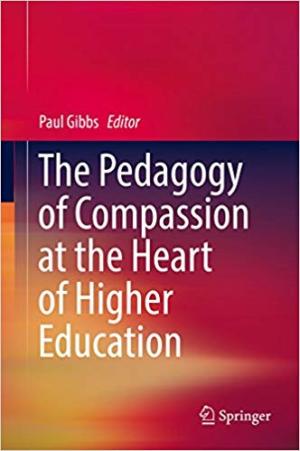
Click Here for Book Review This book offers a moral rather than instrumental notion of university education whilst locating the university within society. It reflects a balancing of the instrumentalization of higher education as a mode of employment training and enhances the notion of the students’ well-being being at the core of the university mission. Compassion is examined in this volume as a weaving of diverse cultures and beliefs into a way of recognizing that diversity through a common good offers a way of preparing students and staff for a complex and anxious world. This book provides theoretical and practical discussions of compassion in higher education, it draws contributors from around the world and offers illustrations of compassion in action through a number of international cases studies.
How is quilt‐making both metaphor and pedagogy for early‐career faculty of theology and religion who seek to cultivate critical and creative imagination for teaching, and to probe the challenges and promises of complex identities and vocations within 21st‐century landscapes of theological education? This forum presents essays (with explanatory introduction) by five members of the 2016–2017 Workshop for Early Career Theological School Faculty, who were impelled to story their experience of being “handed over to themselves” by an “arts and craft” project which forced them to think with their hands, speak with found objects, and re‐present themselves in the form of 12 × 12‐inch quilt squares. In self‐reflexive prose, these scholar‐teachers offer through this medium a glimpse of their unexpected moments of revelatory learning, as each was pulled into deeper contemplation of their personhood, experience, know‐how, and practical wisdom, each uncovering valuable hidden sources for more expansive theological query, and each re‐thinking the possibilities for theological education and its pedagogies.
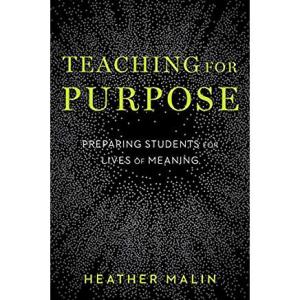
In Teaching for Purpose, Heather Malin explores the idea of purpose as the purpose of education and shows how educators can prepare youth to live intentional, fulfilling lives. The book highlights the important role that purpose—defined as “a future-directed goal that is personally meaningful and aimed at contributing to something larger than the self”—plays in optimal youth development and in motivating students to promote the cognitive and noncognitive skills that teachers want to instill. Based on a decade of research conducted at the Stanford University Center on Adolescence, the book explores how educators and schools can promote purpose through attention to school culture, curriculum, project learning, service learning, and other opportunities. Malin argues for expansive thinking on the direction schools should take, especially in terms of educating students to be creative, innovative, and self-directed critical thinkers. The book includes profiles of six organizations working in schools across the US that have made purpose development a priority. Infused with the engaging voices of purposeful youth, Teaching for Purpose offers a fresh, inspirational guide for educators who are looking for new ways to support students to succeed not only in school, but in life. (From the Publisher)
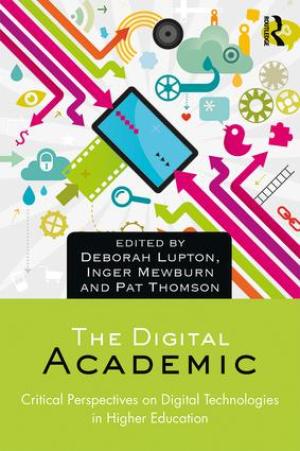
Academic work, like many other professional occupations, has increasingly become digitised. This book brings together leading scholars who examine the impacts, possibilities, politics and drawbacks of working in the contemporary university, using digital technologies. Contributors take a critical perspective in identifying the implications of digitisation for the future of higher education, academic publishing protocols and platforms and academic employment conditions, the ways in which academics engage in their everyday work and as public scholars and relationships with students and other academics. The book includes accounts of using digital media and technologies as part of academic practice across teaching, research administration and scholarship endeavours, as well as theoretical perspectives. The contributors span the spectrum of early to established career academics and are based in education, research administration, sociology, digital humanities, media and communication.(From the Publisher)
This conversation between the editors of Teaching Theology and Religion and Joanne Maguire Robinson continues an occasional series of interviews that has previously featured Jonathan Z. Smith, Stephen Prothero, Mary Pierce Brosmer, and Mary Elizabeth Mullino Moore. The exchange takes as its point of departure the teaching statement that Professor Robinson produced in support of her candidacy for the American Academy of Religion's Excellence in Teaching Award. Issues addressed include the impact of institutional context on one's teaching, teaching the humanities in universities that are ever more focused on job training, making the transition from a graduate program focused on research to teaching undergraduates who are unlikely to take even a second course in the study of religion, and ways in which women are challenged to navigate multiple responsibilities while striving to make their way in a male‚Äêdominated academy.
Podcast. Leading thinkers in the church, the academy, and the non-profit world giving the talk of their lives in 20-minutes or less.
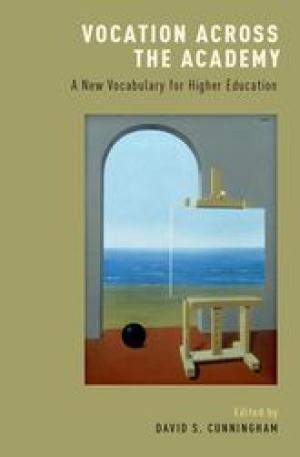
Click Here for Book Review The effort made by Cunningham and his co-contributors will provoke two questions for theological educators: What is it about the concept of vocation that gives it such staying power, and why has it been relegated to the margins of the very institutions that gave birth to the vocabulary? - Frederick W. Schmidt, Garrett-Evangelical Theological Seminary Although the language of vocation was born in a religious context, the contributors in this volume demonstrate that it has now taken root within the broad framework of higher education and has become intertwined with a wide range of concerns. This volume makes a compelling case for vocational reflection and discernment in undergraduate education today, arguing that it will encourage faculty and students alike to venture out of their narrow disciplinary specializations and to reflect on larger questions of meaning and purpose. In conversation with a growing range of scholarly resources, these essays advance the cause of vocational reflection and discernment well beyond its occasional mention in general education courses and career placement offices. The book's thirteen contributors all work in higher education, but they do so as biologists and musicians, sociologists and engineers, doctors and lawyers, college presidents and deans, and scholars of history, literature, and business administration. Together, they demonstrate that vocation has an important role to play across the entire range of traditional academic disciplines and applied fields. Regardless of major, all undergraduates need to consider their current and future responsibilities, determine the stories they will live by, and discover resources for addressing the tensions that will inevitably arise among their multiple callings. Vocation across the Academy will help to reframe current debates about the purpose of higher education. It underscores the important role that colleges and universities can play in encouraging students to reflect more deeply on life's most persistent questions and to consider how they might best contribute to the common good. (From the Publisher)
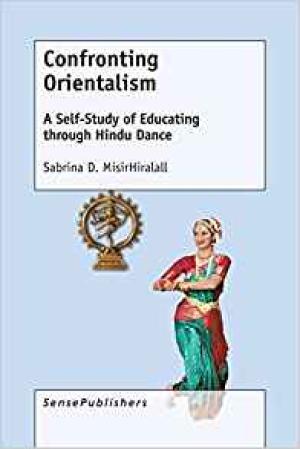
Click Here for Book Review The author aims to use Kuchipudi Indian classical Hindu dance to educate non-Hindus about Hinduism with postcolonialism in mind. This goal arises from her dance experiences and the historical era of imperialism. Colonization occurs when those in power believe there is a need to dominate in a manner that subjugates people. Colonizers created colonies as they moved into territory because they felt there was a need to “civilize” the so-called savages of the land. Postcolonialism is an intellectual discourse that confronts the legacy of colonialism and attempts to de-colonize. With the legacy of colonialism and a postcolonial lens in mind, some research questions arise. How does she, as a Kuchipudi dancer, use Hindu dance to educate non-Hindus about the Eastern literature of Hinduism? For non-Hindus, she feels the power of the exoticizing gaze when she dances, which might very well block the educational intention of the dance. This exoticizing gaze prevents the understanding of the traditional nature of the dance and the introduction to Hinduism as a world religion. The author’s problem is moving the exotic gaze of non-Hindus to an educational gaze that seeks to learn about the ethics of Hinduism in a manner that takes into consideration the multiple perspectives of the complex society we live in today.
Click Here for Book Review Reappraising ideas associated with Ernst Bloch, Roland Barthes and Gaston Bachelard within the context of a utopian pedagogy, Hope, Utopia and Creativity in Higher Education reframes the transformative, creative and collaborative potential of education offering new concepts, tactics and pedagogical possibilities. Craig A. Hammond explores ways of analysing and democratising not only pedagogical conception, knowledge and delivery, but also the learning experience, and processes of negotiation and peer-assessment. Hammond shows how the incorporation of already existent learner hopes, daydreams, and creative possibilities can open up new opportunities for thinking about popular culture and memory, learning and knowledge, and collaborative communities of support. Drawing together theoretical and cultural material in a teaching and learning environment of empowerment, Hammond illustrates that formative articulations of alternative, utopian futures, across sociological, humanities, and education studies subjects and curricula, becomes possible.