Resources

Richmond, Boysen, and Gurung’s work provides a much-needed resource for new teachers and is valuable to experienced teachers as well. The text is both concise and comprehensive concerning the current state of the Scholarship of Teaching and Learning (SoTL). The authors are psychologists who include their disciplinary insights, as well as provide important examples and resources from disciplines in the sciences, social sciences, and humanities. Chapters one and two set up the context of the “model teacher.” Rather than providing an essentialist answer to the definition of the model teacher, the authors focus on behaviors that produce consistent ideal results in the classroom. Chapters three through five – focused on teacher training, instructional methods, and student learning respectively – are useful to new teachers. As a text for initiating teachers, these chapters provide a reliable systematic introduction to key ways in which teachers interact with students in the classroom. These chapters should be complemented with discipline-specific examples or readings in graduate school teaching programs. Chapters six and seven on assessment of student learning and syllabus construction are the most valuable to teachers at any stage in their career. The insights into the scholarship on assessment is invaluable for the development of class, departmental, and university-wide curriculum. These two chapters are the most practical chapters for reconsidering the significance and purpose of teaching strategies and assignments. Finally, chapter eight examines student evaluations. There are many important insights in this chapter for new teachers on how to engage meaningfully with student summative evaluations. One point of interest was the authors’ statement on the significance of student satisfaction with a course. The authors could have included a lengthier conversation on how to meaningfully address the question of student satisfaction. In the end, “evidence-based” means that one organizes the multiple resources we employ in higher education in a way that substantiates the claims we wish to make. This text provides concrete advice that is useful for the novice; it is also a helpful aid for anyone wishing to mentor others in the art of teaching. An Evidence-based Guide to College and University Teaching employs an engaging hypothetical dialogue with the reader and an interactive approach. There are self-assessments at the beginning and end of each chapter along with hypothetical case studies for each chapter. An appendix at the end presents the uninterrupted self-assessment scale on sixty-four criteria for model teachers. These elements are excellent resources for group discussion in graduate seminars or faculty retreats. This book presents an accessible synthesis of the SoTL literature. It is successful as a gateway resource to the dialogue from the last forty years on pedagogical best practices. The text is limited in terms of the depth that it covers given the myriad topics it addresses, but it provides a solid beginning to engage the conversation.
Touting itself as “the first scholarly volume to exclusively mentor graduate students of color” (x), this collection of essays offers invaluable insights for navigating the academic job market and working as junior faculty. This volume is divided into three sections. The six chapters comprising the first division, “Practical Advice for Finding Success in the Academic Job Market,” provide concrete examples of how to deal with various aspects of the job application process. For instance, Michelle Camacho outlines steps from submitting a CV to negotiating terms of hire. Her sample messages illustrate proper email etiquette. The second part of the book, “Identity, Fit, Collegiality, and Secrets for Thriving in the Ivory Tower,” includes four chapters of advice for avoiding career derailments commonly faced by tenure-track faculty of color. Various professors share their experiences of both hardship and success. Nayeli Chavez-Dueñas and Hector Adames challenge the reader, via “ten reflective questions,” to introspect concerning motivations and commitment to a career in academia (124). Furthermore, their tables “Skills Required for Entry-Level Academic Positions and Alternatives to Strengthen Application” and “Seven Psychological Strengths of People of Color” (132-133) can be referenced daily, for goal setting and encouragement. Every academician would be wise to avoid the pitfalls Elwood Watson highlights in his essay “Fifteen Missteps That Can Derail Faculty Early in a Career.” The final five chapters make up the segment entitled “Work-Life Balance: Strategies for Transitioning From Graduate School to the Classroom.” It addresses decisions that scholars of color should make early in their careers to effect sustainable work-life balance. The articles urge both students and faculty to develop healthful ways of being. A few additions to the volume would enhance what is already a strong collection of essays. An article on the role of social media in the hiring and tenure process for scholars of color would be a welcome expansion. While Watson warns of the dangers of inappropriate social media posts (113), graduate students are also grappling with how to use social media to enhance career prospects. Similarly, a full chapter on crafting and presenting a conference paper would be an elucidating follow-up to Nadine Finigan-Carr and Natasha Brown’s insightful chapter “Navigating Professional Conferences.” Finally, while Tom Otieno’s essay “Transitioning Strategies from Graduate School to Early Career Faculty” explicates different types of academic institutions (74), an expanded orientation to the field would also be beneficial. This could include more explanation of the Carnegie Foundation for the Advancement of Teaching’s classification system (74) and definitions or etymologies of terms such as “research I universities” (9). This volume is a great resource for new initiates to the academic job market and workplace, as well as for those who already have some familiarity or experience. The short, engaging essays, which can be read in any order, invite scholars to revisit this guide often for help to land a new job or maintain a healthy work-life balance.
This book is pitched to college and university faculty at all career stages, and it stands out from other books in this category because of its research-based findings and its thoughtful case studies. The authors based their guidance on a year-long research study of 688 faculty from a wide range of institutions as well as on years of personal professional experience. The book covers the major aspects of an academic career: effective teaching and promoting student success, defining and facilitating collegiality and positive relationships within departments and with administration, conducting research, performing effective service to the institution or guild, and moving through the ranks to tenure and beyond. This book’s strengths include the liberal use of longer case studies and shorter scenarios, each of which works through a series of questions and proposed resolutions (for case studies) and a challenge question and outcome (for scenarios). The initial warm-up questions are often quite broad (for example, “Is there any general advice you think might be helpful to your friend?” [6]) while later questions tend to be more specific and thoughtful, requiring the reader to consider multiple factors and angles within one scenario. These vignettes were well written and thoughtfully prepared, and on the whole they engage the reader quite effectively. That the scenarios are so clearly taken from actual experience makes them more valuable, especially to newer faculty members who haven’t yet seen it all. Two chapters of this guide focus specifically on teaching. The first, titled “Teaching Effectively in the Classroom,” strongly promotes active learning over lecturing. The case studies in this section deal with common problems, such as how to respond to poor results in student evaluations and what to do when the entire class fails an exam. This chapter emphasizes the importance of learning how to teach large courses effectively, although the authors do include a section at the end of the chapter on “teachniques” for teaching smaller courses. Many new faculty and older faculty who are retooling will find this chapter a useful primer. The second chapter focuses on “Promoting Student Success and Engagement,” with a focus on developing friendly but not-too-familiar relationships with students. Using research and experience, the authors explain the pivotal importance of faculty in shaping students’ lives and ways of thinking well beyond the classroom. Taken together, these two chapters address many issues of interest to readers of this journal, and the remainder of the book is equally valuable for those looking for guidance and food for thought. As a guide designed for all faculty, this book necessarily elides issues of race and gender, for instance, that significantly shape faculty experience. That said, the book accomplishes much in a short space, and each chapter of the book is short and well-structured. Above all, this book uses the very techniques it suggests for effective teaching, and new faculty members in particular will find themselves better prepared for everyday faculty life after thinking through these realistic case studies.
Academic identity, like all identity, is fluid. This volume places questions about academic identity in the equally fluid context of “Europe,” which is here defined as at once united and fragmented, particularly after the economic crises of 2008. This volume pulls together thirteen articles in three sections: Frameworks and Perspectives, Academic Trajectories, and Formations and Re-formations. The authors are not sociologists of life course or scholars who study academic identity; they are, more usefully for this volume, speaking from their own contexts and experiences in European higher education from the late twentieth into the early twenty-first centuries. The editors have done a fine job choosing and grouping these essays, many of which were written by authors in their second or third languages to comply with market demands for English publication. This is one of the many strengths of the book, as it illustrates the kinds of demands that are placed on European academics that are absent in many ways from American contexts. Nevertheless, much is familiar here: academics in neoliberal systems of mass higher education struggle with ever-increasing bureaucracy, top-down management, and the encroachment of academic “professionalism.” Pressure to be represented well in world rankings tends to encourage institutional systems of assessment and auditing of outcomes that shape the academic enterprise as an inward-looking, self-serving part of a labor-driven economy and individual academics as cogs in the machine. As Jon Nixon states in his introduction, treating academic work like labor, as a matter of “pre-specified outcomes and destinations,” produces an unfortunate mismatch: “Academic identity is – to come full circle – a process that is uncertain in direction and indeterminate in outcome” (13). To treat academic work as labor is to misunderstand the potential benefits of outward-looking institutions that value intellectual autonomy and innovation above target-setting and performance measures. Many of the chapters in this volume could stand alone as case studies; each presents its own particular balance of interrogating biographical, institutional, or broader contextual identities and each brings a coherent and defined voice to the shared project. It is impossible to capture the richness of each of these chapters here, and each somehow manages to consider an individual life within the vast institutional, sociocultural, historical, and political contexts in which that life is lived. Although there is nothing specific to either religious studies or theology in this volume, there is much here that will resonate with academics who struggle with being pulled away from research and teaching to comply with institutional mandates. This volume should help academics in all disciplines to reflect on the power of context and particularly institutional context to shape lives and careers. Implicit here is a call to embrace the best in higher education despite the “regulations, financial incentives, rewards, quality standards, as well as academic, public, and professional values” (6) that constrain and give shape to our identities. These essays hint that a mix of resilience and subversion might well be the academic’s best allies.
The Slow Professor takes its cue from the slow food movement (http://www.slowfoodusa.org). Borrowing the words of Carlo Petrini, author of Slow Food Nation, Maggie Berg and Barbara K. Seeber define slowness as “not so much a question of duration as of an ability to distinguish and evaluate, with the propensity to cultivate pleasure, knowledge, and quality” (89-90). Slowness, in their thinking, is less about speed than it is about intentionality. They raise this point in a number of contexts. On the slim volume’s opening page, Berg and Seeber identify the popular and academic discourses they engage in their exploration of time management and timelessness; pedagogy and pleasure; research and understanding; and collegiality and community. They intersperse expert opinions from a variety of fields, including other research on teaching and learning, to support their stance that slowness is a productive stance for academics. Each chapter builds a case for slowness that culminates in practical suggestions, many of which seem like the kind of advice a reader with this book in hand may have considered already. I found value, however, in Berg, Seeber, and their chorus of sources confirming my suspicion that in the face of pressure to work constantly, I have a right to health, a life with my family, and enjoyable hobbies (16). Still, their advice tends to focus on what individual readers can do on a daily basis rather than on how institutional change might occur. For example, the first chapter, “Time Management and Timeliness,” ends with elaborations on these recommendations: “We need to get off line;” “We need to do less;” “We need regular sessions of timeless time;” “We need time to do nothing;” and “We need to change the way we talk about time all the time” (29-32). I am all for these, and I wholeheartedly agree that “if you want an event to be joyless, make it mandatory,” a takeaway from the end of “Collegiality and Community” (83). Still, the pressure of knowing that I have five years to publish another book, mere months to submit my next article, or a few weeks to finish a book review (ahem) gives me pause when I weigh walking the dog against writing. Institutional pressures directly affect individuals, but change in an individual’s perspective on time – especially that of a junior or contingent faculty member, for instance – does not lead directly to institutional change. Berg and Seeber acknowledge that “academic culture celebrates overwork” but, they argue, “it is imperative that we question the value of busyness” (21). Herein lies their contribution: in questioning busyness, they advocate learning from slowness so that the work we do is planned, thoughtful, deliberate, and energizing rather than scattered, scatter-brained, hurried, and draining. The latter leads to diminishing returns hidden behind the familiar, “I’d love to, but I’m busy.” The former can yield Csikszentmihalyian flow in reading, writing, and teaching.

This is a book about teachers and not about teaching. Furthermore, it is a book about data on mass populations of teachers in higher education from ten different countries ungarnished by local anecdote or illustrative portraits of a faculty person in real working conditions. The reason this book is worth paying attention to in this forum is that it shines a comparative light on the perils and possibilities that face new entrants into the academic field – some of whom will be your colleagues. Or rather, because this book is of more interest as a reference for hiring committees and deans, it tells you of the challenges your candidate has faced to reach your attention in the first place. That is if you are open to exploring how to move from even national inbreeding to internationalization of faculty recruitment. We find here the results of a ten country participative research program into the realities of career preparation, openings and market transparency, prospects and permanence, of the academic life, individually presented and analyzed and then cumulatively assessed by the editors in the final chapter. The countries are Brazil, China, France, Germany, India, Norway, Portugal, Russia, South Africa, and the U.S. There is of course a vast difference in contexts – from massive increase of student demand and a dearth of faculty, to a tedious and precarious shuffle of young faculty into middle age before a realistic prospect of career stability and something coming close to middle class lifestyle. (This latter is an unquestioned normative standard even as it is evident that the status of the academic profession in many societies is falling.) A number of thematic emphases emerge throughout the chapters, specifically the impact of hiring practices and terms of employment on female faculty, the difficulty of inbreeding and the social burden of academic networking, as well as more common experiences of young faculty such as heavy teaching load and administrative obligations with less time for research. It is agreed that contract and temporary employment with attendant uncertainty is the newest but also most detrimental aspect of current higher education. Some gems, of course, emerge from the textual detail. Male professors can get paid more in India after undergoing a vasectomy, a PhD will get male students out of military service cheaply enough in Russia, females are in the majority of doctoral students in Portugal. As a foreign born and trained academic teaching abroad, and given the international prospectus of the book, I shall concentrate a few remarks on the international (and not just national) data. Norway is concerned that too much of its government investment in doctoral work funds foreign born scholars, Portugal experiences a brain gain and often requires doctoral students to have international experience, France is relatively closed as a system, whereas South Africa welcomes PhDs from abroad in large number. Interestingly the chapter devoted to the US paid no attention to its cohort of international faculty. Perhaps this is so because international faculty are imagined to be ubiquitous, but alongside collegial anxiety about brain drain from abroad this disregard of the good or otherwise of international recruitment was noteworthy. India and Brazil have fewer foreign imports but radical differences in conditions for young faculty in public (better) or private (worse) sectors. India has a massive teacher shortage whereas the EU experiences long waits for civil servant professors to retire, and in the US there is not even a retirement age. If teaching religion is to benefit from an international perspective, as I believe it does, it is going to mean pursuing scholars from very different educational settings and looking (for US job searches) beyond easily accessible US-based guild networks. (I leave to others the judgment, case by case, as to whether US-trained international scholars are as international as those trained abroad.) It will mean understanding different pressures faced by potential job candidates from other countries. This book is a great resource for this purpose. Its data may also facilitate the comprehension of institutional pressures that affect the success or otherwise of international scholarly networks and projects as faculty from one country interact with faculty from another. I think of my current project with colleagues from Brazil where the broad data of Elizabeth Balbachevsky's chapter contextualizes what I have picked up in conversation.
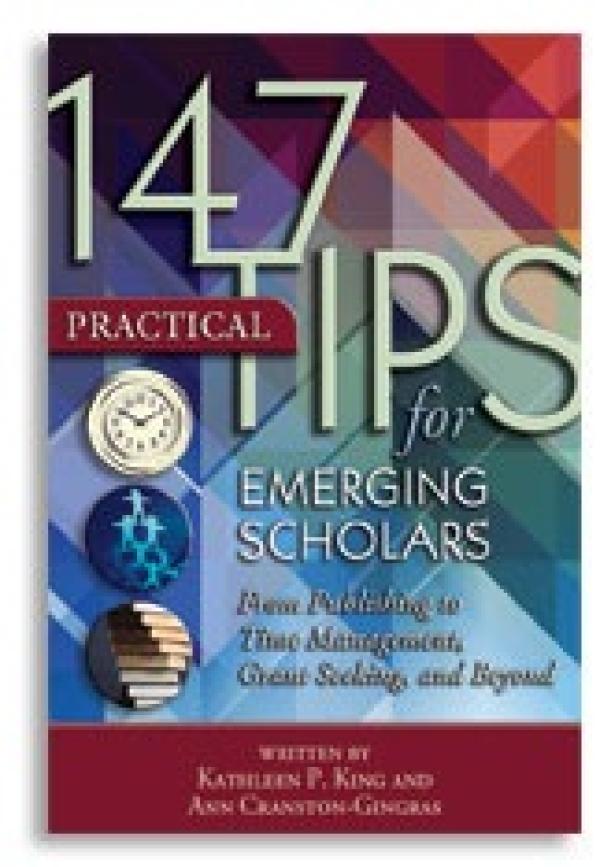
The authors of 147 Practical Tips for Emerging Scholars describe their work as offering much “to initiate or advance your success as a scholar, and nothing to lose as you invest a short time to read it” (22). This is a bold claim for a slender volume. However, this clear, honest, unpretentious work lives up to that promise. Authors Kathleen King and Ann Cranston-Gingras identify a key problem with the structure of academia: Those who seek to engage with it too often find themselves without guidance: the professional lives of doctoral faculty, new faculty, and experienced faculty (the three groups the book addresses) are often unsupervised and lack critical guidance for developing and establishing professional reputations, maintaining schedules, pursuing tenure, and avoiding mistakes. Guidance for making good professional decisions is what 147 Practical Tips seeks to provide. The key word which characterizes these tips is “practical”; the tips range from advice about scheduling to reminders to spell-check all correspondence. Some of the tips are about personal development; the authors focus not just on writing, but writing well, learning to vary styles and approaches. Others concern etiquette, with the dos and don’ts of collaborating with peers and contacting publication editors. The final section encourages scholars to apply this knowledge in the service of other emerging scholars, becoming the mentors to students and colleagues we wish we had had. Throughout, there is the acknowledgment that not all of the tips are relevant to all persons at all times; instead, King and Cranston-Gingras intend this to be a re-read resource, to be returned to as often as necessary. Though both authors work in education departments, the tips are meant to be applicable across disciplines – which is one of the book’s unfortunate weaknesses, as most tips are by necessity wholly unspecific. In addition, the section on technology already feels a touch outdated, as though it were targeted to an older audience, one which could use reminders that Dropbox can facilitate collaboration and all-caps text reads like shouting. For a short, cross-discipline guidebook, however, this book provides a significant amount of helpful hints and general guidance. Even in its limited scope, it encourages readers to take the extra steps they need to learn about publications, trends, and significant works inside their own disciplines, and then to apply the information here as necessary. The advice is often simple but rarely simplistic; even the most basic suggestions are good reminders of things too easy to forget in what can be chaotic pursuits. An emerging scholar myself, I would recommend this book to others on the path to establishing academic careers, and I expect to find myself opening it again.
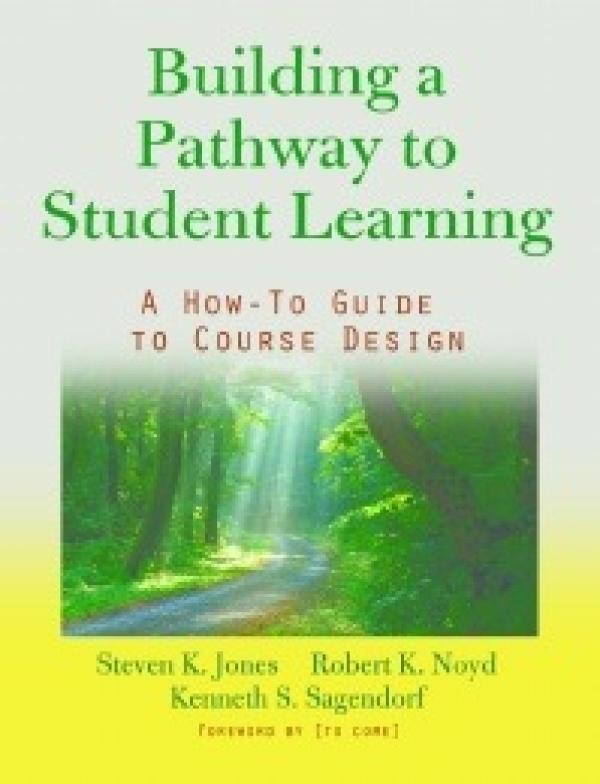
There are many important discussions happening in the academy about how to re-envision the student experience in order to provide better learning opportunities. The culture of higher education is undergoing a shift from an instruction-centered model to a learning or student-centered paradigm. These discussions are extremely significant in that they force faculty to re-evaluate and re-envision the traditional models – and ultimately lead to a more thorough and permanent education for the students. However, many of these studies are difficult since ways of applying these new theoretical models is often not immediately obvious. In Building a Pathway for Student Learning, Jones, Noyd, and Sagendorf have compiled a comprehensive and effective workbook addressing this lack. The workbook represents the results of a faculty development course design retreat that the authors have conducted for the last several years. This is not a book about course design, it is a systematic workbook giving direction for designing a learning-centered course in any discipline. At every stage in the course design process, the reader is reminded that, “our success ultimately comes not from what we as instructors are able to do but from what our students learn as a result of taking our courses” (9). To this end, the following pathway is suggested for effective course design. First, know the students you will teach. Second, identify the course learning goals. Third, build a summative assessment to determine the extent to which students have accomplished the learning goals. Fourth, develop a list of learning proficiencies that are required to successfully accomplish the learning goals, and then sequence them. Fifth, create learning experiences that will allow students to build and develop the central proficiencies, and to accomplish the learning goals. Sixth, construct several formative assessments, and use them to evaluate student progress toward the core proficiencies, which will encourage student improvement. After going through each of these stages, the authors lead the reader through two synthetic activities: creating a course poster and syllabus. The course poster assembles the learning experiences to be utilized in class, the proficiencies that will be developed, the way these proficiencies will be assessed, and the goal of the class, in order to ensure coherence and alignment within the course, and to transparently display the structure of the course to students. The syllabus is envisioned as a tool to demonstrate the learning-centered design of the course, not just the course policies and assignments. Each of these synthetic steps is aided by the use of the companion website. The workbook has much to commend. First, each chapter contains a helpful and thorough survey of the more significant research on the topic under consideration. Second, the system suggested to redesign courses is logically ordered, and effective. Third, at several key points the authors suggest proactive ways of finding evaluation of stages in the course design from colleagues. Most importantly, the authors recognize that effective course design has to be a flexible system; they do not claim to have all the answers for how every course can best be structured, rather they provide a series of guiding questions so that individual instructors can think through how to order their classes so that they effectively take students from wherever they begin, to the acquisition of central proficiencies and the accomplishment of learning goals, whatever the discipline. For these reasons, this book should be essential for anyone developing or revising courses towards a learning-centered model.
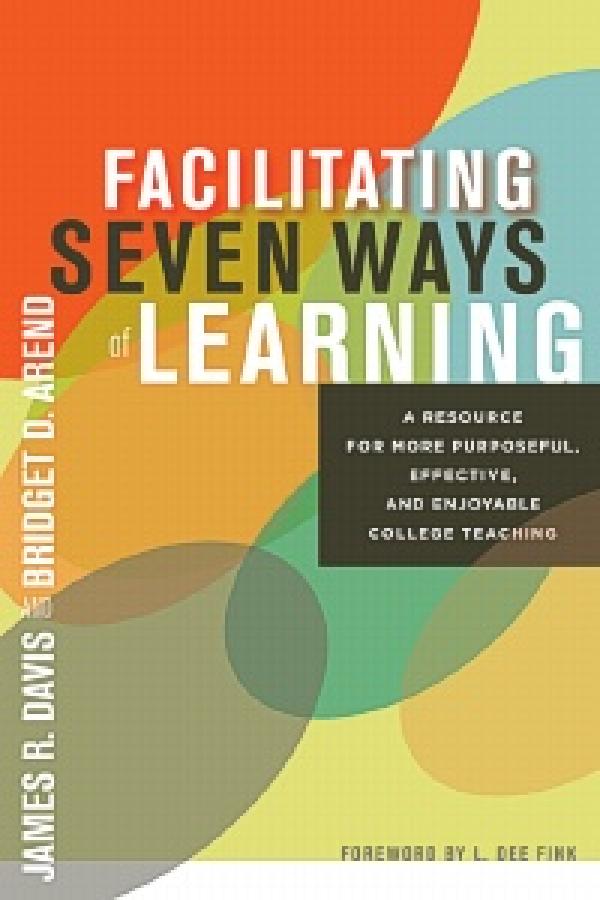
Two university educators who have led campus teaching and learning centers and worked as academic administrators have served us all well with their Facilitating Seven Ways of Learning. Davis and Arend seek explicitly to connect teaching practices to specific learning goals chosen for university classes. Not only do I recommend this book to you, but I will use it in my January PhD Teaching Seminar. At times the language of the book is a bit grand, talking about being “trapped” in a “lecture paradigm” with an “obsolete” view of learning (5, 8). They claim “confusion reigns as the paradigm crumbles (15).” I forgive them, for it does not continue too long. Perhaps the assumption was that a grand view was necessary to sell books to skeptical readers. Nevertheless, the book delivers what it promises: to help faculty, trained as scholars, researchers, and writers, to focus additionally on being effective teachers concerned about learning – for citizenship, personal development, and the ongoing generation of knowledge. Conversation about teaching is increasing in graduate schools, professional schools, and universities. At a recent consultation, I heard faculty members talk among themselves about how they trusted their colleagues, knew that individual classes were faithful and effective, and yet were concerned that their overall curricular goal for critical, integrative practical theological wisdom was not occurring. One mentioned that they all worked hard at fulfilling goals for individual classes, but had not attended to specific integrative commitments of their curriculum together. Facilitating Seven Ways of Learning is a way to begin addressing that concern. After assisting faculty to define course learning goals, the authors take seven explicit learning commitments and demonstrate effective pedagogical practices. The seven ways of learning are: building skills; acquiring knowledge; developing critical, creative, and dialogical thinking; cultivating problem-solving and decision-making abilities; exploring attitudes, feelings, and perspectives; practicing professional judgment; and reflecting on experience. One can see the influence of Bloom and Shulman here. The authors help faculty clarify how learning goals connect with these seven ways of learning and offer concrete strategies for teaching. To quibble: I am not certain that simply reflecting on experience is a goal. Is it not more a learning strategy for professional judgment, acquiring knowledge, or practicing decision-making skills? Regardless, this book will generate conversation among faculty members and will assist them to make the move from learning commitments to classroom strategies. As mentioned, I will use this book in my next PhD teaching seminar. Faculty are committed to assisting doctoral students to consider the vocation of teaching, connect academic study with teaching, and gain practical skill in course design and teaching practices. I have brought together bibliographies on theological education, course design, and learning strategies that I routinely share with graduate students. With Facilitating Seven Ways of Learning, students can practice naming commitments of their disciplines and their own scholarship, explore the learning goals they have for their students, dialogue with faculty mentors about the particular concerns of classes, and connect teaching practices to learning commitments. Clearly this book was written after years of experience in a college teaching center, empowering faculty colleagues. I recommend it.
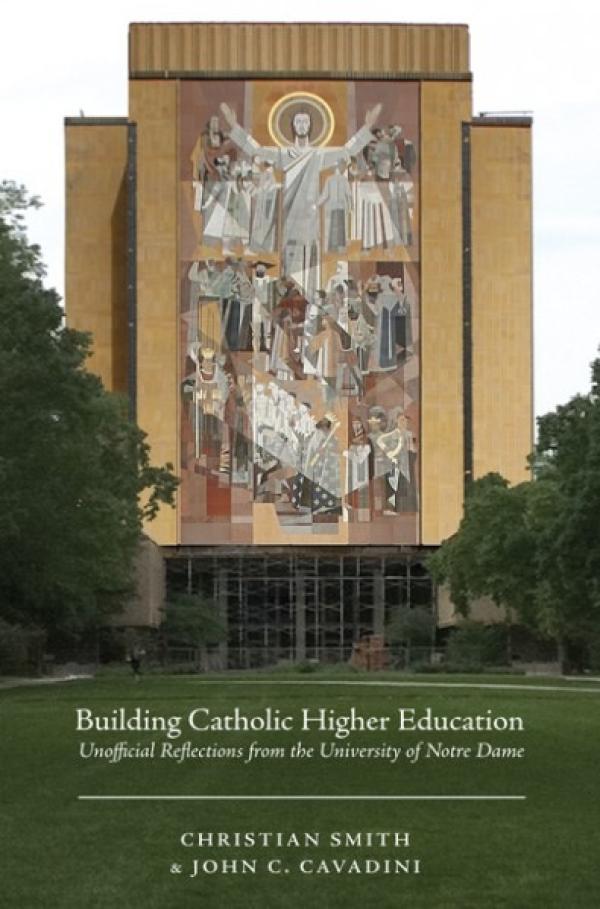
In this slim volume, Christian Smith, a sociologist of religion on the faculty of the University of Notre Dame, takes on a pivotal question for the future of Catholic higher education: faculty engagement with Catholic intellectual tradition. Exploring the convergence of Notre Dame’s three strategic goals – to provide an unparalleled undergraduate education, to gain recognition as a globally premier research university, and to remain thoroughly and distinctively Catholic – Smith brings into sharp focus two fundamental issues: (1) that any faith-grounded university’s capacity to fulfill its mission rises and falls on the knowledge, quality, and dispositions of its faculty; and, (2) that Catholic universities must wrestle with how their faculties engage Catholic intellectual tradition in their academic disciplines. His wrestling with these issues makes the book worth reading for anyone involved in faith-based higher education. In the first chapter Smith lays out the texts from which he will work: the University of Notre Dame’s mission statement, Fr. John Jenkins’ inaugural presidential address, excerpts from Jenkins’ annual addresses to faculty, and Provost Tom Burish’s letter announcing a committee to explore hiring outstanding Catholic faculty. In four subsequent chapters Smith details the assumptions behind these texts with their implications for faculty; elaborates a range of ways that faculty, whether Catholic or not, can support Notre Dame’s mission; proposes what the pursuit of social science disciplines might entail in a context where Catholicism matters; and, takes a hard look at whether it is possible for Notre Dame, or any other faith-grounded university, to pursue three goals simultaneously – unparalleled undergraduate education, premier research status, and robust engagement with the Catholic thought across all disciplines. (He doubts that it is.) A paper by John Cavadini on the role of theology in a Catholic college or university serves as the appendix. Smith’s dialectical approach emphasizes boundaries. He asserts that universities “cannot meaningfully call themselves ‘Catholic’” unless “Catholicism as a distinctive approach to life and the world” significantly influences intellectual inquiry, scholarship, and teaching; initiatives in valuing social justice or in spiritual formation will not suffice (65). His chapter detailing the “tensions, trade-offs, and dangers” involved in attempting to achieve excellence in undergraduate education and premier research status “in an institutional, cultural, and pedagogical context that is robustly Catholic” is refreshingly practical and pragmatic (78). Smith recognizes the challenge involved in an academic department attempting to maintain coherence with some faculty focused on teaching, others on research, and still others on Catholic dimensions of a discipline. At points Smith is nostalgic for an era when Catholic universities were Catholic by virtue of their enmeshment in the webs of a subculture. He is far more anxious about the prospects for maintaining the Catholic character of universities than is John Haughey, S.J., whose Where is Knowing Going? The Horizons of the Knowing Subject (Georgetown University Press, 2009) offers an alternative, analogical approach to the question. Still, Smith makes his case that Catholic universities cannot maintain a robust Catholic identity without a critical mass of faculty members who both understand and engage Catholic thought and life critically and faithfully. Read together, Smith and Haughey could animate a vital conversation in which Catholic college and university faculties need to participate.