Resources

I could not put this book down, and I strongly recommend that anyone concerned about higher education in America take it up. In this volume, Leonard Cassuto expands on topics he explores in his Chronicle of Higher Education column (“The Graduate Advisor”) and integrates them into an argument to reconceive the role and nature of teaching in graduate schools for the benefit of graduate students and higher education in general. What Cassuto means by “reconceiving” teaching at the graduate school level is something more fundamental than changing styles or methods of pedagogy. He wants faculty to help students succeed, personally and professionally, by seeing careers outside academia as worthy of professional pursuit. This is not, Cassuto repeats, a betrayal of graduate training, rather it is the retrieval of an earlier model of graduate education that envisioned doctorates serving in a broad variety of professional positions. In this, Cassuto differs from common approaches to “fix the mess,” such as calls to expand the ranks of professionally preferred and economically sustainable positions by converting part-time, non-tenurable ones to full-time, tenurable ones (for example, American Association of University Professors 2015-16 Annual Report on “The Economic Status of the Profession”). Cassuto argues, persuasively, that this will not come to pass. The days of every freshly minted PhD stepping into a full-time, tenure-track job belongs to the past; specifically, the period between the end of WWII and the close of the 1960s. In the history of American higher education woven throughout the book, Cassuto establishes that the unique circumstances of that period led to those halcyon days for those aspiring to the professorship. Changes in demographics and policies (educational and public) force us to abandon hope of this returning and instead imagine, again, a more expansive job market for those with doctorates. Towards this end, Cassuto recommends that from first contact with a prospective student through every stage of advising, faculty speak openly of the dismal academic market and approvingly of “alt-ac” careers. The chapters are arranged around the “life-cycle” of a graduate student (Admissions, Classwork, The Comprehensive Exams, Advising, Degrees, Professionalism, and The Job Market Reconceived) and offer concrete recommendations on how to adjust each of these phases in ways that will serve graduate students, graduate education, and by extension, undergraduate education and public life. The discrete changes he advocates (such as ways to reduce time to degree completion and alternate models of comprehensive exams and dissertations) are not original, but situating them within an enlarged concept of the possible uses of a doctorate is. An expanded concept of the potential purposes of the doctoral degree requires a significant change of attitude among graduate school faculty; they must sincerely support, and at times initiate, student embrace of career paths that do not resemble their own. Jobs in high schools, in business, in government, and so forth, must be accorded the same respect as full-time, tenure-track positions. This attitude shift will be, I venture, more challenging than Cassuto acknowledges. Cassuto is correct that this shift requires faculty to grasp, and leverage, the oversized role they play in their students’ lives. Interviews and anecdotes poignantly remind readers that the trust and admiration graduate students extend to their advisors may result in students shying from decisions that are in their own personal and professional interests for fear of disappointing their advisors. The prejudice that only a career in academia is worthy of doctorates exacts a tremendous toll on students. They sacrifice years, foregoing earnings and retirement savings, while accumulating debt and enduring personal and professional limbo. Cassuto rightly characterizes this as a “moral” crisis demanding action.
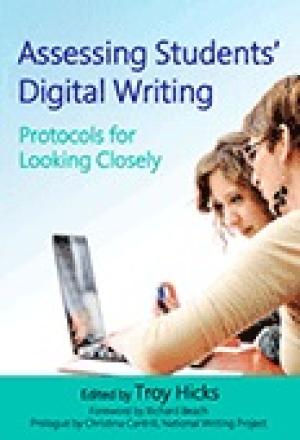
Assessing Students’ Digital Writing: Protocols for Looking Closely collaboratively addresses teachers who want to know about how to give feedback on digital writing. The book provides six digital writing protocols used to give feedback to teachers about student learning. The authors of the protocols are teachers themselves; Erin Klein, Julie Johnson, Jeremy Hyler, Bonnie Kaplan, Jack Zangerie, Christina Puntel and Stephanie West-Puckett wrote this book as a part of the National Writing Project in Berkley, California. Each teacher in this project uses a digital format to teach a specific lesson. At the end of each chapter the teacher discusses the implications of the digital process for instruction and assessment. At the end of the book the editor discusses broad themes and issues about curriculum, instruction, and assessment. This discussion is based on the study of student work in the writing as shared through conversations among the various authors and teachers of the project. As stated earlier, this book is a collaborative work and evidence of this is seen throughout each chapter. A weakness of the book is that it may be difficult for those who are just entering into digital writing because of the use of many technical terms associated with web-based learning. Although in general I find this book very valuable for gaining a better understanding about digital learning, I would like to see more information about the students who were part of the writing. The book is intriguing because of its focus on youth and their learning through digital writing methods. It is also timely in that it gives rise to more conversation about the remnants of the No Child Left Behind era and the very present views on Common Core State Standards that are sweeping across K-12 public education in the United States. Additionally, the rise of many digital formats for classroom teaching gives one reason to take the book seriously. As the author points out, this conversation is even more in vogue because of the accessibility of teachers and students to web-based services such as Google Docs, Wikispaces, and Voicethread. All of these services can be accessed on digital devices that are mobile. I can personally relate to what the authors are saying because I am presently teaching in an online platform that pushes me to look at digital writing very seriously. Furthermore, the book is interesting because the voices of the teachers in conversation about student learning are present throughout the book. I find this to be important in a time when much effort is made to assess student achievement where it seems student learning is not at the core of the assessment concern, although on the surface it may seem to be. Overall, this book is a valuable asset especially for those interested in assessment and digital writing.
Towards the end of their introductory chapter, the editors of Community Engagement in Higher Education succinctly state the broad concern holding the volume together: “More emphasis should be made to link teaching and research with community initiatives” (17). The remaining seventeen chapters show what this can look like across a variety of higher education institutions, from community colleges to urban universities and from regional systems to global partnerships. Though divided into three parts – thematic issues, U.S., and international cases – the basic approach throughout the volume is descriptive case study written by persons with firsthand knowledge of the specific program or community engagement initiative. So, for example, contributors to part one raise “thematic issues” by reflecting on particular cases of the role of technology in enhancing university-community partnerships or service learning in disaster recovery. Similarly, scholars in parts two and three identify thematic issues in their interrogation of case studies focused on sustainable partnerships or the limits of current institutional commitments to critical community engagement. The subtitle of the book, “Policy Reforms and Practice,” suggests a more robust discussion of the way forward. However, most of the authors focus on their own institutional practices, relegating the larger questions of education policy reform to brief historical overviews of policies (such as the Morrill Act) and commissions (for example, the Kellogg Commission) that have served to legitimate the community engagement role of higher education. Given the parochial focus of individual chapters, the absence of a concluding, forward-looking synthesis chapter is conspicuous – even more so given the increasingly narrow metrics employed to measure the value of higher education institutions and persistent suspicion about the value-added of service learning. As many of the chapters remind readers, community engagement is not new, and many institutions support a range of initiatives. But therein lies the rub. In one of the strongest chapters – theoretically and practically – Seth Pollack critiques the “pedagogification” of service learning, a process through which service learning becomes primarily a method for teaching traditional content, rather than an “epistemologically transformative educational practice” aimed at forming students for critical civic engagement (170). Pollack’s chapter stands out as one of the few in the volume to find the sweet spot in case study research, using the case to illustrate theory and theory to illumine both the case and the wider social context in which the case is situated. Unfortunately, many of the other chapters do little more than report out on initiatives in which the authors played a significant role. As a result, the volume struggles to assert critical leverage in two important ways: self-critique and social critique. That is, the chapters would benefit, on the one hand, from a bit more critical distance from the programs discussed and, on the other hand, from critique of the wider social forces and structures that significantly shape the societal fault lines along which most community engagement initiatives are carried out. Taken together, the various case studies suggest that two challenges consistently threaten the success of community engagement: (1) alignment of both resources and vision between a large educational institution and diverse community stakeholders and (2) integration of the community engagement function into the identity of the university. A fair amount has been written in the past five years about the role of universities as anchor institutions, or institutions that are embedded in a particular place and committed to leveraging their resources and the community’s assets for community development, neighborhood revitalization, and so forth. The discussion of anchor institutions has catalyzed a conversation about both of the pressing challenges noted above, offering up a way to think about community engagement as more than just one-off service learning experiences or the aggregate of individual student volunteer hours. Yet, the volume has little to say about this current conversation. I looked forward to this volume, in part because we had just begun a conversation about how our small, religiously affiliated university could be a better neighbor to those in and around our campus. For those teaching religion and theology, such conversations are opportunities to draw from the deep well of religious reflection on who our neighbor is and what our obligations to one another might be – individually and as institutions. This conversation is not on the radar for the contributors in this volume, an omission that may have to do with the particular interlocutors in the Pittsburgh Studies in Comparative and International Education book series of which this book is a part. (The case studies are drawn primarily from public institutions, with the exception of a chapter on Duquesne University.) Yet religiously affiliated universities are often located in urban centers facing considerable challenges or negotiating difficult transformations. And these institutions articulate a purpose that, in mission statements, at least, resonates with the distinctive moral arc of public serving universities in the United States. These colleges and universities are also often anchors in many small town and rural communities, both of which merit more attention than is afforded in this book (as well as in the broader community engagement literature). I would be remiss if I didn’t mention one final concern: the appearance of sloppy scholarship in many of the chapters, beginning in the editors’ introduction. Issues include misidentifying the town in which a university is located, to quotations without citations, to grammatical errors. These could, perhaps, be dismissed as the collateral damage of publishing in an era with limited copy editing support. However, in light of the constant need many of us feel to defend community engagement and service learning as rigorous, such writing style concerns bear additional weight insofar as they detract from the credibility of those whose commitment to scholarship for social change can – and should – be a catalyst for revitalizing the service mission of higher education institutions.

The question, “Can you give me some feedback on this,” is incredibly problematic. It is what some leadership theorists call a “landmine question.” Giving constructive feedback can be a tricky wicket. We may call feedback “honest.” However, it almost always comes across as critical, perhaps even mean. The idea is to focus on the negatives or how others can improve themselves, so we address it in what I call a “combatively collaborative” fashion. However, because of the possibly aggressive or even bullish nature of the one giving the feedback, it can have the reverse effect. Tell Me So I Can Hear You is a helpful volume for educators and leaders. Rooted in the cognitive-developmental theory of human development as espoused by Robert Kegan, the authors base their entire argument firmly in the “four ways of knowing – instrumental, socializing, self-authoring, and self-transforming” (40). The authors convincingly argue that feedback to colleagues and peers works best when it is understood to be part of the continuing education or professional development process. For them, this results in primarily offering feedback in a way connects with our learning styles. For example, if you are an instrumental learner, you will focus on offering feedback that adheres to the rules, regulations, and expectations of an employee of that organization. Since this approach relies heavily on rubrics, it will positively help colleagues understand where they stand professionally, based on the commonly-accepted careerist markers. However, it does not take into account more abstract qualities, such as emotional health, creativity, or one’s personal background. Those in administrative educational leadership often offer constructive or critical feedback and tend to process feedback differently than the faculty colleagues and students who are recipients of that feedback. The one receiving feedback may become confused, angry, or withdrawn because they interpret the administrator’s comments differently than the intended meaning. The benefits of this volume are in the consistent and thorough explanation of the “four ways of learning,” as the authors ground their entire discussion on showing how these ways of learning can work together through feedback settings to build a healthy and collaborative environment. To this end, the chapters on how we receive feedback (chapter 4), give feedback (chapter 5), and build a culture of trust in the organization (chapter 6) are certainly worth the price of the book. The reader should, however, be aware of two minor concerns: First, this volume accepts Common Core Standards as its operating model for understanding competency rather than seeking out a more integrated model of content comprehension and skills application. Second, the authors seem to interchange the concepts of “colleague” and “adult learner,” which causes some confusion as to whether this handbook is for the quad office or the adult-learning classroom. If you find yourself being required to offer more and more intense feedback or are in a leadership position, read Henry Cloud’s extremely practical volume Necessary Endings (New York: HarperBusiness, 2011) before diving into this volume.

Distance education is a growing component of higher education. Whether students combine distance courses with traditional classroom hours or focus entirely on distance learning, the presence of distance education in major colleges and universities in America continues to expand. Hybrid courses, which combine face-to-face learning with a digital component, are becoming very popular options for students. Most college graduates in the class of 2020, for example, will have received some of their credit hours online. The essays collected by Maureen Snow Andrade for Issues in Distance Education address each of these phenomena and more. The initial essay, “Issues in Distance Education: A Primer for Higher Education Decision Makers” by Michael Beaudoin, provides an overview of the development of distance learning in higher education. This is a very useful chapter, particularly for administrators and prospective instructors who are looking for a short introduction to how distance education became such a prominent feature of American higher education and some of the resistance it has encountered. Beaudoin refers to distance learning as a disruptive technology, which is an apt description of the kind of impact it has had on administrators, faculty, and students. Disruptive technology requires transformative leadership in order to make the best use of what is logistically possible. Farhad Saba’s discussion, “Theories of Distance Education: Why They Matter,” analyzes various theories of distance learning and links the theories to future institutional policies and practices. Saba advocates a community of inquiry model that combines a social, cognitive, and teaching presence that makes the best use of new technologies and flexible learning schedules. Andrade’s essay, “Effective Organizational Structures and Processes: Addressing Issues of Change,” explores both macro and micro level structural models for distance education. She proposes four interconnected leadership frameworks for both creating and managing change. The strengths and weaknesses of each model, such as environmental and stakeholder issues, are also discussed along with a set of guiding questions for institutional change. These first three essays provide a core of information and key questions that will serve readers well. Each of the six chapters which follow focuses on a related issue that the initial essays prompt. For instance, how can a development plan contribute to course consistency and quality? Is a team approach to course development desirable? What sort of faculty support is essential for high level learning outcomes? How can distance learning be successfully offered on a global scale? What sort of strategic planning will facilitate all of this? This compact volume does not attempt to settle all of the issues that it raises. It does provide an excellent starting point for discussions about innovative methods for teaching theology and religion as well as the attendant policies, costs, infrastructure, and support necessary to sustain them.

This collection highlights the depth and breadth of interest in the historical Jesus across various forms of higher education. Editor Zev Garber has done an outstanding job of assembling high quality scholar-teachers to explicate their framework for understanding Jesus in his social-historical setting. What makes the volume noteworthy for a faculty teaching theology and religion, however, is the reflection on how to teach this important subject in ways that are pertinently positioned for a variety of student audiences. Taken as a whole, the volume answers Rudolf Bultmann’s question, “Can there be exegesis without presuppositions?” with a resounding “no.” Each contributor clearly presents their own position, the background of their institutional context, and assumptions that surround the teaching of their group of students. The collection is made up of twenty shorter essays and full comment on each cannot be made here. The first part of the volume examines teaching and student engagement from a variety of institutional contexts – primarily undergraduate, but including a rabbinical school and a Christian seminary. Further marks of delineation are private versus public; Protestant, Jewish, Catholic; and even a public community college. Some contributors function both in academia as well as in the training of religious leaders, formally or informally. Pedagogy is presented and explained, along with reflection on student questions, reactions, and participation in the learning process. The underlying purpose in doing this teaching work is to increase fruitful interfaith dialogue. The second section examines specific issues in teaching the historical Jesus – often these are difficulties encountered, with solutions suggested (for example, the use of art or cinema; the nature of Judaism and Jesus; the extended turn toward later Christian terms and theology; the use of gospel materials in reconstruction; clarity on the “parting of the ways”). The final section consists of four technically positioned essays about Jesus’s Jewish background and his roles within local, pan-Mediterranean, and larger political contexts of his society (who was Jesus among other males, the Pharisees, and political seditionists?). If readers of Reflective Teaching believe that good teaching is enhanced by “good conversations about teaching,” then this volume is a gold mine. Garber has directed the contributors to be transparent about themselves, their contexts, and their students. This allows us to contrast them to our own pedagogies, experiences, expectations, and accomplishments or difficulties. In addition, we can be reminded that our own contexts may be busy and focused to the extent that we are unaware of or inattentive to the differing contexts and perspectives of colleagues that both warrant our notice and our conversation – thus increasing our respect, tolerance, civility, and openness to dialogue. And because much of the discussion in this book revolves around students, we have an opportunity to see the variety of perspectives that we might one day engage in the classroom ourselves. I highly recommend this book for those who teach early Christianity or introductory courses in which the historical Jesus is a significant subject of inquiry.

Touting itself as “the first scholarly volume to exclusively mentor graduate students of color” (x), this collection of essays offers invaluable insights for navigating the academic job market and working as junior faculty. This volume is divided into three sections. The six chapters comprising the first division, “Practical Advice for Finding Success in the Academic Job Market,” provide concrete examples of how to deal with various aspects of the job application process. For instance, Michelle Camacho outlines steps from submitting a CV to negotiating terms of hire. Her sample messages illustrate proper email etiquette. The second part of the book, “Identity, Fit, Collegiality, and Secrets for Thriving in the Ivory Tower,” includes four chapters of advice for avoiding career derailments commonly faced by tenure-track faculty of color. Various professors share their experiences of both hardship and success. Nayeli Chavez-Dueñas and Hector Adames challenge the reader, via “ten reflective questions,” to introspect concerning motivations and commitment to a career in academia (124). Furthermore, their tables “Skills Required for Entry-Level Academic Positions and Alternatives to Strengthen Application” and “Seven Psychological Strengths of People of Color” (132-133) can be referenced daily, for goal setting and encouragement. Every academician would be wise to avoid the pitfalls Elwood Watson highlights in his essay “Fifteen Missteps That Can Derail Faculty Early in a Career.” The final five chapters make up the segment entitled “Work-Life Balance: Strategies for Transitioning From Graduate School to the Classroom.” It addresses decisions that scholars of color should make early in their careers to effect sustainable work-life balance. The articles urge both students and faculty to develop healthful ways of being. A few additions to the volume would enhance what is already a strong collection of essays. An article on the role of social media in the hiring and tenure process for scholars of color would be a welcome expansion. While Watson warns of the dangers of inappropriate social media posts (113), graduate students are also grappling with how to use social media to enhance career prospects. Similarly, a full chapter on crafting and presenting a conference paper would be an elucidating follow-up to Nadine Finigan-Carr and Natasha Brown’s insightful chapter “Navigating Professional Conferences.” Finally, while Tom Otieno’s essay “Transitioning Strategies from Graduate School to Early Career Faculty” explicates different types of academic institutions (74), an expanded orientation to the field would also be beneficial. This could include more explanation of the Carnegie Foundation for the Advancement of Teaching’s classification system (74) and definitions or etymologies of terms such as “research I universities” (9). This volume is a great resource for new initiates to the academic job market and workplace, as well as for those who already have some familiarity or experience. The short, engaging essays, which can be read in any order, invite scholars to revisit this guide often for help to land a new job or maintain a healthy work-life balance.

his is the fourth in the Routledge Research in Religion and Education series. The series editor provides a Foreword distinguishing between religious education as formation within religious institutions and the concern of the series, which is education about religion. In this context, the essays address comparative theology as a process and as a pedagogical method in primarily, though not exclusively, undergraduate classrooms. Editors Brecht and Locklin provide a concise, effective introduction which establishes an overview of the intersecting thematic components of the collection: comparative theology, particularly the “departure-and-return” model as developed by Francis X. Clooney, SJ., and ways in which the digital culture of the millennial generation impacts epistemology and identity. The fifteen essays are arranged in three sections. The well-placed first essay, by Judith Gruber, offers a postcolonial critique of the comparative theological model as implicitly essentialist. Essays in the second group address issues of identity raised by millennials and the nature of the millennial classroom in relation to comparative theology. Essays in the third section discuss hands-on examples and specific pedagogical practices. An afterword by Clooney, in which he identifies “six recurring issues” which he finds in the essays and addresses sequentially, concludes the volume. Clooney’s frankly personal account of his own context in developing the departure-and-return model and his rejoinder to the charge of essentialism bring the dialogue to a fitting end. The diversity of the collection is rich in both content and authorial voices, some of whom are well-established scholars and others of whom are emerging, most teaching in religious studies or theology departments at public or private North American universities, though the balance leans toward Roman Catholic institutional affiliations. Editors Brecht and Locklin note that this collection is the fruit of a Wabash Center teaching workshop. The robust range of reflection invites readers into the feel of a working group of teacher/scholars who share a concern for facilitating transformative learning in the religion or theology classroom, yet who address this concern and comparative theology’s relevance to the millennial context in quite distinct ways. A brief sampling demonstrates the range of perspectives authors develop: soteriological privilege (Brecht); Muslim theology of tawhid (Hussain); embodiment and material culture (Gasson-Gardner and Smith); storytelling as a pedagogical method of African Traditional Religions (Aihiokhai); comparing dharma and moksha, works and faith, ethics and spirituality (Yadlapati); a voluntary female Jewish-Muslim textual study group (Golberg); and use of film in an online context (Sydnor). As Jeanine Hill Fletcher writes in her essay, “the work of the comparative theology classroom shares in this important work of shaping citizens in a multifaith world toward tolerance, appreciation, meaningful relationships, and the common good” (149). The same may also be said for religious studies classrooms. Many teachers of religion who are neither theologians nor comparativists by academic training will nevertheless find this collection useful and even inspiring for their pedagogical reflection and practice.
Gender and Diversity Issues in Religious-Based Institutions and Organizations offers a chilling reminder that much remains to be done to educate people on race, gender, and diversity. Blanche Jackson Glimps and Theron Ford craft a goldmine filled with breathtaking essays insisting that schools, institutions, and organizations cannot afford a wait-and-see attitude hoping that these issues will somehow work themselves out. They argue that education to inspire intentional acts to diversify is quintessential. This is accomplished in thirteen chapters written with a national and international scope by concerned experts who agree that although progress is being made in the areas of gender, race, and diversity, many people still feel alienated. For this, the authors marshall copiously documented arguments that expose relational problems in many religious schools, institutions, and organizations around the world. A dense annotation of each chapter is implemented with meticulous summaries and abstracts to offer a clear layout of the entire book. Readers are graciously guided to address a timely need while also given actionable solutions to these nagging issues and further recommendations on helpful publications to consult. In the end, what Glimps and Ford offer is a timely well-written encyclopedic work not just for socially and religiously engaged teachers and leaders but for any caring person willing to make a difference in human relationships for many years to come. As an African scholar teaching in the United States, I am particularly struck by Sheri Young’s “Psychological Essentialism” (80-123). Aspects of her argument permeate the entire book in many ways. She explores how religious institutions handle diversity matters and wonders if “there is a benefit to being ‘essentialized’ versus ‘essentializing’ others?” (84). In other words, do religious and social institutions have a good grasp on how to diversify their spaces? Case studies suggest that this is hardly the case. To essentialize self or someone else, she avers, has little if no benefit at all. To deal with psychological essentialism, religious and social institutions must own up to their stated mission goals because most of them “have an institutional mission statement that includes a goal to develop individuals who stand with, and serve, their fellow human beings” and “hold a view of education that includes promoting education that does justice, as faith does justice.” Exercising this noble mission by avoiding the biases that transform religiosity into wars about hierarchy and superiority, while upholding messages of faith, hope, and equality, religious institutions are better prepared to create positive changes to develop positive campus climates than religious institutions that are held in place by waging outdated superiority wars. (114) In many ways, the contributors to this volume testify to the fact that ours is anything but a postracial or gender sensitive world, even in religious circles. Racial and gender objectification is a daily experience for many people around the globe. A resilient hope runs through the book that well-meaning religious educators and leaders inspired by their mission statements will strive to reclaim their confessed commitments and goals to do the right thing by exercising genuine gender diversity, justice, and equality. This book is long overdue and should be read, studied, and its content applied in every institution, school, and social organization worthy of its socioreligious commitment to the betterment of human interrelationships for a foreseeable and lasting future.
The title of this volume alone, Men of Color in Higher Education: New Foundations for Developing Models of Success, inspires intrigue in educators and administrators who are concerned about the relative dearth of men of color in higher education. The absence of men of color in higher education and the regular portrayal of their poor academic performance has been propelled by deficit discourse contending that men of color are defective and inadequately suited for the academy. This volume interrogates this perspective and counters studies and programs that have largely been guided by the presumption of men of color’s academic “deficiency.” It intimates that college and university approaches (or lack thereof) to educating men of color are habitually insufficient and offers compelling evidence that supports “a strengths-based approach” (xi) as a model for success for academic institutions that aspire to effectively educate Black, Native American, Latino, and Asian American and Pacific Islander (AAPI) men. This timely investigation was prompted by consideration of the inadequate educational progress of Black men, but pushes beyond “the two most politically visible groups” (xiii), namely African American and Latino men, toward a more inclusive depiction of men of color in higher education. Although culturally distinct, Williams contends that there are conspicuous social continuities between men of color that can be leveraged for the work of developing models of success that are responsive to their educational needs. Intersectionality, the ways in which men of color’s lives connect and overlap based on shared experiences of gendered power relations and social marginalization, is the guiding framework of the project. It is propelled by black feminist standpoint theory that highlights the “problem of patriarchy” and racial gender roles as social dilemmas that not only negatively affect the lives of women, but are also severely detrimental to men of color. The volume’s engagement with AAPI intersectionality, the Native American experience of ahistoricism, and Latino masculinity was revelatory in its presentation of damning statistics that unveil the educational deprivation of men of color across racial/ethnic designations, shatter model minority social mythologies that characteristically position AAPI men as overwhelmingly successful in higher education, and most importantly uncover the underperformance of academic institutions in relationship to men of color. The most convincing aspect of the argument is found in its exploration of the effects of racialized gender roles and its assertion of action steps that point toward models of success for teaching and learning in higher education, but that are dependent upon naming social realities and “(re)setting” an educational agenda that is responsive to the heterogeneity of minoritized college men. Even as intersectionality theory emphasizes the double/triple jeopardies of racialized gender identities, there is no doubt that men of color have historically been gender-privileged in theological education as opposed to their female counterparts of color, precisely because of the status quo favorability of cisnormative male religious leadership. In fact, the emergence and marginalization of feminist and womanist theological and ethical inquiry offers evidence of women’s continued subordination in the church and theological academy. Reading Men of Color in Higher Education as a Black womanist theological ethicist who is driven by a traditionally communal ethic concerned with the flourishing of all people – male, female, and non-gender conforming – but who is also clear about how patriarchy compromises Black men’s theological burgeoning in the church and the classroom, the black feminist framework that drives the volume’s argument is particularly exciting. Its wrestling with the interplay of patriarchy and racial gender roles uncovers how even in spaces where men of color are demographically dominant to women of color their success is still threatened by the limits of patriarchy that often call them to perform communally death-dealing and sometimes even self-cannibalizing masculinities. In other words, although the gender demography of many theological schools is much different from colleges and universities, the core argument of the book concerning men of color and success in higher education is relevant and compels theological educators toward critical questions about effective teaching and learning for men of color.
Wabash Center Staff Contact
Rachelle Green, Ph.D.
Associate Director
Wabash Center
greenr@wabash.edu