Resources
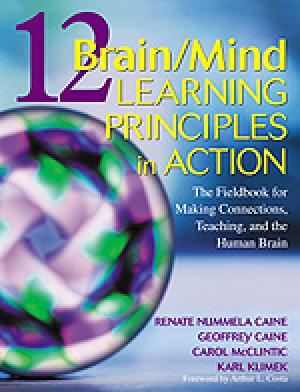
Step up to-and meet-the challenges of how to use the latest brain research for teaching, with practical concrete applications! This new book from the Caines and their colleagues will introduce new readers to their renowned 12 organizing principles for how the brain learns and how to use that knowledge for student learning. For those hundreds of thousands already using the Caines' groundbreaking work in their schools, this fieldbook will bring the latest research on the brain and its executive function and make the principles more practical than ever before for classroom application. 12 Brain/Mind Learning Principles in Action is grouped around key teaching and learning fundamentals: * Climate for learning * Instruction * Student processing (From the Publisher)
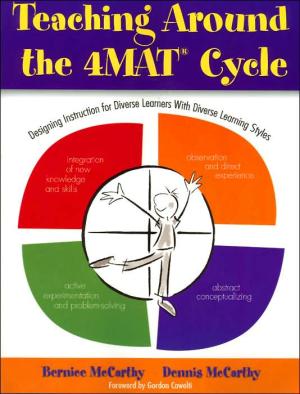
From the Publisher Learning styles are linked to preferences in the ways people perceive and process experience. Bernice McCarthy's unique 4MAT cycle is a brain-based teaching method that emphasizes diverse learning styles, honors learner individuality, teaches concepts as well as facts, and improves student thinking and performance on traditional as well as high-stakes assessments. With 25+ years of field testing and field use supporting its effectiveness, the 4MAT method uses a 4-quadrant cycle of learning that begins by engaging learners through direct experience, moving them toward: Reflective observation, Abstract conceptualizing, Active experimentation and problem-solving, Integration of new knowledge and skills. Learning happens as we unite our experiences and their meaning with actions that test those meanings in the world. This exciting new resource offers schools a powerful tool to enhance teaching and learning for students with all learning styles, backgrounds, and preferences.
From the Publisher Educators expect learners to solve problems, think critically, communicate effectively, and collaborate well. These complex processes require young learners to engage in active learning and to understand that their own experience is the foundation for new learning. They also require teachers to move from the traditional role of "sage on the stage" to the new role of "guide on the side." Constructivist Learning Design offers teachers a six-step framework for lesson planning and assessment: * Situation: develop goals, tasks, and curriculum standards * Grouping: group students and materials, and use cooperative learning * Bridge: recall prior knowledge using students' cognitive maps, skills, values, motivation, and expectations * Task: use higher-level thinking skills and problem-based learning * Exhibit: arrange student portfolios and work samples * Reflection: synthesize critical thinking and knowledge With clear classroom applications and ready-to-use planning templates, this research-based resource guides teachers through the complex process of aligning constructivist learning events with standards-based curriculum. Engage students in tasks, help them think for themselves, and support them in making meaning of their learning.
From the Publisher This is the thoroughly revised and updated second edition of the best-selling book Exploring Leadership. The book is designed to help college students understand that they are capable of being effective leaders and to guide them in developing their leadership potential. Exploring Leadership incorporates new insights and material developed in the course of the authors' work in the field. The second edition contains expanded and new chapters and also includes the relational leadership model, uses a more global context and examples that relate to a wide variety of disciplines, contains a new section which emphasizes ways to work to accomplish change, and concludes with concrete strategies for activism.

These essays come from scholars in a wide variety of fields: not just theology, but law, literature, political science, education, and philosophy. The essayists are teacher-scholars who genuinely seek to live out the sometimes-competing vocations of professor and believer. Though most of them teach in church-related institutions, they not only affirm the need for a clear theological vision on which to base institutional and pedagogical planning; they also stress the importance of diversity, pluralism, and true academic freedom. (From the Publisher)

From the Publisher This book gives voice to the experiences of women of color - women of African, Native American, Latina, East Indian, Korean and Japanese descent - as students in pursuing terminal degrees and as faculty members navigating the Academy, grappling with the dilemmas encountered by others and themselves as they exist at the intersections of their work and identities. Women of color are frequently relegated - on account both of race and womanhood - into monolithic categories that perpetuate oppression, subdue and suppress conflict, and silence voices. This book uses critical race feminism (CRF) to place women of color in the center, rather than the margins, of the discussion, theorizing, research and praxis of their lives as they co-exist in the dominant culture. This book makes salient three characteristics of critical race feminism. Just as it is places emphasis on the application of theory to real life issues, the authors' narratives address concerns about the academic community, home, and family. Just as CRF supports a discourse of resistance, the book provides a forum for different voices as multi-representations of the counterstories against the acceptance of the dominant culture and the status quo. And, finally, the contributors' stories reflect CRF's emphasis on narrative to deepen the understanding of their lives as women of color. The first part of the book addresses the issues faced on the way to achieving a terminal degree: the struggles encountered and the lessons learned along the way. Part Two, Pride and Prejudice Finding Your Place After the Degree, describes the complexity of lives of women with multiple identities as scholars with family, friends,and lives at home and at work. The book concludes with the voices of senior faculty sharing their journeys and their paths to growth as scholars and individuals. This book is for all women of color growing up in the academy, learning to stand on their own, taking first steps, mastering the language, walking, running, falling and getting up to run again, and illuminates the process of self-definition that is essential to their growth as scholars and individuals.

Chronicles the development of the intellectual culture of the Western university and proposes an approach to university education that keeps faith with central Christian doctrines. (From the Publisher)

High-performance mentors are not born. Even experienced educators need training in order to provide constructive support to entry-year teachers. James B. Rowley's mentoring framework has been used to successfully train thousands of teachers to acquire the six essential behaviors of high-performance mentoring: committing, accepting, communicating, coaching, learning, and inspiring. With more than twenty years of experience in training mentor teachers, Rowley blends real-life stories with established research to help readers * Understand mentoring as a performance continuum with escalating developmental stages * Improve assessment, communication, and coaching skills * Reflect on the mentoring process and analyze mentoring relationships * Utilize mentoring as a pathway to personal and professional growth Designed for both experienced and novice mentor teachers, this book will also be an enormously useful resource for mentor program coordinators, trainers, staff developers, and principals who want to assure that participants grow in their teaching practice as a result of the mentoring experience. (From the Publisher)
Wabash Center Staff Contact
Rachelle Green, Ph.D.
Associate Director
Wabash Center
greenr@wabash.edu