Resources
Key Findings from the First National Longitudinal Study of Undergraduates' Spiritual Growth, conducted by the Higher Education Research Institute (HERI) at UCLA www.spirtuality.ucla.edu
Two troublesome portraits of religious studies professors often exist in the minds of some students at any given time: the Guru, or wise spiritual teacher, and the Deceiver. These metaphors capture student perceptions of us that may be ill-informed and beyond our control. We will examine and compare how our own chosen metaphors for teaching – theological typologist and neutral enthusiast – respond creatively to the unchosen metaphors of guru or deceiver. We cannot avoid being cast as gurus/deceivers, but we can discern how our own metaphors for teaching engage "unchosen" student metaphors for us. This exercise can enhance our self-awareness about our own normative agendas in the classroom, and help to sharpen colleagues' conversations about our sometimes differing assumptions regarding the discipline and teaching of religious studies.
Teaching a required introductory Bible course to non-majors at a church-related college presents a number of pedagogical challenges. When considering how to teach such a course in the context of concerns common to the liberal arts, I find myself reflecting on authority. My thoughts on the teaching of this course in my own context are organized around authority understood as a developmental issue, an educational issue, and a religious issue. In each case, I seek to use my discipline and the primary and secondary materials of the course as occasions for the development of capacities that will contribute to the life of students as critical thinkers, creative problem-solvers, and responsible global citizens.
Journal Issue.
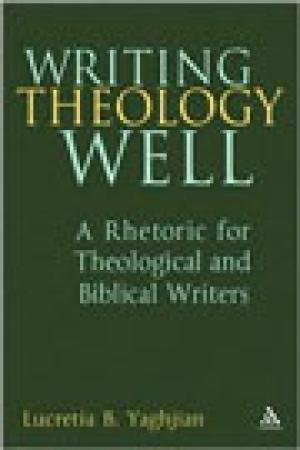
In its creative integration of the disciplines of writing, rhetoric, and theology, Writing Theology Well provides a standard text for theological educators engaged in the teaching and mentoring of writing across the theological curriculum. As a theological rhetoric, it will also encourage excellence in theological writing in the public domain by helping to equip students for their wider vocations as writers, preachers, and communicators in a variety of ministerial and professional contexts. (From the Publisher)
University teaching and learning take place within ever more specialized disciplinary settings, each characterized by its unique traditions, concepts, practices and procedures. It is now widely recognized that support for teaching and learning needs to take this discipline-specificity into account. However, in a world characterized by rapid change, complexity and uncertainty, problems do not present themselves as distinct subjects but increasingly within trans-disciplinary contexts calling for graduate outcomes that go beyond specialized knowledge and skills. This ground-breaking book highlights the important interplay between context-specific and context-transcendent aspects of teaching, learning and assessment. It explores critical questions, such as: What are the ‘ways of thinking and practicing’ characteristic of particular disciplines? How can students be supported in becoming participants of particular disciplinary discourse communities? Can the diversity in teaching, learning and assessment practices that we observe across departments be attributed exclusively to disciplinary structure? To what extent do the disciplines prepare students for the complexities and uncertainties that characterize their later professional, civic and personal lives? Written for university teachers, educational developers as well as new and experienced researchers of Higher Education, this highly-anticipated first edition offers innovative perspectives from leading Canadian, US and UK scholars on how academic learning within particular disciplines can help students acquire the skills, abilities and dispositions they need to succeed academically and also post graduation. Carolin Kreber is Professor of Teaching and Learning in Higher Education and the Director of the Centre for Teaching, Learning and Assessment at the University of Edinburgh (From the Publisher)
Reflective practice has moved from the margins to the mainstream of professional education. However, in this process, its radical potential has been subsumed by individualistic, rather than situated, understandings of practice. Presenting critical perspectives that challenge the current paradigm, this book aims to move beyond reflective practice. It proposes new conceptualisations and offers fresh approaches relevant across professions. Contributors include both academics and practitioners concerned with the training and development of professionals. Definitions of reflection (which are often implicit) often focus on the individual's internal thought processes and responsibility for their actions. The individual - what they did/thought/felt – is emphasised with little recognition of context, power dynamics or ideological challenge. This book presents the work of practitioners, educators, academics and researchers who see this as problematic and are moving towards a more critical approach to reflective practice. With an overview from the editors and fourteen chapters considering new conceptualisations, professional perspectives and new practices, Beyond Reflective Practice examines what new forms of professional reflective practice are emerging. It examines in particular the relationships between reflective practitioners and those upon whom they practise. It looks at the ways in which the world of professional work has changed and the ways in which professional practice needs to change to meet the needs of this new world. It will be relevant for those concerned with initial and ongoing professional learning, both in work and in educational contexts. (From the Publisher)
Has higher education been transformative over the last three decades? Miram David’s question is double-edged, based on her educational experience and her social research. What influences have second wave feminists, drawing on feminism as the key social movement of the twentieth century had on the pedagogies and practices in global higher education? As aspiring academics, their aims were for gender and social justice through inclusive pedagogies in higher education or lifelong learning. Ideas about inclusive pedagogies have begun to percolate into forms of mass higher education in the 21st century, linked to widening access and participation in higher education. Yet the expansion of higher education and the knowledge economy has been more about transforming global labor markets than it has been about social or gender justice. Higher education has indeed expanded and afforded diverse opportunities for participation as students and as researchers or academics yet these transformations maintain systemic inequalities. (From the Publisher)
What's the problem with literacy at college? How might everyday literacy be harnessed for educational ends? Based on the first major study of literacy practices in colleges in the UK, this book explores the reading and writing associated with learning subjects across the college curriculum. It investigates literacy practices in which students engage outside of college, and teaching and learning strategies through which these can help support the curriculum. With insightful analyses of innovative practices, it considers ways of changing teaching practices to enable students to draw upon their full potential. Recent research work has challenged the myth of individual student deficit, arguing cogently that people have ‘funds of knowledge’ from diverse and vibrant cultural roots, and that these have been misguidedly disqualified by the education system. It has claimed that different ‘ways with words’ can provide valuable resources for learning. However, the empirical exploration of this claim has lagged far behind the theoretical debate. Improving Learning in College resolves this by showing the integrity and richness of the literacy practices of a significant population, not previously the focus of such research: those who take vocational and academic college courses in colleges. It addresses an issue which has not until now been developed within this research tradition: that of how these practices can not only be valued and validated, but mobilised and harnessed to enhance learning in educational settings. This book will interest all teachers, teacher-educators and researchers concerned with post-compulsory education and vocational education in compulsory schooling. (From the Publisher)
Praise for Harnessing America's Wasted Talent President Obama offered America and the world renewed hope for a better tomorrow. With decades of experience in alternative forms of higher education, Peter Smith grabs that optimistic spirit and seizes the moment to reveal to us the exciting age of Web-based teaching and learning, which is opening access to untold numbers of learners while harnessing the previously wasted talents of millions of people in America and billions around the world. Those seeking insights, a vision of the future, and a chance to join this educational revolution should look forward to Harnessing America's Wasted Talent. Anyone who wants to understand where American higher education is headed should read Harnessing America's Wasted Talent. Peter Smith's vision of the future of higher education is based on several decades of experience—at the national, state, and international levels. He brings a rare perspective that will interest students, educators, politicians, and those American business leaders who are worried about the future of our workforce and the health of our democracy. Harnessing America's Wasted Talent is a must-read for those of us concerned about the increasing economic and education gaps in our country. Peter Smith takes on an important American disconnect: the need for an educated workforce and the fact that most working Americans lack a college degree. Drawing upon his experience in higher education and politics, Smith dissects the problem and presents a contemporary, practical plan to enhance the learning capacity of our country. (From the Publisher)
Wabash Center Staff Contact
Sarah Farmer, Ph.D.
Associate Director
Wabash Center
farmers@wabash.edu