Resources
A special section of "Teaching Theology & Religion" with 7 essays that explore different issues and challenges in study abroad programs that involve the academic study of religion.
A special issue of "Teaching Theology & Religion" to mark the 10th anniversary of the journal and Dr. Lucinda Huffaker's decision to step down as the Center's director. The special issue examines a key virtue of the Wabash Center, hospitality: what the term means, how it is embodied in Wabash Center programs, how it contributes to excellence in teaching and learning, and the difference it makes in the lives of scholar‚Äêteachers, their institutions, and their guilds. In this way, the contributors provide a description of hospitality in and through the Wabash Center, and an assessment of its effects.

Like so many aspects of the online course, we must pre-plan student interaction and incorporate it into the course at the design stage. I find it helpful to distinguish between organizational interaction (exchanges that help learners understand, and thrive in, the structures of the course) and social interaction (ways that the instructor mediates social presence to learners and helps them do the same with the instructor and with one another). Here, I focus on organizational interaction. In a later post, I will focus on mediating social presence online. A running theme animating the following suggestions is "What do we owe our learners?" It's easy to get caught up in easy bashing on "entitled students," and it's true that learners are sometimes unskilled in knowing reasonable from unreasonable expectations in higher education (it's a weird environment!). But in our more measured moments, instructors acknowledge that we have obligations to our students, among which I include clarity of expectations and a willingness to admit the imperfections of our course designs. Pre-Term Communication: Interacting with learners online begins when class registration opens, months before the term begins. Learners considering your online course have a right to know what they are getting into. A syllabus for the online class is a learner's first chance to discern whether the class is a good fit. Before registering, a learner should know: information about required synchronous sessions: Zoom, Skype, Google Hangouts, etc. the shape, or "flow," of a typical week or unit; for example, "Readings are due Mondays," "Discussion forum posts are due Tuesdays with replies to peers by Fridays," "Short written assignments are due at the end of every three-week unit." the planned assignments and activities; these may be in brief "draft" form but must be reliable policies: participation policies, late work policies, disability/accommodation policies, academic integrity policies, instructor contact policies Don't stop at the registration point: email registered learners a month before the first day of the term, directing them to the syllabus and reminding them of first-week activities and requirements. Do it again at the two-week mark, and once more the day before the term begins. This is the time for potential students to weed themselves out. If your online class is not the right fit for a learner, better for everyone if they realize it now, rather than in the third week of your class! Weed now, or pay later. Which brings us to . . . Squeeze them out! This is a tough interaction, but necessary. If I am confident that all my registered learners have received the information they need about early-term expectations, then with a clear conscience I can employ a draconian first-week participation policy . . . and I do employ a draconian first-week participation policy. My reason for this is that (at least in my experience) there will be a few students who sort of drift in around the middle of the second week, or even later, now ready to start getting involved. Without exception (again in my experience), these learners will not prove to be a good fit in terms of meeting deadlines and accomplishing work according to instructions. By requiring learners to have participated in all activities during the first week (on penalty of an immediate withdrawal), these students are spared a likely failing grade, and these students will now NOT soak up a disproportionate block of the instructor's time and attention at the expense of other learners. Those who show up have a right to our time and attention, and students not yet prepared to succeed have a right to be dealt with honestly. Squeeze them out. Mid-term evaluations: In this instance, I mean "learners evaluating you." (Hopefully, your learners have been receiving early and frequent feedback on their own work from the instructor.) By allowing learners to evaluate their learning experience mid-term, and by responding promptly and honestly, you communicate to learners that their experience matters. Even small "mid-course corrections" in response to learner evaluations can pay off large dividends in the form of student goodwill . . . right at the time in the calendar when learners and instructors alike are prone to grow frazzled and, shall we say, disenchanted with one another. Of course, also designed into the course will be the modes and means of interactions: emails, video or audio lectures, remote office hours, possible synchronous sessions, social media, and so on. I will address these in a later post on mediating social presence in the online course.

Many teachers have had cause in the last few years to ponder questions around teaching in a “post-truth” culture. How do reading, writing, and thinking change in a world in which groups cannot or will not agree on essential facts and rules of evidence? How can we teach meaningful reading in an overwhelmingly information-rich landscape? How can we heal the divisiveness that pervades so much of our culture, and how can we help students discern true from false? This book is written primarily for instructors in first-year college writing courses, but much of it will prove useful to frustrated teachers in any discipline. It does not give many specific recommendations for classroom strategies, but it does set out thoughtful ideas about how to think about teaching reading. The book begins with a chapter on “theoretical first principles.” Chapter 2 considers the ways in which standardized tests (and teachers in turn) encourage an unthinking reverence for text by dismissing the role of the reader. Carillo provides convincing evidence of negative outcomes from this approach. These two chapters set the stage for an argument in Chapter 3 about reading and writing as embodied, affective acts, as this writer is firmly against the devaluing of emotion and engagement so common in a world that prizes objectivity. In Chapter 4, Carillo argues that modeling and imitation have been given short shrift in reading instruction. She gives several useful tips for developing imitative exercises that help students see good reading and writing practices, and she especially trumpets the power of annotation, illustrated with a case study from her own teaching. The problems highlighted in Chapter 5, specifically targeting writing and composition instruction, are common to other fields as well: focus on reason over emotion; focus on traditional essay forms; and lack of focus on psychological studies that can enhance both teaching and learning. This book’s title promises more than it delivers, although it delivers a lot. Carillo’s insistence on redirecting students away from claims and argumentation and “toward stylistic elements that contribute to a text’s meaning” (41) will strike many teachers trained in other modes as difficult to attain. “Reading for argument” is, for Carillo, a problem: students only read for a relatively simplistic argument and miss so much that could make them stronger readers, such as inquiring about the how and why, not just the what. Yet many teachers find that students can’t even read for argument, a fact this book glosses over. That said, a call to encouraging more affective and empathetic reading is timely and needed. The use of Peter Elbow’s doubting and believing game (47-50) will be familiar to many in religious studies, as will the call to look outside one’s own discipline for expertise. This book helps teachers think about ways to mitigate aspects of culture that revere text and steer students “away from the language of negotiation and compromise” (114).
Celebrating the Scholarship of Teaching P23-301 3:30 PM to 5:00 PM Convention Center-22 (Upper Level East) Join the editorial team of the new peer-reviewed, open-access, digital journal, The Wabash Center Journal on Teaching, for a forum celebrating the scholarship of teaching and learning. Authors of the inaugural issue (January 2020) will discuss their essays on teaching in the changing contexts of theological and religious studies. Share your ideas for publishing scholarship on teaching in an open-access, digital platform. Thomas Pearson,Wabash Center, Presiding
AAR & SBL Session Teach with Confidence: Self-Disclosure in the Classroom Doctoral StudentLuncheon P23-113 Saturday, November 23 - 11:30 AM to 1:00 PM Convention Center-22 (Upper Level East) Join experienced faculty leaders for lunch and conversation concerning self-disclosure in the classroom by students, by teachers. What is to be gained? What is risked? What might we consider as we discern appropriate levels and types of self-disclosure? We will begin with a buffet lunch at 11:30am and conclude at 1:00pm. Space is limited to 50 participants. Pre-registration is required. Send an email to Beth Reffett,reffettb@wabash.edu Brian K. Bantum, Garrett-Evangelical Theological Seminary, Panelist Katherine Turpin, Iliff School of Theology, Panelist Wabash Center events at AAR & SBL Annual Meetings Wabash Center events at the ETS Annual Meeting

I distinctly remember what my husband said when he found me typing an email to a student in the middle of the night, the glow of my laptop illuminating my face in the darkness: “You need to set better boundaries.” Suffering from insomnia–whether it was in the late stages of pregnancy or the first year of night feedings, I can’t remember–I rationalized my behavior by saying that I was being productive since I was up already, and that the student seemed genuinely distraught by the state of their paper in light of a pressing deadline. In fact, his words resonated profoundly with my own sense of being out of balance. Online teaching can blur the boundaries between our work and our lives. People readily remark that online courses take a long time to design and develop, but less time to administer. In other words, they are more frontloaded than face-to-face courses. However, communication and interaction with students over email, Skype or Zoom, or even face-to-face can also place considerable demands on our time during the course of the semester. Because we can virtually correspond anytime and anyplace, it is easy to find oneself replying to students during times that one would not even entertain the possibility of a face-to-face meeting. An added pressure is that online students consider prompt responses and feedback from their instructor crucial and an indication that they care. On their evaluations students report greater satisfaction when they receive prompt replies to their emails. Yet we do a disservice when we reply as soon as we see their email, regardless of the time of day. Although this might create a greater sense of satisfaction on the part of our students, it fuels the idea that instructors are constantly “on call” and undermines their own capacity to delay gratification, which is a crucial skill for self-regulated learning. Moreover, when they see that we have emailed in the middle of the night, they may conclude that it’s all right to prioritize other things over sleep, rest, and wellbeing. We lose the opportunity to model to our students a more balanced, mindful approach to our communication and interaction. Mindfulness encourages us to cultivate an embodied presence, receptivity, and awareness of ourselves and our surroundings, so that instead of immediately reacting to what we experience, we can instead create space for a more thoughtful response. We may overlook our bodies as we interface with digital devices and screens, but as Linda Stone has observed through the phenomena of “email apnea” – the temporary absence or suspension of breathing, or shallow breathing, when doing email (https://www.huffpost.com/entry/just-breathe-building-the_b_85651 )– our online interactions have physical, emotional, and cognitive ramifications. By immediately replying to students’ emails, I was failing to address my own sleep habits, and I was not giving the space for students to try to resolve their problems by themselves. In the case of students who had clearly procrastinated and emailed me an hour or two before a deadline, one could even argue that I was encouraging bad habits. Aiming for a quick turnaround, I was being reactive rather than responsive. A more mindful approach would have aligned my online communication with the expectations laid out in my syllabus, where I explain that email is my preferred method of contact, and that they should expect a reply within 24 hours. Those parameters allow for balance: one can establish hours to be offline. Admittedly, we may still find the need to accommodate students even when it impinges on our personal lives. Once I found myself emailing back and forth with a student, trying to clarify the expectations of the final project, when he suddenly asked, “Can we talk over the phone?” Although I was at my parents’ house, I felt bad and agreed to call. Bracing myself for the potential of a half-hour interruption, I dialed his phone number. After responding to various questions I hung up and looked at my phone. It had taken less than ten minutes. This made me realize that we should take advantage of multiple channels of communication with our students. In another case, a student asked if we could meet face-to-face to discuss his ePortfolio for the course. We sat together looking at his laptop, and he scrolled through some of the ePortfolio pages to ask about my comments and suggestions. Again, within a very short span of time, I was able to address all of his concerns . . . and meet the student in person. These kinds of interactions with students–over the phone, via Zoom or Skype, or in person–not only show that we care about our students, but they contribute to a greater sense of embodied presence. Although I still have a long way to go, I have found myself trying to be a more mindful online teacher, for the sake of both myself and my students.
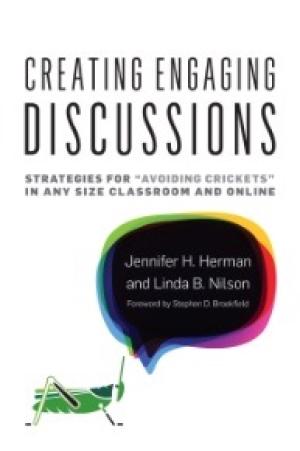
In the preface to their book, Herman and Nilson note that there are not many book-length treatments of discussion as a teaching method; the relative few that exist focus on student participation and are primarily oriented toward small face-to-face classrooms. Other books feature discussion as one tool among many in the teacher’s toolbox, and again focus on getting students to talk. But, as Herman and Nilson write, “Talk alone is cheap” (xxiv). The fact that students are participating in a discussion does not necessarily mean that they are actually learning. In addition to questions of participation, treatments of discussion as a way of learning also need to take into account the variety of classrooms in which students are learning: large and small, face-to-face, online, and blended. This is what Herman and Nilson set out to do. Chapter one lays out three common challenges of discussion in both online and face-to-face classrooms: inconsistent or uneven student engagement, lack of adequate connection between course goals and discussion content or process, and lack of assessment. Chapters two and three focus on student behavior, chapter four suggests a variety of strategies for ensuring that discussions advance learning, and chapter five details ways to assess discussion both for skillful student engagement and for clear connection to course content. Chapters six through thirteen are case studies, written by a variety of practitioners and addressing a variety of discussion delivery systems (face-to-face, online, and blended) and levels (undergraduate, graduate, and professional). The final chapter, written by Herman and Nilson, provides writing prompts, discussion questions, and workshop ideas that both teachers themselves, and those charged with the professional development of teachers, could use to engage with the book’s contents. Like many of Nilson’s previous books, this one is packed with information. As a practitioner, it is tempting to grab one or more of the discussion activities referenced in the quick guide at the front of the book and then return the book to the shelf. Doing so is a mistake precisely because of one of the ideas this book successfully advances: the need to align discussion content and process with course learning goals. This emphasis on alignment is one of my main learnings from the book, and one I will need to keep pondering and experimenting with. Each teacher must consider her course content, delivery system, institutional objectives and constraints, and student population in wisely selecting and applying discussion tactics to her particular circumstances. If I have one suggestion for the authors of this book, it might be to put the quick reference at the end to underline this point. I will confess that when I picked up the book, I was dubious about the value of the case study chapters for my work as a theological educator. What is the relevance of collaborative autoethnography to a class on Christian worship, or of course-based scientific research to a class on Christian formation? As I continued reading, however, the case studies underlined two of Herman and Nilson’s theses: the need for and value of learning from others, even when their circumstances are different than ours, and the benefits of a deep dive into a tactic rather than a quick ransack of possible takeaways. So having finished reading the book, I plan to read it again – this time with colleagues, and over time.

Justice is one of those ideas that has captured our imaginations for generation upon generation; yet it is still a contested notion. Collectively, systemic racism, sexism, classism, homophobia, white supremacy, and a judicial system that is lenient on “white collar/white male” crime, while vengeful upon the poor and minoritized people, provide ample evidence that justice for some is not justice for all. For these and other reasons, I need my students to be articulate about the notion of justice. It is not enough to “believe in” the idea. It is not enough to agree with it intuitively or “in your heart.” Education as a practice of freedom, as a practice of transgression, as a practice of re-humanization, is the theory I teach in my graduate level introductory course. This course insists that the ability to articulate the theories of justice, regardless of personal experience or personal belief, is a pedagogical necessity. It is the rare student who enters my introductory course able to speak the language of liberative pedagogy or to talk about the connection between education and social transformation. This is why they are learners–there are important things which they do not yet know and which they cannot articulate, but which we can teach them. My pedagogy of justice is not so interested in teaching skills of “critical thinking.” Most of my students have families, are gainfully employed, and have responsibilities in church as well as community. Many own their own businesses, provide support for several generations in and beyond their households, and are looking to religious leadership as a second or even third career. By the time they reach my “Introduction to Educational Ministries” course they have demonstrated considerable ability to think critically, to problem solve, to engage successfully in tactics of survival. Rather than “critical thinking,” I want to teach my adult learners methods of power analysis necessary for the summoning of moral courage in a society steeped in body politics, violence, and systemic hatreds. I want my students to be praxis thinkers, able to analyze injustice and articulate justice in an unjust society. They must be able, in their own communal context, to analyze white supremacy and patriarchy in its myriad expressions. The healing of their community and the restructuring for a more equitable society depends upon their ability to articulate justice. What I stress in my course is the ability to articulate what justice actually entails in the world. Simply feeling it, believing it, desiring it, hoping for it–just won’t do. The power is in speaking it. Have you ever known something but could not articulate it? You thought you understood it, but did not know the words, the vocabulary, the way to convey the basic concepts with depth? Sometimes, as a consequence of complex experiences, you may find your ability to describe the learnings of that experience to be limited or incomplete. In order to give full voice to your experience, as well as the insights gained from that experience, drawing on the collaborative power that emerges from sustained conversations is a key. Equally, having a firm grasp upon basic theories of justice making and moral courage are imperative. Being able to articulate theories of justice provides a hermeneutical mirror for analysis of, and meaning-making from personal experiences and perspectives. Finding ways to assist my students with articulating theory and helping them order the learnings of personal experience entails exposure to new vocabulary and interrogation of basic concepts. Personal experience can provide new insights, new understanding of the age-old problem of injustice when communal-reflexive habits are incorporated as a way to animate and elucidate theory. Because, of course, theory and practice are two-sides of the same coin. On the first day of the course, then reinforced in each subsequent session, I tell my students to pay attention to the argument of the authors we are reading. The focus of reading is not so much deciding if they “like it or not,” but noticing the authors’ use of vocabulary, basic concepts, and illustrative examples and narratives. I tell them to learn these funky words and use them in and out of class. Once new vocabulary is mastered, the ability to conceive the basic concepts and the ways these concepts create the theory is more evident. I tell them to be able to map the basic concepts of the theory because all basic concepts do not function in the same way to create the theory. When they look puzzled, I teach them concept mapping. Learning to play with theory for praxis is a mighty challenge. I have, over the many years, devised this mid-term learning exercise to assist my students in articulating the basic concepts of the theory we study: Step One - I email, before the class session, and instruct my students to be able to access in class all the readings, all their notes taken, and all the assignments graded thus far. In other words, bring all you stuff! Step Two - Once we are gathered in class, I tell them to get out all of these materials and base any group participation upon our conversation since day one of our class. In other words, do not talk off the top of your head, focus upon what we have been discussing all semester. Step Three - I divide the class into small groups. I inform the groups they have an hour to collaboratively write 10 basic concepts of the theory of liberative pedagogy. When the anxiety in the room spikes, I inform them that they are to use all the materials they brought to class. Sometimes the anxiety lowers and sometimes not. Step Four - I say, “On your mark–GO!” I do not tell them it is a mid-term exam, but it is. Step Five - While the groups are working to articulate their lists of basic concepts, my teaching assistant sets-up the computer so there is a blank page projected on the screen for all to see. The teaching assistant, during the report-in by the small groups, will record each of the concepts I approve to be written on our class list. Step Six - After the hour, I reconvene the groups for our “round-robin report-in.” Our aim is to take the lists from all the groups and create one list of basic concepts that we can ratify as a class. We refine the concepts during the group report-in through our conversation and through my editing. A member from one of the small groups reads aloud one basic concept from the list they created when it is their turn. Groups will have multiple turns but will report-in only one concept at a time. If, when the one concept is shared aloud, the concept sounds reasonable and resonates with our collective understanding (and my listening ear), then the teaching assistant records the draft of the concept as read for all to see. Once that concept is typed on the screen, I ask if any other group has a similar concept. If so, we use the other group’s work to wordsmith the concept on the screen until it is clear and strong. If not, we wordsmith as a class. Once a concept is refined to my satisfaction, we move to the next group to read aloud one basic concept from their list. We continue with the “round-robin report-in” until all the groups have exhausted all the concepts they recorded during their small group collaboration and until we have one common, sound list of basic concepts refined on the screen. This takes about an hour. Step Seven - I provide a list of basic concepts from a previous course as a final way to strengthen our collective work. I invite the class to look through the list in order to add, reword, or strengthen the new list we have just drafted. There are always additions, edits, and re-wording to strengthen the list we have just created. Students like seeing the work of other classes as it lets them know the complexity of the task of articulation. Step Eight - I ask, referring to our list on the screen, “Does this list of basic concepts articulate the theory we are studying?” If yes, we celebrate our hard work. If no, we continue to work until we are satisfied with our articulation of basic concepts of emancipatory pedagogy. Step Nine - I email our list of basic concepts to each student. Of course, my students’ ability to excel at this exercise varies from class to class. Most fascinating is that, from year to year, no two lists of basic concepts have ever been the same while still capturing the crux of the theory. Every class has found their own way of articulating, from their own unique perspectives and experiences, the basic concepts. I am not looking for an essentialist or universal list of basic concepts. I am looking for their rendition. We say a learner-centered education nurtures, kindles, and coaxes students into voice. With voice comes the responsibility of agency and service. Teaching toward voiced students is teaching the ability to speak articulately, eloquently, and intelligently about the issues of oppression, hegemony, violence and captivity–and not just passionately, without substance. Coming into voice is hindered by class sessions riddled with self-centered, pseudo-psychological moments of students filibustering through personal stories and anecdotes. Learner-centered teaching focuses upon the learner being able to articulate new ideas, new theories, new concepts, new vocabulary and hopefully, newly refined visions for a more just and equitable society.
A 2019 course by Madison Tarleton at the University of Denver/Illiff School of Theology introduces "students to the academic study of religion" through a survey of "early theorists and anthropologists as well as examine how these theories evolved over time."
Wabash Center Staff Contact
Rachelle Green, Ph.D.
Associate Director
Wabash Center
greenr@wabash.edu