Resources

Evaluations of faculty, both peer and student, can be a valuable part of the teaching landscape. Without doubt, faculty peers see strengths and weaknesses an individual instructor might not otherwise notice. Similarly, asking students about their experiences yields important insight into how learning happens--if one poses the right questions. Well-designed instruments interpreted with a critical eye by employers should be standard. For online instruction, however, particular downsides emerge that often prove dicey for faculty whose merit pay, tenure and promotion considerations, and, most especially, contract status depends, even if only in part, on the results. Online faculty must proactively design processes that handle the challenges of the online environment appropriately. While I have by no means mastered making evaluation of my online courses helpful, I do have observations about what I have tried and what I am planning to do to negotiate this required process more thoughtfully. When a peer evaluator lacks experience with online learning, or does not have familiarity with best practices for creating, mounting, and running an online course, the utility of the evaluation can come into question. Too often an idealized imagination of the traditional classroom remains the model by which a course is judged, rather than looking at the online experience for what it offers. If a university employs a given standard, like Quality Matters, for online course development, having peer evaluators look through that prism can be useful (https://www.qualitymatters.org/qa-resources/rubric-standards/higher-ed-rubric). The elements outlined provide clear criteria for assessment. Additionally, affording a faculty member the opportunity for peer evaluation from other online instructors or learning technology designers, even if they are not subject matter experts, can also be valuable. My university is now doing “teaching squares” for online instructors where we get together and work through one another’s courses. Seeing how other online faculty structure learning, and hearing feedback about my course format and assignments generated new ideas and helped me see where I needed to improve. Indeed, I would welcome a combination for peer evaluation that blended the insights of other online instructors with respect to the medium and what departmental colleagues would note about content. In the end, these options all stress one thing: that the purpose of peer evaluations ought to be to improve student outcomes by focusing on pedagogical practice. Regarding student evaluations, online instructors already know what studies demonstrate: online courses tend to yield lower ratings for faculty than face-to-face courses. This result likely stems, in part, from the lack of personal contact built up in weekly face-to-face meetings. Relationship mitigate against harshness in evaluation. But this also serves as a reminder that faculty presence, however it is accomplished in online classrooms, is important. While faculty members cannot completely alleviate the electronic remove, students still need to see faculty members in videos and engaged in discussion. They continue to want personal interactions, whether it be through email, text or video messaging, or phone calls. Structuring that contact into the course is vital. Returning work and inquiries promptly also proves important. The urgency of our online lives drives expectations here, so faculty must set up precise standards for communication and stick to them. Students might not be able to get an answer to a question posted at 2:00 a.m., for example, but it is not unreasonable to expect an answer to come within the next 12 hours in most cases. Many students evaluate faculty based on expectations about online courses and they often anticipate online options will be easier than face-to-face classes. Institutional messaging around online options can plant that idea. “Learn anytime, anywhere” our promotions might say, as if students can successfully navigate a class while strolling the aisles of the grocery store or pausing briefly between serving customers on the job. Faculty, therefore, must establish detailed instructions for assignments and specific rubrics for grading that can help learners understand what they need to accomplish. Still, disappointments in this arena can lead to frustrations expressed via end of term evaluations. More helpful options might include evaluations geared to each assignment, perhaps even completed when the assignment is turned in. What did a student learn from completing that task? How did the assignment relate to the goals of the course? If faculty include these elements in their course design, it can alleviate problems along the way and serve to remind students at the close of a term about what they achieved. Likewise, making students partners in their own learning asks for a higher level of reflective awareness. Foregrounding why a student enrolled in a course, what the student wants to gain by completing it, and how it might relate to overall academic goals can be a great starting exercise because it makes students clarify expectations. Instructors get a snapshot of why students show up and the opportunity to engage in discussion of where faculty expectations may correspond to those of students, where they may differ, and why. Modifications, even if only mental, can happen through this exercise and students can come to see faculty as partners and guides in learning as opposed to obstacles. In the end, we must acknowledge that evaluations will remain a fact of faculty life. How to make them less punitive–not focused on faculty shortcomings or “consumer satisfaction” measures–and more formative, aimed to achieving educational purpose, should always be a goal for faculty and administrators. Adapting the evaluation form to the delivery method of a course is a part of that process.
A 2018 course by Ingie Hovland at the University of Georgia investigates the origins, course, and contemporary forms of Christianity in Africa. Issues in missionology and colonialism are considered.
A 2018 course by Peter Gottschalk at Wesleyan University for religious studies majors on "how the discipline of the study of religion creates knowledge."
A 2018 course by Jill DeTemple at Southern Methodist University introduces "several social scientific approaches to the academic study of religion. We will investigate the history and use of anthropological, sociological, and psychological theory and method in relation to the study of religion, especially as these fields relate religion to broader cultural, societal, and physiological fields of knowledge."
A 2017 course by Jill DeTemple at Southern Methodist University provides "an introduction to a wide variety of religious traditions, communities and practices within the context of globalization" through modern methods in the field of the study of religion.
A 2017 course by Jill DeTemple at Southern Methodist University introduces "International Economic Development as a global social institution which often intersects with social constructions of gender, religious institutions, and religious world views."
A 2018 course by Jill DeTemple at Southern Methodist University is "an introduction to the principal questions and modes of argument that have shaped the Philosophy of Religion as an academic discipline." Specific ethical issues are analyzed.
A 2018 course by Jill DeTemple at Southern Methodist University "is designed as an intermediate course" to introduce students to "the border as a geographic and cognitive location rooted in history."
A 2019 course by Peter Gottschalk at Wesleyan University considers religion "as a phenomenon . . . the meaning of 'sacredness' & 'the sacred' and question their comparative use" in various religious traditions.
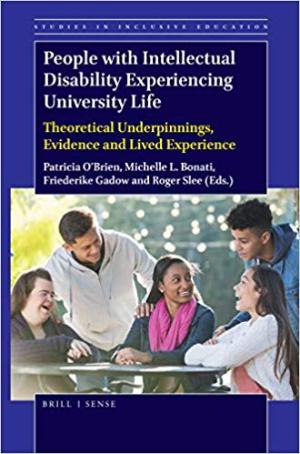
This book will introduce the reader to international perspectives associated with post-secondary school education for students with intellectual disability attending university settings. Examples of students with intellectual disability gaining their right to full inclusion within university settings are outlined, as well as the barriers and facilitators of such innovation. The four parts of the text will act as a reader for all stakeholders of inclusion at the university level. The first part examines the philosophical, theoretical and rights-based framework of inclusion. The second part provides evidence and insight into eight programs from across the globe, where students with intellectual disability are included within university settings. The third part consists of six chapters associated with the lived experiences of stakeholders in the programs profiled in Part 2. These stories are represented through the voices of former students of inclusive tertiary education initiatives, parents of adult children with intellectual disability who have participated in tertiary education, and lecturers who have taught students with intellectual disability as members of their courses. In the fourth part, critical issues are examined, including the role of secondary school counsellors, sustaining post university outcomes, transition from university to employment, inclusive university teaching approaches, and decision-making approaches to successfully implement a tertiary education initiative. The text concludes with a synthesis of the book themes and proposes calls to action with specific tasks to move the rhetoric of human rights into reality for adults with intellectual disability through an inclusive tertiary education.
Wabash Center Staff Contact
Rachelle Green, Ph.D.
Associate Director
Wabash Center
greenr@wabash.edu