Search Results
9338 results found using the following search criteria: .

Journal Issue.
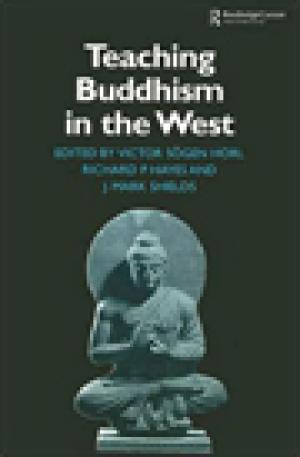
At a time when the popularity of Buddhism is at a peak in the west, both inside and outside the university setting, scholars and students alike are searching for guidance: How should Buddhism, a religion which is ultimately 'foreign' to western experience, be taught? How should one teach central Buddhist doctrines and ideas? Should one teach Buddhist practise; if so how? Until now, those interested in these and other related matters have been left with little guidance. Despite the wealth of scholarly publications on Buddhist traditions and the plethora of books about meditation and enlightenment, a serious lacuna exists in the sphere of teaching Buddhism. This book fills this lacuna, by providing a series of thematically arranged articles written by contemporary scholars of Buddhism throughout North America. Some of the major themes covered are the history of teaching Buddhism in Europe and North America (Reynolds, Prebish), the problem of representations of Buddhism in undergraduate teaching (Lewis), the problem of crossing cultural and historical divides (Jenkins), the place of the body and mind in the Buddhist classroom (Waterhouse), alternative pedagogical methods in teaching Buddhism (Wotypka, Jarow, Hori, Grimes) and the use of the Internet as a resource, and metaphor for teaching Buddhism (Fenn, Grieder). (From the Publisher)
Journal Issue.

Written by national expert on assessment, Peter Ewell, this paper reflects on the challenges of general education and assessment reform in the context of recent calls for accountability in higher education. The author argues that by focusing on abilities, alignment, assessment, and action, campuses can both improve general education programs and demonstrate student achievement of learning outcomes key to success in the 21st century. This book is ideal for general education or curricular reform committees and campus discussions about assessment, general education, and accountability. (From the Publisher)
Teaching narratively calls forth images of storytelling, simulation gaming, dramatization and ritual reenactments. But teaching narratively is more than a set of techniques that can be thrown into an eclectic bag of tricks. Narrative is a significant mode of human communication, a bearer of culture, and a potentially profound and far-reaching educational methodology.
The present study sought to investigate the perceptions of 300 ministers, 85 recent graduates from theological colleges, and 954 church members regarding (a) the effectiveness of ministry education, (b) priorities for ministry education, and (c) the acquired competencies of ministers. Participants were surveyed using the Inventory of Ministry Education Perceptions and Priorities (IMEPP), which displayed good validity and reliability in the study. Results of the study indicate that participants were largely satisfied with the effectiveness of ministry education and the acquired competence of ministers. However, on the whole, ministers and recent graduates were less satisfied with their ministry education and acquired competence than were church members. The study also identified significant differences between ministers, recent graduates and church members with regard to the priorities they perceived theological colleges should pursue.
Journal Issue.