Search Results
9336 results found using the following search criteria: .

Journal Issue.
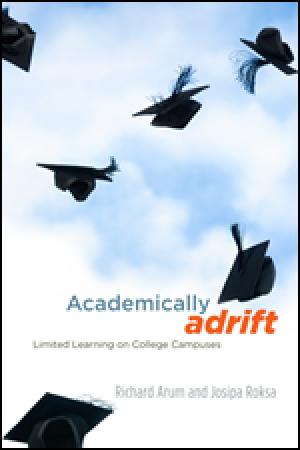
In spite of soaring tuition costs, more and more students go to college every year. A bachelor’s degree is now required for entry into a growing number of professions. And some parents begin planning for the expense of sending their kids to college when they’re born. Almost everyone strives to go, but almost no one asks the fundamental question posed by Academically Adrift: are undergraduates really learning anything once they get there? For a large proportion of students, Richard Arum and Josipa Roksa’s answer to that question is a definitive no. Their extensive research draws on survey responses, transcript data, and, for the first time, the state-of-the-art Collegiate Learning Assessment, a standardized test administered to students in their first semester and then again at the end of their second year. According to their analysis of more than 2,300 undergraduates at twenty-four institutions, 45 percent of these students demonstrate no significant improvement in a range of skills—including critical thinking, complex reasoning, and writing—during their first two years of college. As troubling as their findings are, Arum and Roksa argue that for many faculty and administrators they will come as no surprise—instead, they are the expected result of a student body distracted by socializing or working and an institutional culture that puts undergraduate learning close to the bottom of the priority list. Academically Adrift holds sobering lessons for students, faculty, administrators, policy makers, and parents—all of whom are implicated in promoting or at least ignoring contemporary campus culture. Higher education faces crises on a number of fronts, but Arum and Roksa’s report that colleges are failing at their most basic mission will demand the attention of us all. (From the Publisher)
Journal Issue.

Wild parties, late nights, and lots of sex, drugs, and alcohol. Many assume these are the things that define an American teenager’s first year after high school. But the reality is really quite different. As Tim Clydesdale reports in The First Year Out, teenagers generally manage the increased responsibilities of everyday life immediately after graduation effectively. But, like many good things, this comes at a cost. Tracking the daily lives of fifty young people making the transition to life after high school, Clydesdale reveals how teens settle into manageable patterns of substance use and sexual activity; how they meet the requirements of postsecondary education; and how they cope with new financial expectations. Most of them, we learn, handle the changes well because they make a priority of everyday life. But Clydesdale finds that teens also stow away their identities—religious, racial, political, or otherwise—during this period in exchange for acceptance into mainstream culture. This results in the absence of a long-range purpose for their lives and imposes limits on their desire to understand national politics and global issues, sometimes even affecting the ability to reconstruct their lives when tragedies occur. The First Year Out is an invaluable resource for anyone caught up in the storm and stress of working with these young adults. (From the Publisher)
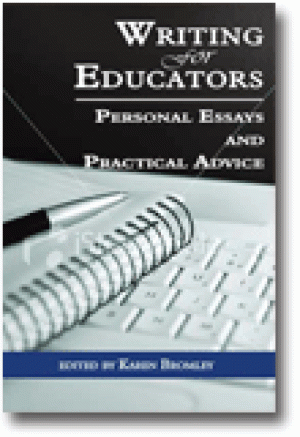
This book is for new faculty, graduate students, teachers, administrators, and other academics who want to write more clearly and have their work published. The essays focus on writing journal articles, dissertations, grants, edited books, and other writing in educational settings. The authors are educators who share their own first-hand experiences that provide novice writers with important knowledge and support in the quest for success in professional scholarly writing. A variety of authors discuss the writer's craft, including issues of voice, audience, planning,drafting, revision, conventions, style, submitting to journals, editorial review, and editing. (From the Publisher)
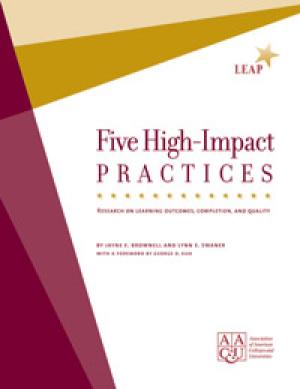
This monograph examines what educational research reveals about five educational practices: first-year seminars, learning communities, service learning, undergraduate research, and capstone experiences. The authors explore questions such as: What is the impact on students who participate in these practices? Is the impact the same for both traditional students and those who come from historically underserved student populations? The monograph includes a foreword by George D. Kuh, High-Impact Practices: Retrospective and Prospective, and recommendations for how to improve the quality of high-impact practices. (From the Publisher)
Praise for The Heart of Higher Education Palmer and Zajonc have issued a compelling call for change and renewal in higher education. They show us how colleges and universities can be transformed by taking a more integrated approach to teaching and learning that focuses on the inner lives of their students and faculty. At a moment when many are dreaming of an integrative form of higher education that unites intellectual rigor with compassion and love, Palmer and Zajonc invite us to engage in conversations designed to infuse the academy with meaning, purpose, and soul. For those who yearn to transform colleges and universities from sterile, vacuous spaces to places of hope, possibility, and respect for everything human, this is the book you have been waiting for. Parker Palmer and Arthur Zajonc call for a renewal of our commitment to inspiring deeper thinking and educating the whole person. This book should and will inspire debate about our larger purpose, about how we can go beyond the traditional silos in which we work for the sake of individual and institutional transformation. What should be at the center of our teaching and our students' learning? Palmer and Zajonc take up this simple but daunting question and provide the most solid ground yet on which to hold a conversation about the heart of our enterprise. They reimagine higher education in a way commensurate with the magnitude of our problems and offer us practical paths toward implementation. Integrative education is the most important reformation of higher learning since the rise of the modern university. This book can help us achieve it. (From the Publisher)
Praise for Cultivating the Spirit A groundbreaking study of the spiritual growth of college students.... The spiritual dimension of higher education has been explored from a variety of angles for the past twenty years, but not until now have we had a competent and comprehensive body of data organized around well-defined dimensions of this complex phenomenon. This is an essential book for anyone in academia who cares about the education of the whole person. An extremely important book for layperson and professional alike. A stunning wake-up call for higher education—highly recommended! Cultivating the Spirit makes a unique and important contribution to one of the least examined yet most fundamental questions about undergraduate education: how students acquire the values and convictions that help to give meaning and purpose to their lives.... The authors provide a wealth of valuable findings about this vital process and its effects on student achievement, well-being, and personal growth in college. The fruit of a decade of elegantly designed and compelling research, Cultivating the Spirit provides timely and significant data for reorienting the conversation about the relationships among intellectual inquiry, traditional academic values, and the formation of the inner life. Informative, clearly written, essential, and evocative reading for today's faculty across all institutions—public and private, secular and religious. (From the Publisher)
This essay describes a web site evaluation project which served as the final assignment for an undergraduate “Introduction to Religion” course. The essay discusses lessons learned from the design and implementation of this web-based research assignment over three consecutive semesters. It includes insights from an instructor and a reference librarian who collaborated on this project.
Contemplative Pedagogy is a new and sometimes controversial pedagogical practice. Faculty often have basic questions about how to implement the pedagogy in their classrooms, in addition to questions that challenge the educational value and appropriateness of the practice. Assembled here are the most frequently asked questions about Contemplative Pedagogy, with responses from six contemplative professors, each from a different institutional and philosophical location. The respondents are founding members of the Contemplative Studies Consultation of the American Academy of Religion. The diversity of views expressed by the respondents invites the reader to see that there is no single theory or praxis of contemplative pedagogy.