Resources
Professional societies in religious studies negotiate academic practices and confessional commitments. Here, Lester narrates one episode in the Society of Biblical Literature's understanding of "critical" biblical studies.
By “Decoding” what an expert does so that he or she does not get stuck at the bottleneck, we can spell out crucial operations, the “critical thinking” of a discipline.
Click Here for Book Review Abstract: This volume presents findings from recent research focusing on young people and the way they relate to religion in their education and upbringing. The essays are diverse and multidisciplinary - in terms of the religions they discuss (including Christianity, Islam and Sikhism); the settings where young people reflect on religion (the classroom, youth club, peer group, families, respective religious communities and wider society); the different perspectives which relate to religious education and socialisation (the teaching of RE, the role of teachers in pupils’ lives, the way teachers’ personal lives shape their approach to teaching, school ethos and social context, and the place and rationale of RE); the contexts within which the authors work (different national settings and various academic disciplines); and the methodology used (qualitative, quantitative and mixed-method approaches). The authors make important contributions to the debate about the role of religious education in the curriculum. They demonstrate the crucially important formative influence of religious education in young people’s lives which reaches well into their adulthood, shaping religious and other identities, and attitudes towards the ‘other’ - whatever that ‘other’ may be. This book was originally published as a special issue of the Journal of Beliefs & Values. (From the Publisher)
Click Here for Book Review Abstract: Religion, Education, Dialogue and Conflict analyses the European Commission-funded REDCo project, which addressed the question of how religions might contribute to dialogue or conflict in Europe. Researchers in education from eight countries – the UK, Estonia, France, Germany, the Netherlands, the Russian Federation, Norway and Spain – studied how young Europeans of different religious, cultural and political backgrounds could engage in dialogue in the context of the school. Empirical studies conducted with 14-16 year old students included them offering their own perspectives and analyses of teaching and learning in both dialogue and conflict situations. Although there were some different national patterns and trends, most students wished for peaceful coexistence across differences, andbelieved this to be possible. The majority agreed that peaceful coexistence depended on knowledge about each other’s religions and worldviews, sharing common interests and doing things together. The project found that students who learn about religious diversity in school are more willing to discuss religions and beliefs with students of other backgrounds than those who do not. The international range of expert contributors to this book evaluate the results of the REDCo project, providing examples of its qualitative and quantitative studies and reflecting on the methods and theory used in the project as a whole. This book was originally published as a special issue of the British Journal of Religious Education. (From the Publisher)
This interview was recorded in November 2012 in Jonathan Z. Smith's Hyde Park graystone. Professor Smith offers insights into how he thinks about his classroom teaching and his students' learning through descriptions of various assignments and classroom activities he has developed over more than forty years of teaching. The discussion ranges broadly over such topics as: how students read, the failure to adequately prepare graduate students as teachers, students' faith commitments, the use of newspapers (and humor) in the classroom, and the role of definition, de-familiarization, and critique of the study of religion in introductory classes. The discussion presents vivid glimpses into Jonathan Smith's teaching practice and his teaching persona, including the time a student brought a minister to class to do an exorcism because she thought he was the Devil.
While teaching a course on religion and consumer culture in the United States, the author was intensely preoccupied with holding the interest of her undergraduate students during class sessions. Inspired in part by the subject matter of the course, she reflects here upon the extent that her courses on American religion drew upon the semiotics of commercial entertainment. While acknowledging the limitations and distortions possible in thinking of the teacher as an entertainer, this paper explores the teaching metaphor of the Vaudevillian Performer, arguing that if put in context with the work on reception in cultural studies, it can be a helpful model in the classroom.
Journal Issue.
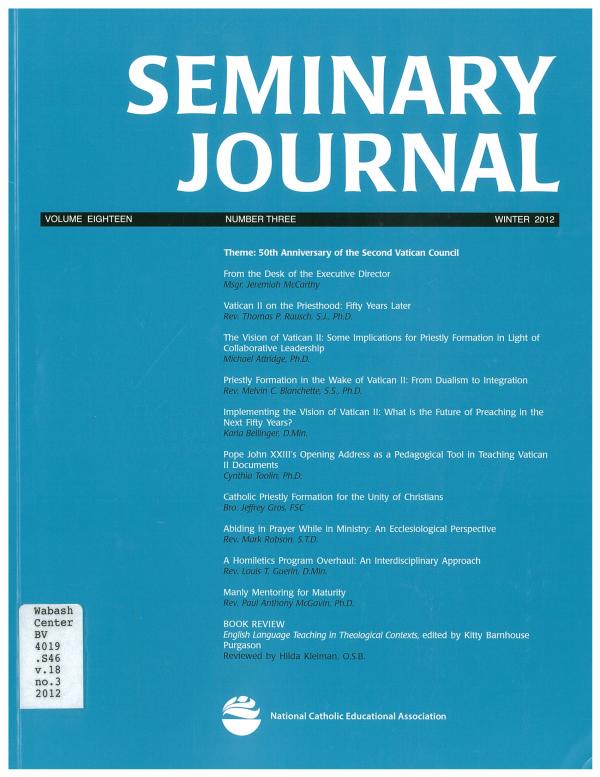
Journal Issue.
Offers a view on teaching Islam. Reason instructors do not look to Muslim scholarship; Role of the instructor in the modern university; Impact of the September 11, 2001 terrorist attack on teaching the religion.