Resources
Click Here for Book Review Abstract: Eugene V. Gallagher, Rosemary Park Professor of Religious Studies at Connecticut College, writes: ‘In a context where the general value of the Humanities has increasingly come under question by those who see a college education as necessarily being directly tied to the first job that students will have after they graduate, an ability to make a vigorous case about the contribution of studying the Bible to any college student’s education is crucial for any teacher’. This second collection of essays edited by Jane Webster and Glenn Holland seeks not only to promote the role of biblical studies in an undergraduate liberal arts education, but also to suggest strategies and approaches for teaching the Bible in a range of academic situations. Combining the theoretical and the practical, this volume will be another useful source of guidance and support for teachers of biblical studies at any point in their professional careers. (From the Publisher)
Click Here for Book Review Abstract: Teaching the Historical Jesus in his Jewish context to students of varied religious backgrounds presents instructors with not only challenges, but also opportunities to sustain interfaith dialogue and foster mutual understanding and respect. This new collection explores these challenges and opportunities, gathering together experiential lessons drawn from teaching Jesus in a wide variety of settings—from the public, secular two- or four-year college, to the Jesuit university, to the Rabbinic school or seminary, to the orthodox, religious Israeli university. A diverse group of Jewish and Christian scholars reflect on their own classroom experiences and explicates crucial issues for teaching Jesus in a way that encourages students at every level to enter into an encounter with the Hebrew Scriptures and the New Testament without paternalism, parochialism, or prejudice. This volume is a valuable resource for instructors and graduate students interested in an interfaith approach in the classroom, and provides practical case studies for scholars working on Jewish-Christian relations. (From the Publisher)
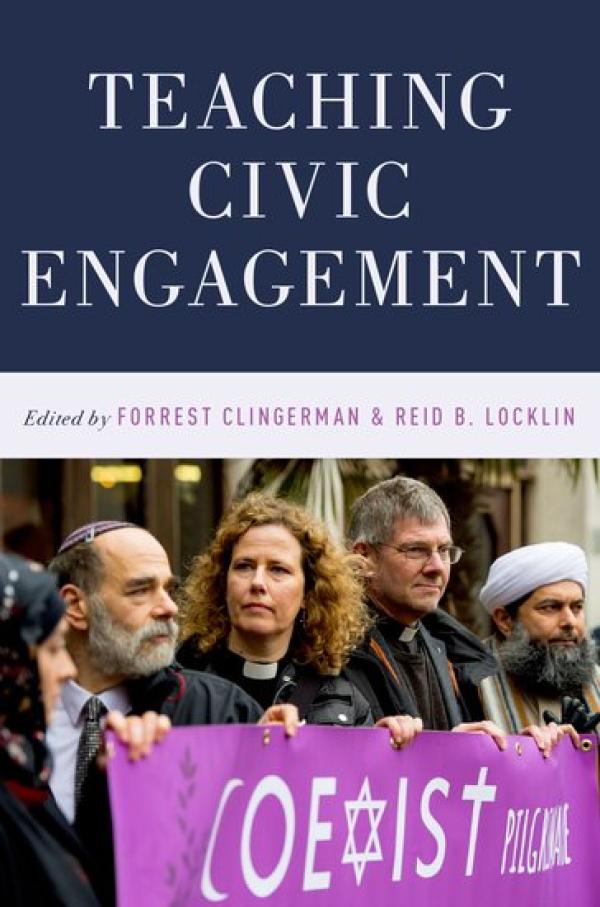
Click Here for Book Review Abstract: Using a new model focused on four core capacities-intellectual complexity, social location, empathetic accountability, and motivated action--Teaching Civic Engagement explores the significance of religious studies in fostering a vibrant, just, and democratic civic order. In the first section of the book, contributors detail this theoretical model and offer an initial application to the sources and methods that already define much teaching in the disciplines of religious studies and theology. A second section offers chapters focused on specific strategies for teaching civic engagement in religion classrooms, including traditional textual studies, reflective writing, community-based learning, field trips, media analysis, ethnographic methods, direct community engagement and a reflective practice of "ascetic withdrawal." The final section of the volume explores theoretical issues, including the delimitation of the "civic" as a category, connections between local and global in the civic project, the question of political advocacy in the classroom, and the role of normative commitments. Collectively these chapters illustrate the real possibility of connecting the scholarly study of religion with the societies in which we, our students, and our institutions exist. The contributing authors model new ways of engaging questions of civic belonging and social activism in the religion classroom, belying the stereotype of the ivory tower intellectual. (From the Publisher)
Click Here for Book Review Abstract: This volume explores the twenty-first century classroom as a uniquely intergenerational space of religious disaffiliation, and questions about how our work in the classroom can be, and is being, re-imagined for the new generation. The culturally hybrid identity of Millennials shapes their engagement with religious "others" on campus and in the classroom, pushing educators of comparative theology to develop new pedagogical strategies that leverage ways of seeing and interacting with their teachers and classmates. Reflecting on religious traditions such as Islam, Judaism, African Traditional Religions, Hinduism, Christianity, and agnosticism/atheism, this volume theorizes the theological outcomes of current pedagogies and the shifting contours of comparative theological discourse. (From the Publisher)
The “Make Your Own Religion” class project was designed to address a perceived need to introduce more theoretical thinking about religion into a typical religion survey course, and to do so in such a way that students would experience the wonder of theoretical discovery, and through or because of that discovery hopefully both better retain knowledge gained from the project and nurture within themselves the practice of thinking more analytically about religion (and other social and cultural things). Despite a number of challenges and unresolved questions associated with the project, it has proven relatively successful at introducing and provoking theoretical thinking about religion in a compressed period of time, without taking an inordinate number of class periods away from the survey itself. A brief description and analysis of the assignment is followed by four short responses.
This series of short essays considers the complex choices and decision-making processes of instructors preparing to teach, and continuing to teach, introductory courses in religious studies. In a paper originally presented in the University of Chicago's “The Craft of Teaching in the Academic Study of Religion” series, Russell McCutcheon explores a “baker's dozen” of such choices and the larger pedagogical problems with which they are entwined, ranging from classic questions of skill development and content coverage to philosophical concerns around students' identification with their topics of study and institutional concerns around governance and assessment. Aaron Hollander provides a brief introduction and four doctoral students at the University of Chicago Divinity School respond to McCutcheon's essay, widening its scope, testing its applicability, and interrogating its undergirding suppositions from the perspective of early-career educators in the field.
One page Teaching Tactic: using visual arts in the biblical studies classroom.
One page Teaching Tactic: a method for engaging students' religious questions in an Islamic Studies course
This essay explores classroom dynamics when students identify and connect their own painful experiences to structural racism or ethnocentrism exhibited in the Holocaust or parts of Jewish history. The intrusion of this proximal knowledge can be an obstacle to student learning. If engaged by professors, however, I argue that proximal knowledge can be a catalyst that promotes learning. Social scientific theory provides a useful lens for helping students to better grasp and contextualize both their old experiences and the new materials that are being taught in the course within the larger structural frames of race, religion, and ethnicity that they have selected, but may not fully appreciate. Reflective guided journaling is an essential part of the learning experience.
With the rapid growth and interest in food studies around the U.S. and globally, the original essays in this one-of-a-kind volume aid instructors in expanding their teaching to include both the "Teaching Food and Culture offers exciting, innovative pedagogical approaches to topics across the spectrum of the anthropology of food. Firmly grounded in the authors’ respective specialisms, collectively these chapters demonstrate the vital importance in the study of food of connecting multiple perspectives, theories and methods. The volume will be an indispensable resource for teachers in the anthropology of food and food studies. " - Jakob Klein, Department of Anthropology and Food Studies Centre, SOAS, University of London "As Food Studies courses multiply and growing numbers of students are eager to reflect critically on all things food, this book offers stimulating ideas for topics, readings, and assignments to instructors, both veterans and new to the field. The editors have gathered thoughtful contributions that reach out well beyond anthropology, providing useful pedagogical tools to all those who want to teach about contemporary society with and through food. " - Fabio Parasecoli, The New School latest scholarship and engage with public debate around issues related to food. The chapters represent the product of original efforts to develop ways to teach both with and about food in the classroom, written by innovative instructors who have successfully done so. It would appeal to community college and university instructors in anthropology and social science disciplines who currently teach or want to develop food-related courses. This book illustrates the creative ways that college instructors have tackled teaching about food and used food as an instructional device; aims to train the next generation of food scholars to deal with the complex problems of feeding an ever-increasing population; contains an interview with Sidney Mintz, the most influential anthropologist shaping the study of food. (From the Publisher)