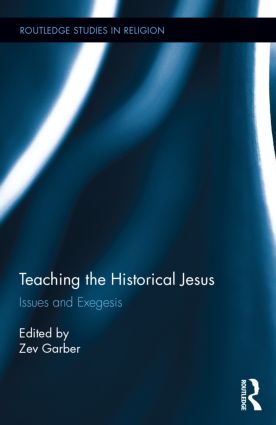
- Author
- Garber, Zev, ed.
- Publisher
- Routledge, New York, NY
- ISBN
- 9781138794610
- Table of Contents
-
Introduction (Zev Garber)
Section 1: Jesus in Undergraduate Education
ch. 1 Teaching Jewish Studies, Hebrew Scriptures and the Historical Jesus in the Context of Jewish Studies at a Two-Year Public College: Rationale, Objectives, Evaluation (Zev Garber)
ch. 2 Untangling Myths and Misconceptions: A Narrative of the Undergraduate Classroom (Rochelle L. Millen)
ch. 3 Jesus "in the Trenches": Pedagogical Challenges Posed by Teaching the Nazarene in the Context of Judaic Studies (Ken Hanson)
ch. 4 Teaching Jesus at the University of Alabama (Steven Leonard Jacobs)
ch. 5 Teaching about Jesus in a Catholic University (Richard L. Libowitz)
ch. 6 Teaching about Jesus and Early Christianity at US Rabbinic Schools (Joel Gereboff)
ch. 7 The Jewish Jesus: An Evaluation after Three Years (Herbert W. Basser)
ch. 8 Dialogue as Integral to Teaching about the Jewish Jesus (James F. Moore and Joseph Edelheit)
ch. 9 Between the Literary and the Historical Jesus: Teaching the Modern Jewish Writers’ Jesus (Neta Stahl)
Section 2: Some Issues in Teaching Jesus
ch. 10 Jesus the Jew: Who Says So? (Norman Simms)
ch. 11 Reflections on a Course: ‘Judaism and Early Christianity: The Parting of the Ways’—When? Where? Why? (Leonard Greenspoon)
ch. 12 Typical Christian Misunderstandings of Jesus and Judaism (Eugene J. Fisher)
ch. 13 Teaching Jesus in a Halakhic Jewish Setting in Israel: Kosher, Treif or Pareve? (Joshua Schwartz)
ch. 14 Jewish Artists and the Perception of the Crucifixion (Nathan Harpaz)
ch. 15 Jesus on Film: Cinema as a Tool in the Discovery of the Jewish Jesus (Penny Wheeler)
ch. 16 Gravitating to Luke's Historical Jesus: Help or Hindrance? (Michael J. Cook)
Section 3: Teaching Views on Jesus
ch. 17 Jesus, the Pharisees, and Mediterranean Manliness (S. Scott Bartchy)
ch. 18 Jesus as Sadducee and Pharisee: Teaching the Teacher in the Gospel of Mark (Peter Zaas)
ch. 19 Jesus as a Seditionist: The Intertwining of Politics and Religion in His Teaching and Deeds (Fernando Bermejo-Rubio)
ch. 20 Was Jesus a Pharisee? And Does it Matter? (John Pawlikowski)
Contributors
Bibliography
Index
Source Index
Click Here for Book Review
Abstract: Teaching the Historical Jesus in his Jewish context to students of varied religious backgrounds presents instructors with not only challenges, but also opportunities to sustain interfaith dialogue and foster mutual understanding and respect. This new collection explores these challenges and opportunities, gathering together experiential lessons drawn from teaching Jesus in a wide variety of settings—from the public, secular two- or four-year college, to the Jesuit university, to the Rabbinic school or seminary, to the orthodox, religious Israeli university. A diverse group of Jewish and Christian scholars reflect on their own classroom experiences and explicates crucial issues for teaching Jesus in a way that encourages students at every level to enter into an encounter with the Hebrew Scriptures and the New Testament without paternalism, parochialism, or prejudice. This volume is a valuable resource for instructors and graduate students interested in an interfaith approach in the classroom, and provides practical case studies for scholars working on Jewish-Christian relations. (From the Publisher)
Abstract: Teaching the Historical Jesus in his Jewish context to students of varied religious backgrounds presents instructors with not only challenges, but also opportunities to sustain interfaith dialogue and foster mutual understanding and respect. This new collection explores these challenges and opportunities, gathering together experiential lessons drawn from teaching Jesus in a wide variety of settings—from the public, secular two- or four-year college, to the Jesuit university, to the Rabbinic school or seminary, to the orthodox, religious Israeli university. A diverse group of Jewish and Christian scholars reflect on their own classroom experiences and explicates crucial issues for teaching Jesus in a way that encourages students at every level to enter into an encounter with the Hebrew Scriptures and the New Testament without paternalism, parochialism, or prejudice. This volume is a valuable resource for instructors and graduate students interested in an interfaith approach in the classroom, and provides practical case studies for scholars working on Jewish-Christian relations. (From the Publisher)