Resources
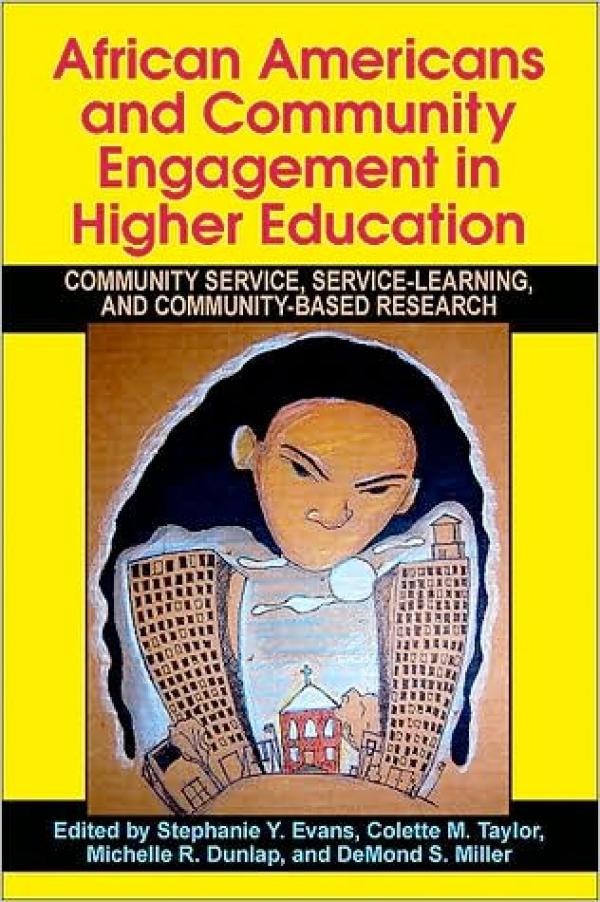
This book discusses race and its roles in university-community partnerships. The contributors take a collaborative, interdisciplinary, and multiregional approach that allows students, agency staff, community constituents, faculty, and campus administrators an opportunity to reflect on and redefine what impact African American identity-in the academy and in the community-has on various forms of community engagement. From historic concepts of "race uplift" to contemporary debates about racialized perceptions of need, they argue that African American identity plays a significant role. In representing best practices, recommendations, personal insight, and informed warnings about building sustainable and mutually beneficial relationships, the contributors provide a cogent platform from which to encourage the difficult and much-needed inclusion of race in dialogues of national service and community engagement. "This book validates the African proverb 'it takes a village to raise a child.' The topics are right on the mark and highlight the benefits of service-learning as an instrument of individual and community involvement and empowerment." - Festus E. Obiakor, coeditor of Culturally Responsive Literacy Instruction (From the Publisher)

What it is like to be a collegian involved in a Christian organization on a public college campus? What roles do Christian organizations play in the lives of college students enrolled in a public college? What are evangelical student organizations’ political agendas, and how do they mobilize members to advance these agendas? What is the optimal equilibrium between the secular and the sacred within public higher education? What constitutes safe space for evangelical students, and who should provide this space? This book presents a two-year ethnographic study of a collegiate evangelical student organization on a public university, authored by two “non-evangelicals.” The authors provide a glimpse into the lives of college students who join evangelical student organizations and who subscribe to an evangelical way of life during their college years. They offer empirically derived insights as to how students’ participation in a homogeneous evangelical student organization enhances their satisfaction of their collegiate experience and helps them develop important life lessons and skills. Ironically, while Christian students represent the religious majority on the campus under study, Christian organizations on this campus mobilize members by capitalizing on members’ shared sense of marginalization, and position themselves as cultural outsiders. This evangelical student organization serves as a safe space for students to express their faith within the larger secular university setting. The narratives and interpretations aim not only to enrich understanding of a particular student organization but more importantly to spark intellectual discourse about the valueof faith-based organizations within public higher education. The role of religion in public higher education, student involvement in the co-curriculum, and peer education are three examples of critical issues in higher education for which this idiosyncratic case study offers broad understanding. It’s All About Jesus! targets multiple audiences – both sacred and secular. For readers unfamiliar with evangelical collegiate organizations and the students they serve, the authors hope the narratives make the unfamiliar familiar and the dubious obvious. For evangelicals, the authors hope that the thickly described narratives not only make the familiar, familiar and the obvious, obvious, but also uncover the tacit meaning embedded in these familiar, but seldom examined subculture rituals. The authors hope this book spurs discussion on topics such as campus power and politics, how organizations interact with the secular world around them, and how members can improve their organizations. Additionally, this text urges secular readers in student affairs to consider the many benefits, as well as liabilities, of “parachurches” as co-curricular learning sites on campus. Lastly, given that the authors lay bare their methodology, their use of theory, and the tensions between their perspectives and those of the participants, this book will serve as a compelling case study for courses on qualitative research within religion studies, anthropology, sociology, and cultural studies fields. (From the Publisher)

The SAGE Handbook of African American Education is a unique, comprehensive collection of theoretical and empirical scholarship in six important areas: historical perspectives, teaching and learning, PK-12 school leadership, higher education, current issues, and education policy. The purpose of the Handbook is to articulate perspectives on issues affecting the participation and leadership of African Americans in PK-12 and postsecondary education. This volume also addresses historical and current issues affecting the education of African Americans and discusses current and future school reform efforts that directly affect this group. Key Features * Promotes inquiry and development of questions, ideas, and dialogue about critical practice, theory, and research on African Americans in the United States educational system * Makes significant contributions to the scholarship on African Americans in the broad context of U.S. education and society * Addresses the central question-in what ways do African Americans in corporate, private, and public positions influence and shape educational policy that affects African Americans? (From the Publisher)
How should you prepare for the first day of class? How can you encourage all students to participate in discussions? How do you ensure disabled students can take part in field work? Increasingly, universities are drawing from a less traditional group of students – international students, disabled students, part time students, and mature students. This book offers specific, practical advice on the issues that teachers encounter when teaching in a diverse classroom. Inclusion and Diversity highlights good practice for all students, and provides a helpful structure around the day-to-day experiences of staff and students as they make contact with each other. With reference to the international literature, and discussing some of the educational principles that underpin an inclusive curriculum, this book covers a wide range of useful topics so that teachers will have quick access to guidelines on different aspects of teaching and learning: o small and large group teaching o e-learning o work placements o students’ lives out of the classroom o personal tutoring o skills agenda o assessment o employability and further study Addressing a range of themes, including student age, ethnicity, disability, sexuality and gender, this book aids all practitioners in higher education today – particularly those new lecturers meeting their students for the first time – to develop a better understanding of the issues involved in teaching a diverse range of students. (From the Publisher)


This book dispels the myth that Black boys are synonymous with underachievement. It demonstrates how many progress into higher education, albeit against the odds, and offers solutions for policy and practice. There is a plethora of research focusing on the underachievement of Black boys. But little attention has been given to their positive achievement until this author's research on both sides of the Atlantic. The book follows black male students in the USA and UK who have successfully accessed higher education— at both elite universities (Harvard and Oxford) and less selective institutions. It sets out to establish the extent to which they have been exposed to the factors known to correlate with the underachievement of Black male youths, and to identify the factors that have led to their educational success and influenced their access to, and choice of universities. Part One sets the educational scene in each country. Part Two looks at the obstacles the students encountered, covering social class; parental social capital; racism and racial identity; and addressing the boys' own negative attitudes and behavior. Part Three unravels the factors leading to success, devoting attention to parental roles; positive encounters with schools, teachers and community; the influence of church; and the students' personal qualities and navigational smarts. Part Four reviews the boys' processes of choice and application to university and concludes with implications for educational policy and practice. Here is a book that can be used both as guide to policy development, and as a practical tool for use by parents, teachers and Black boys themselves to help gainaccess to higher education. (From the Publisher)
* Reveals continuing barriers to success for women students * Offers remedies that will benefit all students What are the realities behind recent press reports suggesting that women students have taken over higher education, both outnumbering males and academically outperforming them? Does women's development during college diverge from the commonly accepted model of cognitive growth? Does pedagogy in higher education take into account their different ways of knowing? Are there still barriers to women's educational achievement? In answering these questions, this book's overarching message is that the application of research on women's college experiences has enriched teaching and learning for all students. It describes the broad benefits of new pedagogical models, and how feminist education aligns with the new call for civic education for all students. The book also examines conditions and disciplines that remain barriers for women's educational success, particularly in quantitative and scientific fields. It explores problems that arise at the intersection of race and gender and offers some transformative approaches. It considers the impact of the campus environment—such as the rise of binge drinking, sexual assault, and homophobic behaviors—on women students' progress, and suggests means for improving the peer culture for all students. It concludes with an auto-narrative analysis of teaching women's studies to undergraduates that offers insights into the practicalities and joys of teaching. At a time when women constitute the majority of students on most campuses, this book offers insights for all teachers, male and female, into how tohelp them to excel; and at the same time how to engage all their students, in all their diversity, through the application of feminist pedagogy. (From the Publisher)
As societal expectations about attending college have grown, professors report increasing numbers of students who are unprepared for the rigors of postsecondary education—not just more students with learning disabilities (whose numbers have more than tripled, but students (with and without special admission status who are academically at-risk because of inadequate reading, writing and study skills. This book provides professors and their graduate teaching assistants—those at the front line of interactions with students—with techniques and approaches they can use in class to help at-risk students raise their skills so that they can successfully complete their studies. The author shares proven practices that will not only engage all students in a class, but also create the conditions—while maintaining high standards and high expectations—to enable at-risk and under-prepared students to develop academically, and graduate with good grades. The author also explains how to work effectively with academic support units on campus. Within the framework of identifying those students who need help, establishing a rapport with them, adopting inclusive teaching strategies, and offering appropriate guidance, the book presents the theory teachers will need, and effective classroom strategies. The author covers teaching philosophy and goals issues of discipline and behavior motivation and making expectations explicit classroom climate and learning styles developing time management and study skills as well as the application of "universal design" strategies. The ideas presented here—that the author has successfully employedover many years—can be easily integrated into any class. (From the Publisher)
The central concern of Diversified Theological Education, which includes Theological Education by Extension, is access. TEE and DTE models have made enormous progress in the urgent task of equipping all God's people for ministry. Ross Kinsler has compiled in this anthology important case studies of the diverse means of contemporary theological education. (From the Publisher)
Drawing on data from a sample of approximately 17,000 male and female students that represent 200 institutions, The Gender Gap in College examines the impact of college experiences, peer groups, and faculty on a comprehensive array of student outcomes. Author Linda Sax’s approach is unique because she directly examines the interaction between gender and a variety of college experiences, a major inquiry which addresses the fundamental “individualization” question: do women and men respond differently to a given educational experience? The areas covered in the book include academic achievement, self-concept, life goals, career development, physical and emotional health, political and social attitudes, and satisfaction with college. (From the Publisher)