Home » Resources » Scholarship on Teaching » African Americans and Community Engagement in Higher Education: Community Service, Service-Learning, and Community-Based Research
Scholarship
March 29, 2017
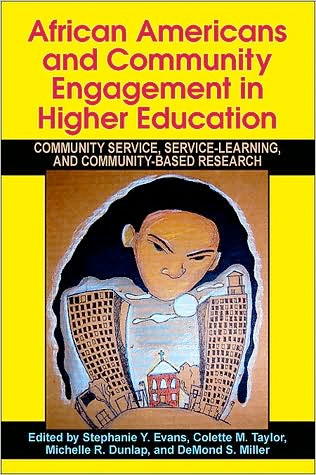
African Americans and Community Engagement in Higher Education: Community Service, Service-Learning, and Community-Based Research
- Author
- Evans, Stephanie Y.; Taylor, Collette M.; Dunlap, Michelle R.; and Miller, DeMond S, eds.
- Publisher
- SUNY Press, Albany, NY
- ISBN
- 9781438428741
- Table of Contents
-
List of Tables
Preface: Using History, Experience, and Theory to Balance Relationships in Community Engagement
Acknowledgments
Introduction: Characteristics of Engagement: Communicated Experiences of Race, Universities, and Communities
Part 1 Community Service, Volunteerism, and Engagement
ch. 1 The Community Folk Art Center: A University and Community Creative Collaboration (Kheli R. Willetts)
ch. 2 An African American Health Care Experience: An Academic Medical Center and Its Interdisciplinary Practice (Kendall M. Campbell)
ch. 3 African American College Students and Volunteerism: Attitudes toward Mentoring at a Title I School (Joi Nathan)
ch. 4 Prejudice, Pitfalls, and Promise: Experiences in Community Service in a Historically Black University (Jeff Brooks)
Part 2 Community Service-Learning
ch. 5 Can the Village Educate the Prospective Teacher? Reflections on Multicultural Service-Learning in African American Communities (Lucy Mule)
ch. 6 Sowing Seeds of Success: Gardening as a Method of Increasing Academic Self-Efficacy and Retention among African American Students (August Hoffman, Julie Wallach, Eduardo Sanchez, Richard Carifo)
ch. 7 A Service or a Commitment? A Black Man Teaching Service-Learning at a Predominantly White Institution (Troy Harden)
ch. 8 Racial Identity and the Ethics of Service-Learning as Pedagogy (Annemarie Vaccaro)
ch. 9 "We'll Understand It Better By and By": A Three-Dimensional Approach to Teaching Race through Community Engagement (Meta Mendel-Reyes, Dwayne A. Mack)
Part 3 Community-Based Research
ch. 10 Black Like Me: Navigating Race, Gender, Research, and Community (Fleda Mask Jackson)
ch. 11 A Partnership with the African American Church: IMPACT and S.P.I.C.E.S. For Life (Micah McCreary, Monica Jones, Raymond Tademy, John Fife)
ch. 12 "I Have Three Strikes Against Me": Narratives of Plight and Efficacy among Older African American Homeless Women and Their Implications for Engaged Inquiry (Olivia G. M. Washington, David P. Moxley)
ch. 13 A Culturally Competent Community-Based Research Approach with African American Neighborhoods: Critical Components and Examples (Richard Briscoe, Harold R. Keller, Gwen McClain, Evangeline R. Best, Jessica Mazza)
ch. 14 Community Engagement and Collaboration in Community-Based Research: The Road to Project Butterfly (GiShawn Mance, Bernadette Sanchez, Niambi Jaha-Echols)
Final Word: African Americans and Community Engagement: The Challenge and Opportunity for Higher Education
List of Contributors
Index
This book discusses race and its roles in university-community partnerships. The contributors take a collaborative, interdisciplinary, and multiregional approach that allows students, agency staff, community constituents, faculty, and campus administrators an opportunity to reflect on and redefine what impact African American identity-in the academy and in the community-has on various forms of community engagement. From historic concepts of "race uplift" to contemporary debates about racialized perceptions of need, they argue that African American identity plays a significant role. In representing best practices, recommendations, personal insight, and informed warnings about building sustainable and mutually beneficial relationships, the contributors provide a cogent platform from which to encourage the difficult and much-needed inclusion of race in dialogues of national service and community engagement.
"This book validates the African proverb 'it takes a village to raise a child.' The topics are right on the mark and highlight the benefits of service-learning as an instrument of individual and community involvement and empowerment." - Festus E. Obiakor, coeditor of Culturally Responsive Literacy Instruction (From the Publisher)
"This book validates the African proverb 'it takes a village to raise a child.' The topics are right on the mark and highlight the benefits of service-learning as an instrument of individual and community involvement and empowerment." - Festus E. Obiakor, coeditor of Culturally Responsive Literacy Instruction (From the Publisher)