Resources
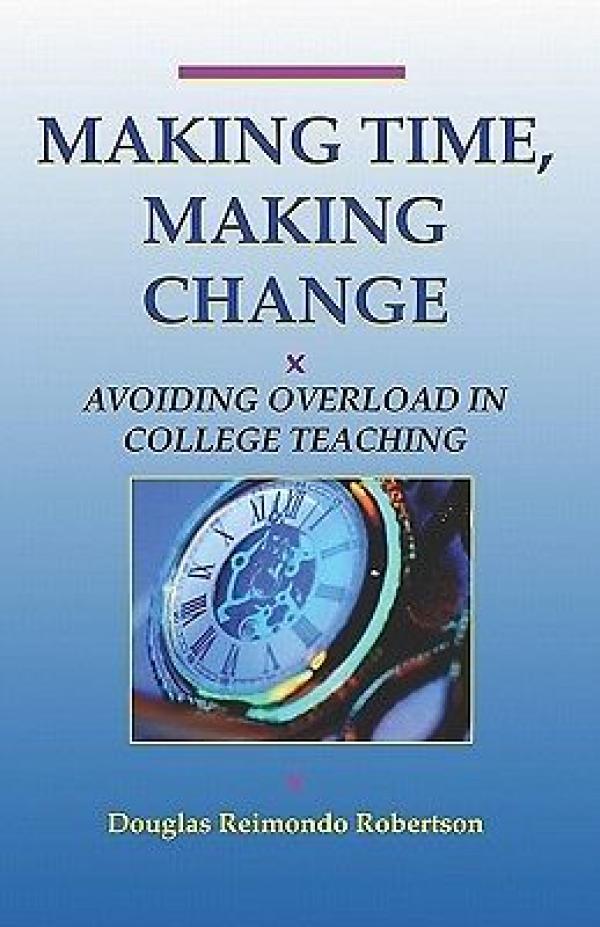
Lack of time may be the single most commonly experienced problem among American faculty. It is fair to say that the overwhelming majority of the roughly 400,000 full time faculty in American colleges and universities feel overloaded in their teaching lives; they perceive that they do not have time to do their basic faculty duties properly; and they believe that overload goes with the job. We complain yet we do not reflect on and evaluate our paradigms for how we use our time. Perhaps a pernicious norm has evolved: anyone not complaining about being overwhelmed is suspect. We act as if we have no choice. Einstein once remarked, "Insanity is doing the same thing over and over again and expecting different results." A Lakota Sioux saying puts the idea in concrete terms, "When your horse is dead, the proper strategy is to dismount." When it comes to avoiding overload, many of us sit on our dead horses kicking them in the sides over and over again, insanely, wondering why we don't get anywhere. However, we do have choices about how we use our time. Einstein suggested a way to discover our choices when he further observed, "Problems cannot be solved at the same level of awareness that created them." Essentially, that is the objective of this book: to elevate our awareness of how we use our time and how we might improve that use of time. We need to shift our perspective on using time from subject (a perspective from which we act naively) to object (a perspective on which we act intentionally). The tool that we will use to stimulate this shift in awareness comes from a vintage analysis of systems theory and research and focuses on managing the boundaries of our teaching selves better. In Making Time, Making Change, author Douglas Reimondo Robertson leads you on the road to a more rewarding, and less harried, teaching life! (From the Publisher)

Radical Presence is a book about our lives as well as our work, suggesting that the "secrets" of good teaching are the same as the secrets of good living. (From the Publisher)

Steal This University explores the paradox of academic labor. Universities do not exist to generate a profit from capital investment, yet contemporary universities are increasingly using corporations as their model for internal organization. While the media, politicians, business leaders and the general public all seem to share a remarkable consensus that higher education is indispensable to the future of nations and individuals alike, within academia bitter conflicts brew over the shape of tomorrow's universities. Contributors to the volume range from the star academic to the disgruntled adjunct and each bring a unique perspective to the discussion on the academy's over-reliance on adjuncts and teaching assistants, the debate over tenure and to the valiant efforts to organize unions and win rights. (From the Publisher)
Key Benefits: Faculty of Color in Academe focuses on inequities based on racial and ethnic differences within the professional workplace in higher education. This book draws on a comprehensive study of African American, Asian, Pacific American, American Indian, and Latino faculty in eight mid-western states. By using both narrative and statistical data, this book provides an in-depth view of the issues surrounding the successful recruitment, retention, and development of faculty of color. Key Topics: The authors attempt to capture and describe some of the similarities and differences experienced by faculty among each of the above mentioned racial/ethnic groups. Includes a comprehensive discussion of what needs to be done in order to achieve diversity in the teaching profession. (From the Publisher)
This set of two volumes offers statements from disciplinary/professional societies on what faculty work deserves recognition and reward in their unique culture/community. Volume I covers religion, history, geography, math, chemistry, the arts, business, journalism, and family/consumer science, plus the National Education Association. (From the Publisher)
Gender and Teaching provides a vivid, focused, and interactive overview of the important gender issues in education today. This is accomplished through conversations among experts, practitioners, and readers that are informed by representative case studies and by a range of theoretical approaches to the issues. Gender and Teaching is the third volume in the "Reflective Teaching and the Social Conditions of Schooling" series edited by Daniel P. Liston and Kenneth M. Zeichner. It follows the same format as previous volumes in the series. Part I includes four cases dealing with related aspects of gendered experiences in schools (nonsexist elementary school curricula, gender and race implications of special education assignment practices, homophobia in high schools and classrooms, and teaching as a woman's profession), followed by a set of teachers', administrators', and professors' reactions to each case. Part II is an elaboration of four "public arguments"--conservative, liberal, women-centered, and radical multicultural--pertaining to the issues raised in the cases in Part I. These arguments exemplify clusters of orientations, organized around general values rather than hard and fast principles. Part III presents the authors' own interpretations of the issues raised throughout the work and provides activities and topics for reflection and an annotated bibliography of additional resources. Content and Pedagogical Features: *Readers are encouraged throughout to interact with the text. They can respond to each case and compare their responses to those of others in the field. *The cases and discussions that follow help students begin to evolve their own "practical theories"; explore and perhaps modify some of their basic beliefs and assumptions; become acquainted with other points of view; and look further into the connections and intersections of gender with other structural dynamics and practices--those of race, class, and culture--as intrinsic to their explorations into the social conditions of schooling. *The major strands in feminist theory about women and education are presented so that students can analyze the differences among them, come up with positions of their own, and learn to defend them. *Although the authors draw on historical and sociological frameworks that show how women have historically been discriminated against in our schools and in our society, their goal is an education that is equally fair to everyone, boys as well as girls. Gender and Teaching is pertinent for all prospective and practicing teachers at any stage of their training. It can be used in any undergraduate or graduate course that addresses issues of gender and teaching. (From the Publisher)

Highlighting the Associated New American Colleges' Faculty Work Project, this volume examines the call for redefining faculty roles and institutional relationships. Believing that in order to serve students successfully colleges must invest in faculty effectiveness, the overriding goal of the project has been to lay the conceptual groundwork for bringing an institution's faculty policies and practices and the actual work patterns of faculty into alignment with the institutional mission. (From the Publisher)
Examines the author's teaching evaluations to help understand what they measure and how they may be used to make changes in classroom performance. States that teachers should view teaching evaluations as an opportunity to develop as teachers.
A junior faculty member reflects on the dilemma of that professional position, noting that its anxieties fall into two categories: "Is this all there is?" and "What if we lose it?" She examines problems with, and prohibitions against, speaking one's mind in that position, sees solutions as being institutional or individual, and examines how concerns are linked to other campus constituencies.

Calling for accountability, Practice What You Preach discusses ethical questions that arise in congregations and pastoral leadership. Formation of pastors, empowering leaders, resolving power struggles between clergy and laity--these and other critical pastoral issues are addressed by an ecumenical group of contributors. Divided into four parts: the way the churches train their pastors; the way their pastors live; the way communities worship; and the way communities behave, this collection identifies and offers positive solutions to areas where churches are often slow to change. Each essay begins with a case describing a typical problem--from wages to in-fighting--and then discusses what virtues or character traits might be developed to resolve the problem effectively. An eye-opener of a book . . . it will involve you from page one as it invites intelligent people everywhere to reckon with its courageous, timely content. (From the Publisher)