Resources
This monograph examines what educational research reveals about five educational practices: first-year seminars, learning communities, service learning, undergraduate research, and capstone experiences. The authors explore questions such as: What is the impact on students who participate in these practices? Is the impact the same for both traditional students and those who come from historically underserved student populations? The monograph includes a foreword by George D. Kuh, High-Impact Practices: Retrospective and Prospective, and recommendations for how to improve the quality of high-impact practices. (From the Publisher)
Teaching on Solid Ground gives practitioners more complete understanding of students and learning. It presents new ways of thinking about instruction, and it explores the issues - including faculty motivation and quality of teaching - that demand faculty attention at the institutional and professional level. Underlying Teaching on Solid Ground is the critical premise that educational researchers and teachers must become partners in the ongoing task of teaching improvement. (From the Publisher)
M.Div. programs sequence curriculum in order to cumulatively build competencies for wise, faithful, reflective, appropriate and effective ministerial practices. That is why the introductory preaching course typically is positioned somewhere near the middle of the program. The author of this article discovered that students who, in the semester immediately preceding the introductory preaching course, were apprenticed in the art of critical theological reflection on previously preached sermons entered the introductory course more eager, with more finely attuned expectation levels, and with anxiety levels that promoted rather than hampered learning.
To increase understanding of how Master of Divinity education actually functions and to respond to accreditors' emphasis on the outcomes of learning, this paper presents a research-based model that focuses on how M.Div. education transforms students. The students-in-seminary model is conceptually undergirded by life course theory. In the model, students attending seminary engage in a messy process in which they respond to competing demands of school, church, and family. The author compares the students-in-seminary model with the dominant message model for theological education articulated by Carroll et al. (1997) and argues that the students-in-seminary model more adequately describes the process of theological education. The author calls for further research to study how seminaries promote key messages to their students, the plasticity of students' sense of calling, the impact of church requirements on M.Div. students, and the complexity of life for multiple-role students.
University teaching and learning take place within ever more specialized disciplinary settings, each characterized by its unique traditions, concepts, practices and procedures. It is now widely recognized that support for teaching and learning needs to take this discipline-specificity into account. However, in a world characterized by rapid change, complexity and uncertainty, problems do not present themselves as distinct subjects but increasingly within trans-disciplinary contexts calling for graduate outcomes that go beyond specialized knowledge and skills. This ground-breaking book highlights the important interplay between context-specific and context-transcendent aspects of teaching, learning and assessment. It explores critical questions, such as: What are the ‘ways of thinking and practicing’ characteristic of particular disciplines? How can students be supported in becoming participants of particular disciplinary discourse communities? Can the diversity in teaching, learning and assessment practices that we observe across departments be attributed exclusively to disciplinary structure? To what extent do the disciplines prepare students for the complexities and uncertainties that characterize their later professional, civic and personal lives? Written for university teachers, educational developers as well as new and experienced researchers of Higher Education, this highly-anticipated first edition offers innovative perspectives from leading Canadian, US and UK scholars on how academic learning within particular disciplines can help students acquire the skills, abilities and dispositions they need to succeed academically and also post graduation. Carolin Kreber is Professor of Teaching and Learning in Higher Education and the Director of the Centre for Teaching, Learning and Assessment at the University of Edinburgh (From the Publisher)
Arguing for an enhanced commitment to evidence-based practice, Taking Stock offers concrete suggestions for changes on a systemic level in support of student learning and calls on all those working in higher education - faculty, educational developers, administrators, and government officials - to work together to bring about these changes. (From the Publisher)
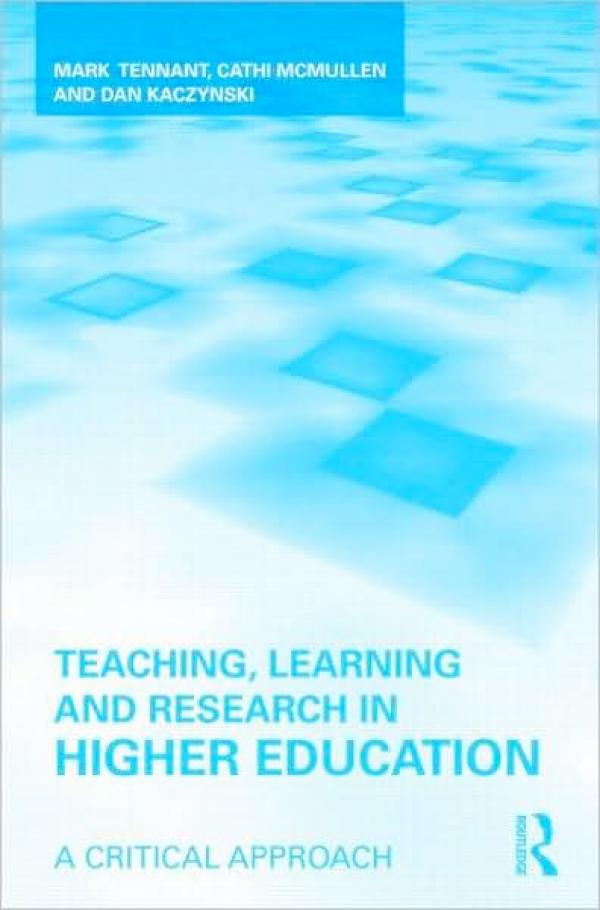
Teaching, Learning and Research in Higher Education offers a combination of critical perspectives and practical advice that is ideally suited for individuals interested in enhancing their practice through analysis and critique. The aim is to promote a critical understanding of one's own practices: to foster personal and professional formation through a reflexive engagement with one's environment and circumstances. At a practical level this means to continuously think about how to adjust practice rather than following a formulaic approach derived from any particular educational theory. Teaching, Learning and Research in Higher Education argues that academics can find space for their own agency in the midst of institutional policies and practices that serve to frame, as well as delimit and constrain, what counts as good academic work in teaching and research. This text bridges a gap between those books that provide a high-level analysis of contemporary higher education, the more practical texts on how to be a good teacher in higher education, and those texts which aim to improve teaching through better understanding of the learning process. Topical chapters include: Teacher-learner relationship, Learning groups, Practice-oriented learning, Teaching for diversity, e-learning, Assessment, Approaches to Staff Development, Quality assurance, Supervision and Research education, Doing research, and Teaching & Research. A must-have resource for higher education professions, academic developers, professionals, and anyone looking to improve their teaching and learning practices, Teaching,Learning and Research in Higher Education is also appropriate for continuing and professional development courses in the UK and teaching and learning courses in the US. Mark Tennant is Dean of the University Graduate School, University of Technology, Sydney. Cathi McMullen is Lecturer in the School of Marketing and Management at Charles Sturt University. Dan Kaczynski is Professor in the Educational Leadership department at Central Michigan University. (From the Publisher)
In Holy Clarity, Sarah Drummond explores the most basic reason leaders of religious organizations conduct evaluations: To find and create God-pleasing clarity regarding the organization's purpose and the impact of its activities. Leadership and evaluation are not separate disciplines, she argues. Effective leaders evaluate because they need to know what is happening in their organizations and how those activities are effecting change. Drummond first describes the way in which our postmodern culture makes clarity difficult to obtain. She then looks at holy clarity from a biblical and theological perspective and make the case that it is a spiritual discipline that can stand on its own theological merits. She presents four approaches to evaluation that can help a leader to guide a community toward greater clarity, both when evaluating or analyzing programs and when planning and starting programs. Finally, she considers the work of clarification as a faith practice, one that can make a pastor or layperson not just a better leader, but a better Christian who is more firmly grounded in God. Each chapter concludes with a fictional case study that provides a jumping-off point for discussion and helps bring her theory to life. (From the Publisher)
Adult and continuing education continues to evolve as both a strong discipline and a professional field of practice throughout the global community. Both adult educators and adult learners require a common and informed conceptual and theoretical framework to assist them in developing meaningful curricula for adult learners. This book, in a collective and unified manner, describes innovative strategies for developing curricula for adult learners in diverse social, cultural, and economic contexts. (From the Publisher)
Adult and continuing education continues to evolve as both a strong discipline and a professional field of practice throughout the global community. Both adult educators and adult learners require a common and informed conceptual and theoretical framework to assist them in developing meaningful curricula for adult learners. This book, in a collective and unified manner, describes innovative strategies for developing curricula for adult learners in diverse social, cultural, and economic contexts. (From the Publisher)