Resources
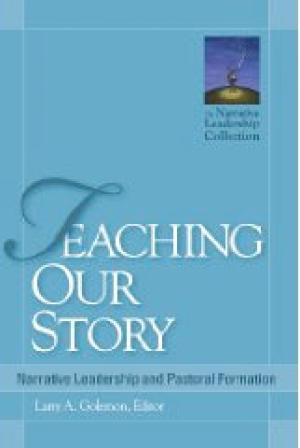
As congregations become intentional story-forming communities, they can shape the lives of millions of generative, faithful, and civic-minded adults. To do so, a framework that relates narrative work to the full range of congregational life is needed. Teaching Our Story offers such a framework, featuring essays that examine crucial shapers of narrative, outline a course in preaching that addresses crucial questions for today's church leaders, illuminate the creative power of listening to the collective stories of a faith community, and observe what can happen when first-year seminary students are asked to become story brokers--integrating the stories from their communities with biblical stories, their own personal stories, and the theological doctrines formed within the story of their tradition. (From the Publisher)
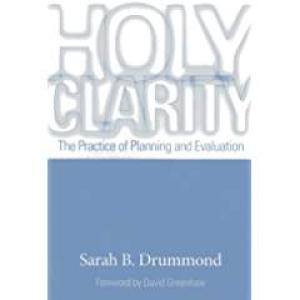
In Holy Clarity, Sarah Drummond explores the most basic reason leaders of religious organizations conduct evaluations: To find and create God-pleasing clarity regarding the organization's purpose and the impact of its activities. Leadership and evaluation are not separate disciplines, she argues. Effective leaders evaluate because they need to know what is happening in their organizations and how those activities are effecting change. Drummond first describes the way in which our postmodern culture makes clarity difficult to obtain. She then looks at holy clarity from a biblical and theological perspective and make the case that it is a spiritual discipline that can stand on its own theological merits. She presents four approaches to evaluation that can help a leader to guide a community toward greater clarity, both when evaluating or analyzing programs and when planning and starting programs. Finally, she considers the work of clarification as a faith practice, one that can make a pastor or layperson not just a better leader, but a better Christian who is more firmly grounded in God. Each chapter concludes with a fictional case study that provides a jumping-off point for discussion and helps bring her theory to life. (From the Publisher)
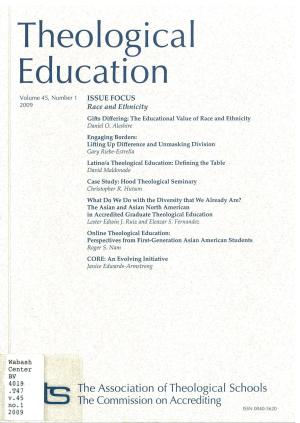
Journal Issue. Full text is available online.

Journal Issue.
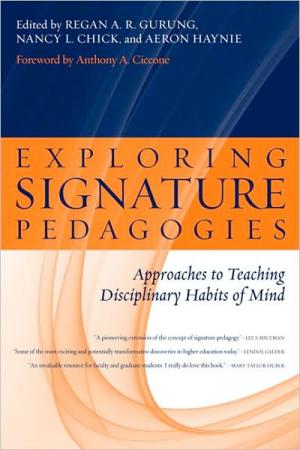
From the Foreword These authors have clearly shown the value in looking for the signature pedagogies of their disciplines. Nothing uncovers hidden assumptions about desired knowledge, skills, and dispositions better than a careful examination of our most cherished practices. The authors inspire specialists in other disciplines to do the same. Furthermore, they invite other colleagues to explore whether relatively new, interdisciplinary fields such as Women's Studies and Global Studies have, or should have, a signature pedagogy consistent with their understanding of what it means to 'apprentice' in these areas. How do individual disciplines foster deep learning, and get students to think like disciplinary experts? With contributions from the sciences, humanities, and the arts, this book critically explores how to best foster student learning within and across the disciplines. This book represents a major advance in the Scholarship of Teaching and Learning (SoTL) by moving beyond individual case studies, best practices, and the work of individual scholars, to focus on the unique content and characteristic pedagogies of major disciplines. Each chapter begins by summarizing the SoTL literature on the pedagogies of a specific discipline, and by examining and analyzing its traditional practices, paying particular attention to how faculty evaluate success. Each concludes by the articulating for its discipline the elements of a "signature pedagogy" that will improve teaching and learning, and by offering an agenda for futureresearch. Each chapter explores what the pedagogical literature of the discipline suggests are the optimal ways to teach material in that field, and to verify the resulting learning. Each author is concerned about how to engage students in the ways of knowing, the habits of mind, and the values used by experts in his or her field. Readers will not only benefit from the chapters most relevant to their disciplines. As faculty members consider how their courses fit into the broader curriculum and relate to the other disciplines, and design learning activities and goals not only within the discipline but also within the broader objectives of liberal education, they will appreciate the cross-disciplinary understandings this book affords. (From the Publisher)
Journal Issue.
With the general practice of online teaching still in relative infancy, nuanced approaches for teaching target populations such as black students are especially scarce. This article submits a theoretical framework for approaching the activity of teaching black students online using a transformative, postmodern pedagogy that is sensitive to black learning styles. It also offers practical suggestions for course design and deployment in online religion courses. In the interest of providing an optimal learning experience for every student, all instructors are encouraged to consider the race and culture variable in their online teaching, whether their roster contains one black student or many.
Order and organization are valued in the classroom, and there is a prevailing understanding that chaos should be avoided. Yet chaos can also be potent space or a source from which new things spring forth. This article investigates biblical, scientific, and cultural understandings of chaos to discover how these contribute to a revelatory metaphor for teaching. It examines Catherine Keller’s engagement with chaos theory in creation theology for pedagogical implications. Using a framework suggested in the work of Mary Elizabeth Moore, the author interprets powers and practices of chaos teaching and provides examples of how the metaphor plays out in the teaching of religion and theology.
One page Teaching Tactic to determine the level of knowledge and understanding students have of a particular subject (in this case, in a Hebrew Bible course).
One page Teaching Tactic: a method for convening discussion in large groups.