Resources
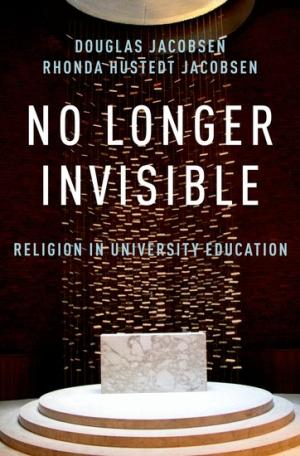
Drawing on conversations with hundreds of professors, co-curricular educators, administrators, and students from institutions spanning the entire spectrum of American colleges and universities, the Jacobsens illustrate how religion is constructively intertwined with the work of higher education in the twenty-first century. No Longer Invisible documents how, after decades when religion was marginalized, colleges and universities are re-engaging matters of faith-an educational development that is both positive and necessary. Religion in contemporary American life is now incredibly complex, with religious pluralism on the rise and the categories of "religious" and "secular" often blending together in a dizzying array of lifestyles and beliefs. Using the categories of historic religion, public religion, and personal religion, No Longer Invisible offers a new framework for understanding this emerging religious terrain, a framework that can help colleges and universities-and the students who attend them-interact with religion more effectively. The stakes are high: Faced with escalating pressures to focus solely on job training, American higher education may find that paying more careful and nuanced attention to religion is a prerequisite for preserving American higher education's longstanding commitment to personal, social, and civic learning. (From the Publisher)
Every year, American universities publish glowing reports stating their commitment to diversity, often showing statistics of female hires as proof of success. Yet, although women make up increasing numbers of graduate students, graduate degree recipients, and even new hires, academic life remains overwhelmingly a man's world. The reality that the statistics fail to highlight is that the presence of women, specifically those with children, in the ranks of tenured faculty has not increased in a generation. Further, those women who do achieve tenure track placement tend to report slow advancement, income disparity, and lack of job satisfaction compared to their male colleagues. Amid these disadvantages, what is a Mama, PhD to do? This literary anthology brings together a selection of deeply felt personal narratives by smart, interesting women who explore the continued inequality of the sexes in higher education and suggest changes that could make universities more family-friendly workplaces. The contributors hail from a wide array of disciplines and bring with them a variety of perspectives, including those of single and adoptive parents. They address topics that range from the level of policy to practical day-to-day concerns, including caring for a child with special needs, breastfeeding on campus, negotiating viable maternity and family leave policies, job-sharing and telecommuting options, and fitting into desk/chair combinations while eight months pregnant. Candid, provocative, and sometimes with a wry sense of humor, the thirty-five essays in this anthology speak to and offer support for any woman attempting to combine work and family, as well as anyone who is interested in improving the university's ability to live up to its reputation to be among the most progressive of American institutions. (From the Publisher)
The Handbook of Transformative Learning provides a comprehensive and critical review of more than three decades of theory development, research, and practice in Transformative Learning (TL). It will help adult educators understand what transformative learning is, distinguish it from other forms of learning, and foster it in their practice. The book covers five broad areas: historical, theoretical, practical, research, and future perspective. It is comprehensive, interdisciplinary, critical, reflective, and accessible to a wide audience of interested scholars, students, and practitioners. Co-edited by leading experts in the field with an advisory group of prominent authorities, this handbook is the leading resource for the field. (From the Publisher)
Every year, hundreds of small colleges, state schools, and large, research-oriented universities across the United States (and, increasingly, across Europe and Asia) are revisiting their core and general education curricula, often moving toward more integrative models. And every year, faculty members who are highly skilled and regularly rewarded for their work in narrowly defined fields are raising their hands at department meetings, at divisional gatherings, and at faculty senate sessions and asking two simple questions: “Why?” and “How is this going to impact me?” This guide seeks to answer these and other questions by providing an overview of and a rationale for the recent shift in general education curricular design, a sense of how this shift can affect a faculty member’s teaching, and a sense of how all of this might impact course and student assessment. (From the Publisher)
A detailed philosophical debate on the nature of expertise is long overdue and Dimensions of Expertise opens up that debate. Christopher Winch firstly explores an account of know-how, derived primarily from the pioneering work of Gilbert Ryle, and moves on to relate this epistemological debate to discussions concerning the nature of expertise in vocational and professional education, including attempts to provide a theory of expertise. (From the Publisher)
Critical thinking is becoming increasingly prominent as an academic discipline taught and examined in schools and universities, as well as a crucial skill for everyday life. To be a successful critical thinker it is vital to understand how the different concepts and terms are defined and used. The terminology often presents a stumbling block for the beginner, since much of it is used imprecisely in everyday language. This definitive A to Z guide provides precise definitions for over 130 terms and concepts used in critical thinking. Each entry presents a short definition followed by a more detailed explanation and authoritative clarification. Armed with the tools and knowledge provided in these pages, the reader will be able to distinguish an assertion from an argument, a flaw from a fallacy, a correlation from a cause and a fact from an opinion. The book is an invaluable resource for teachers and students of critical thinking, providing all the tools necessary to effectively analyse, evaluate, question and reason for yourself. (From the Publisher)
This chapter looks at the teaching of special topics in the study of religion, in this case the representation of evil. Employing the medium of film to teach this topic enables students to reflect on “religious” assumptions and their implications for how we experience ourselves in the world. With the focus on a particular film, Crash, and the theoretical work of Paul Ricoeur, this chapter considers evil by analyzing the racism in Crash and its relationship to alienation, confession, and redemption. The more general project of a similar course would be to introduce students to evil as a complex dimension of human experience. Reading films critically increases the likelihood that students will move beyond either/or and black/white dichotomies toward a more integrated understanding of the problem of evil.