Resources
NOTE: Use the playlist button located in the top left of the video window above to switch between episodes.
NOTE: Use the playlist button located in the top left of the video window above to switch between episodes. Tips for International TAs (2:20) This video is intended for non-native English speakers TAing in English-speaking environments. Key tips: talk with your peers and professors, practice your English, solicit advice from your students. Establishing Expectations for Your Class (4:46) Stresses the importance of setting policies and communicating them to students clearly at the beginning of a course to help them succeed. Offers key questions to consider when establishing policies around attendance and participation, classroom behavior, late work. Recommends including these in syllabus and presenting them in class. Motivating Students to Succeed (3:14) Presenter offers ways to motivate students to succeed: be passionate about your subject, be clear about “how to succeed” (e.g., through syllabus, rubrics), be connected with student interests, and be aware of what they want out of the class. Academic Integrity (2:42) A sympathetic approach to teaching students what “Academic Integrity” is and the consequences of violating it. A few comments on how to recognize plagiarism and how to respond. Mid-semester Teaching Evaluations (4:12) Discusses why you should administer your own mid-semester evaluations, what you might include, and how to use the feedback students provide. Being Enthusiastic about Your Class (2:32) Explores why being enthusiastic while teaching is important and offers simple strategies for expressing engagement and interest in your students. Maintaining Student Engagement Using Eye Contact & ‘Scanning’ (1:44) Details why and how to use eye contact to enhance learning. Seriously? We have to tell people this? Repetitive of “Being Enthusiastic” video.

In two classes that I teach—“Islam” and “The Qur’an”—I often assign the film Wadjda (dir. Haifaa Al-Mansour, 2012) as the first homework assignment. Wadjda tells the tale of a young girl (same name as the film’s title) in Saudi Arabia who longs to own a bicycle, despite cultural norms that allow them only for boys. Her story takes place before a backdrop of a Muslim society, institutional corruption at her all-girls school, her parent’s crumbling marriage, and a male-dominated world. Most importantly, even for the uninitiated, I find that the film is plenty relatable to American college students. Wadjda, the protagonist, is an adorable, clever, and perseverant young girl and it’s easy to become engrossed in her story. I give students a pair of questions to consider as they watch the film, which we spend time exploring in the following class meeting: 1) In what ways does Wadjda challenge stereotypes (yours or American society’s more broadly) about Islam; 2) In what ways does Wadjda confirm stereotypes about Islam? These questions are straightforward, but I find that they work well because they set a tone that invites students to share their experiences, without risking right or wrong answers at the very beginning of the semester. The questions additionally push students to reflect on the complex choices and characters in the film as well as on their own complexity as agents in the world. Naturally, American students enter a course on Islam with any number of sensational ideas about Muslims. Western cinema, moreover, often presents Muslim characters as nothing more than bloodthirsty villains or quaint Orientalized simpletons (or both), which Jack Shaheen adroitly explores in Reel Bad Arabs (both the title of a monograph and documentary film). Indeed Wadjda could well be the first film college students ever see that portrays Muslims as something other than caricatures. By and large students like the film, but I do struggle with how to make the plot sound more intriguing when I tell students about it on the first day of class (i.e., it’s about a girl who wants a bike?); trailers are helpful. Because Wadjda features primarily female characters, it pushes Western viewers all the more, given the naïve ideas many of us have not only about Muslims in general but about Muslim women in particular. The context of the film also offers much for reflection. It’s the first feature film directed by a Saudi woman. It has received acclaim across many venues, including “Rotten Tomatoes” and the New York Times, which refers to the film as “sweetly subversive.” It was also nominated as best foreign language film for the Academy Awards and adapted in 2015 as an English-language novel. Despite all the benefits from assigning the film, I find that subtitles tend to invite a minority of students to complain, as the labor of viewing while reading taints their experience with the film. While I appreciate this as a consumer—plainly, subtitles can create more work for the film viewer, who often prefers a more passive than active experience—I think it also symbolizes a valuable struggle when encountering new cultures and new ideas. Additionally, unless the viewer knows to interpret a small clue (a shirt with KSA on it), or previously learned the context for the film, it’s actually not even completely clear where the film takes place. Throughout the film, Wadjda’s aloof father explores the possibility of a second marriage, while her mother struggles to provide for her family and create a good life for her only child. Like many good films, the characters in Wadjda are complex and believable. Wadjda argues with authority figures and listens to Western music but also lives innocently in her own challenging world of early adolescence. Toward the goal of acquiring her prized bicycle, Wadjda learns to negotiate a few under the table deals with members from her community (e.g., delivering secret messages between sweethearts), but her primary strategy to earn money involves entering herself in a Qur’an recitation competition. She practices with dedication and her hard work shows. Students won’t usually catch a certain subtlety at this part of the film, but the verses recited in the competition (including their translations in subtitles) speak to many of the themes in the film—thus this scene on its own could work well pedagogically in a number of contexts. While the film resolves the question of acquiring the bike (with an endearing twist), the overall ending leaves Wadjda’s future open to interpretation. I think it leaves a key question for my students: How can Wadjda and other females in the film demonstrate such agency and complexity if Muslim women are supposed to be oppressed? Even though this question presupposes a monolith of “Muslim women,” I think that the first part of the question, which acknowledges complexity and nuance, works well to emphasize one of the main themes of my courses: you can’t study religion without also studying people. Indeed, a required visit to a local mosque is among the most memorable aspects of my course for many students, so starting the semester with a drama helps set the stage for thinking about humanly complicated interactions with our course topic. What makes the film so effective, though, is that it’s not just a central question that the film raises. It touches effectively on so many themes, subtly and explicitly, central to what I want my students to engage throughout the course: gender, Islamophobic stereotypes, “religion” vs. “spirituality,” public vs. private religion, multivalent characters, polygamy, and non-English languages. Islam functions subtly in the film, moreover, which works well pedagogically for communicating how religion often works in people’s lives—as an integrated but still striking aspect of culture and society, in relationship to the lives of individuals, with unique stories and experiences. I’ve introduced other courses I’ve taught, as well, with feature films, and in this way, I think my approach with Wadjda is largely transferable as a model to begin a course. I would like to argue, as well, that it’s a strategy that could do well to receive more attention. After all, how important is the “hook” in any rhetorical expression? I’m of course not arguing that films are necessarily the best hook to capture students’ attention—I think this is largely a matter of taste—but I wonder to what extent that opening a course with a feature film is often overlooked because it doesn’t fit into the typical paradigm of how a college course is supposed to begin. Indeed, how is a college course supposed to begin? Do you use films to frame your courses? What kinds of questions best help your students to make sense of their themes? Have you screened Wadjda for your students? Please leave your thoughts in the comments section below!
NOTE: Use the playlist button located in the top left of the video window above to switch between episodes. Active Learning Wabash Center for Teaching and Learning in Theology and Religion (4:13) What is Active Learning (5:34) Active Learning Classrooms: Everyone is engaged! (18:45) View full playlist (3 videos) What is Active Learning? (4:12) The video introduces “active learning” and its benefits with helpful examples of active learning strategies to employ in face-to-face and online learning environments. Active Learning Classrooms: Everyone is Engaged! (5:33) Professor and students in a “high-performance workgroup” at McGill University describe and demonstrate features of the active learning design of their course. The benefits of this experience are also enumerated. Learning: 3 Easy Ways for Higher Education (18:45) A detailed Powerpoint presentation of 3 active learning strategies: Pause, Asking Questions, and Using Cases or Problems.
Directions to the Wabash Center Be sure that you have notified us if you will be arriving by your own transportation. Rachel Mills (millsr@wabash.edu) 800-655-7117 The Wabash Center is located on the Wabash College campus in Crawfordsville, Indiana, 45 miles northwest of Indianapolis and 150 miles southeast of Chicago. It is conveniently served by Interstate 74 from the east and west, and U.S. 231 from the north and south. The Wabash Center is in the Eastern Time Zone. The Wabash Center offices and meeting space are located across campus from the guest lodging. These directions are to the lodging facility. Wabash Center Lodging: 410 West Wabash Ave Crawfordsville, IN 47933 765-361-6490 From Indianapolis International Airport: Exit the airport on I-70 east toward Indianapolis and I-465. After only several miles, take I-465 north (follow signs to Peoria). After only several miles, take I-74 west (continue following signs for Peoria). In half an hour or so, take exit 39 (Indiana 32). Turn left off the interstate ramp, west on Indiana 32. At approximately 3 miles, bearright at the stop sign and proceed on East Market Street into downtown Crawfordsville. When you've reached downtown, turn left (south) on U.S. 231 (Washington Street). Continue three blocks and turn right on Wabash Avenue. Continue three blocks and the Wabash College campus will appear on the left. About 100 yards from the corner of campus, the main entrance to campus will be on your left, but turn right into the parking lot next to Trippet Hall (a large brick building with broad steps and white pillars, on the right hand side of the road, across from campus). Park and proceed to the front desk of Trippet Hall to check into your guest room. From the East (Indianapolis) Take I-465 North to to the I-65/465 split. Follow the signs for Chicago. Continue on I-65 for approximately 11 miles to the Crawfordsville exit 39 (Indiana 32). Go left off the interstate and continue on Indiana 32 for 22 miles into Crawfordsville. Bearright at the stop sign and proceed on East Market Street into downtown Crawfordsville. When you've reached downtown, turn left (south) on U.S. 231 (Washington Street). Continue three blocks and turn right on Wabash Avenue. Continue three blocks and the Wabash College campus will appear on the left. About 100 yards from the corner, the main entrance to campus will be on your left, but turn right into the parking lot next to Trippet Hall (a large brick building with broad steps and white pillars, on the right hand side of the road, across from campus. Park and proceed to the front desk of Trippet Hall to check into your guest room. From the North (I-65 through Lafayette, Indiana) Exit I-65 at exit # 178 (West Lafayette, Purdue University). Turn right at the end of the exit ramp and continue south on route 43 into West Lafayette. The road becomes route 231. Stay on U.S, 231 south for half an hour (approximately 30 miles) into downtown Crawfordsville. Proceed south to 3rd traffic light in town: Wabash Avenue (you will see a sign for Wabash College on the right). Turn right onto Wabash Avenue, continue three blocks, and the Wabash College campus will appear on the left. About 100 yards from the corner of campus, the main entrance to campus will be on your left, but turn right into the parking lot next to Trippet Hall (a large brick building with broad steps and white pillars, on the right hand side of the road, across from campus). Park and proceed to the front desk of Trippet Hall to check into your guest room. From the South (I-70, through Greencastle) Take U.S. 231 from Greencastle, Indiana, north to Crawfordsville (30 minutes). Proceed north on U.S. 231 (Washington Street) into downtown Crawfordsville. Turn left onto Wabash Avenue, continue three blocks, and the Wabash College campus will appear on the left. About 100 yards from the corner of campus, the main entrance to campus will be on your left, but turn right into the parking lot next to Trippet Hall (a large brick building with broad steps and white pillars, on the right hand side of the road, across from campus). Park and proceed in the front desk of Trippet Hall to check into your guest room. From the West (Illinois) Take I-74 to exit 34 (U.S. 231). Turn right (south) off the interstate exit ramp and proceed into downtown Crawfordsville (five miles). Continue proceeding south to the 3rd traffic light, which is Wabash Avenue (you will see a sign for Wabash College on the right). Turn right onto Wabash Avenue, continue three blocks, and the Wabash College campus will appear on the left. About 100 yards from the corner of campus, the main entrance to campus will be on your left, but turn right into the parking lot next to Trippet Hall (a large brick building with broad steps and white pillars, on the right hand side of the road, across from campus). Park and proceed to the front desk of Trippet Hall to check into your guest room.

What do you know to be true now that you used to think was false? What do you know to be false now that you used to think was true? What is something you’ve always thought true that remains true? I once heard a conference presenter ask a version of these questions and now I occasionally use them in my teaching. Such questions suggest that the status of knowing grows and changes, shifts and turns over time. This is good news for teachers and students everywhere! The pliable character of knowledge is also a political matter. Libraries and lives are filled with stories about the politics of teaching and learning, particularly around matters of deeply held faith convictions and religious practices embodied in various histories, bodies, and communities today. Learning itself evokes a kind of devotional practice in which the desire to learn and to unlearn are political acts of room-making in the mind, heart, body, soul for more than this moment’s capacity. Deep learning is often accompanied by a desire to be moved, even an expansive desire that surprises us in the learning process. In and beyond my seminary teaching and learning experiences in middle America in this political climate, I am seeing a troubling divergence around the changing status of knowledge: is learning now less or more important than ever? Do expectations of room-making lean toward being moved or rather thirst for antagonistic encounters? With the striking contrast of embracing the urgency of deepening learning around current social issues such as #syllabi devoted to blacklivesmatter, sanctuary cities, women’s health, islamophobia, refugees, and more on one hand, and abandoning intellectualism in favor of relentless questioning sources of expertise or even verifiable facts on the other, how do we teach into a political moment that threatens the status of learning itself? Five Threats to Syllabi “It’s in the syllabus” is the punch line to many an academic riddle. Syllabi are blueprints, detailed instructions for shared learning experiences. Syllabi outline plans for the way in, through, and out of the course of study. The best syllabi align student learning outcomes, assignments, and learning activities in clear and compelling ways. A syllabus can also be open to change and can never be totally locked in from the start if it intends to guide a living, breathing classroom. Many syllabi thus include a caveat somewhere that goes something like this: “instructor reserves the right to amend the syllabus for the sake of deepening student learning, but not to add unexpected work.” I usually write a version of the first part on my syllabi and discuss the second part in class because change is work, even and especially change for the better amid threats to learning. In this highly charged political moment that pit bodies and communities against each other, I am seeing an increase in five interconnected syllabi threats: (1) Rejecting Close Reading: I’ve noticed increased charges of irrelevance of reading that takes time in favor of a formula such as “I used to believe that doing the assigned reading before every class was important, but now I see that it doesn’t make a difference.” Discourse includes more and more references to headlines and skimmed resources. (2) Retreating from Deep Connections across Difference: As the political moment threatens to recode inclusion as political correctness, the allure of unrestrained exclusion is appearing in class discussions in relation to readings, to other students, to contemporary figures that appear in a posture of “I don’t have anything to learn from you.” I have heard this disturbing phrase uttered in the classroom directly twice recently. (3) Receding Horizon of Moral Imagination: While I think it’s a mistake to see empathy as perfectly achievable, the act of considering the consequences of my words and actions for other people and places is critical. Therefore, I welcome many voices from texts read to voices represented in the class to perspectives notably absent from any class. Learning in conversation with many voices requires sustained willingness to consider familiar and unfamiliar perspectives – a requirement that appears less compelling in much public discourse today as relationships between texts, persons, and ideas lean far toward the antagonistic pole rather than a desire to be moved. (4) Pressuring Quick Undisciplined Performance: It can take more time to write more succinctly, yet the pace of twitter both models and encourages quick, undisciplined performance. Respond now! The pressure is on to shortchange the discipline of public discourse for rapid response. There is an art to brevity and real-time public debate that can be learned, but right now time-pressure is relentless. (5) Acting Out Around Power: Power always flows through teaching and learning, sometimes in more subtle and sometimes in more obvious ways. This political moment is evidencing more blatant efforts of grasping, hiding, pushing, and pulling people and ideas out of the way for the sake of accumulating power. These five threats aren’t unique to the moment, but also describe predictable patterns of dehumanization that we can trace over time through resurgences of oppression that depend on these kinds of threats.[i] All five of these threats to learning were sharply evident in the classes I taught during the 2016 US Presidential election. This semester, several of the same students enrolled in a different seminar class. What’s a teacher to do to support pedagogical response to these syllabus threats to the promise of becoming? How could I respond to these threats pedagogically, helping to transform my teaching plans into a syllabus of becoming? As a scholar discerning which organizations and conferences to attend, writing projects to adopt, I often ask myself, “to what extent does this support my learning and becoming?” A syllabus of becoming opens this question in the arena of teaching and learning: does this assignment, set of texts, teaching practice invite becoming? A moving syllabus transforms predictable threats into invitations of becoming. I am experimenting with the following responses to the above threats to learning: A Syllabus of Becoming (1) Reading More: In my seminar this semester we are reading fewer texts, but more closely. There is much to read. And sometimes, the very texts needed to translate careful study into prophetic and pastoral speech in today’s contexts are not yet written. So we are also creating original texts that are not eliminating, but beautifully and quite unexpectedly responding to the above threats. (2) Connecting to a Sacred Third Text: Every week, the seminar shares in common assigned reading of published texts and reading of the class itself.[ii] In addition, I invited each student to choose a third text that they consider sacred in their context. Across the first half of the semester, students have engaged lectionary readings, other Bible texts, a musician’s canon, music in general, visual art, photography, and poetry. Assigning a search for the sacred without predetermining the form has opened unexpected depth this semester. (3) Imagining Publics, Remembering What’s at Stake: In crafting the short weekly writing assignment, I left open the possibility that the set of texts we produce, or a subset of them, could be assembled as a devotional resource for a larger public within and/or beyond the seminary. Reading the first half of Patrick B. Reyes’s new book Nobody Cries When We Die[iii] early in the semester has provided language for remembering the real lives and loves at stake in reading and writing about human suffering and healing. An imaginary public also joins the room when each student reads their reflection aloud during class each week. (4) Practicing Every Week: Even though the pace of reading, writing, and conversation is deliberately slowed down with less reading and shorter writing assignments, I am amazed how class time flies by. Instead of the increased resistance and fatigue with many of the same students last semester in which I decided to scale back on practice in class (we were all exhausted and shocked albeit for many reasons), in this seminar, energy is sustained at a high register. Weekly practice with each other is creating room for mutual invitation, calling out profound connections between texts and students. (5) Sharing Voice and Power: Instead of coordinated turn-taking across the arc of the semester with different student presentations different weeks, I am trying a model where everyone shares their brief reflection or summary of it every week. Instead of power-grabbing, there are palpable and powerful moments of power-sharing every week. Politics are interwoven with personality and it doesn’t escape me that every class is its own microcosm so that what works in one class can be less successful in another and vice versa. However, I am astonished that structuring a syllabus of becoming has not only tempered palpable threats of the contemporary moment, but also made room for invitations of becoming. When discouraged at the very real threats to learning at this historical moment, I am reminded of the power and promise of a syllabus moving toward room-making. What have you found moving in your teaching and learning in such a time as this? [i] To interrogate this point with my students, we are reading Beverly Eileen Miltchell’s Plantations and Death Camps: Religion, Ideology, and Human Dignity (Minneapolis, MN: Fortress Press, 2009). While Mitchell makes plain patterns of threat that contribute to the violence of dehumanization, books like Angela D. Sims, Lynched: The Power of Memory in a Culture of Terror (Waco, TX: Baylor University Press, 2016) reminds us how taxing remembering these patterns can be, especially for more made-vulnerable communities. [ii] The field of pastoral theology uses the metaphor of “the living human document” to point to how humans can learn to read (and misread) each other on par with published texts about human experiences. For a brief overview of this metaphor, see Robert Dykstra’s Images of Pastoral Care: Classic Readings (St. Louis, MO: Chalice Press, 2005) or a more recent postcolonial interpretation in my “Literacies of Listening: Postcolonial Pastoral Leadership in Practice(s),” in Postcolonial Practice of Ministry: Leadership, Liturgy, and Interfaith Engagement, eds. Kwok Pui-lan and Stephen Burns (Lanham, Maryland: Lexington, 2016). [iii] Patrick B. Reyes, Nobody Cries When We Die: God, Community, and Surviving to Adulthood (St. Louis, MO: Chalice Press, 2016).
This is the third and penultimate blog in a series of posts in which I have sought to meditate on the question of how one might present theoretical/conceptual arguments to students in an introductory course on Islam in a manner that does not burden them with theory talk. To recap, in the last two posts, I shared some thoughts on this front in relation to teaching about the category of religion and in regards to teaching Sufism. In this post, I want to continue this theme by reflecting on the topic of what could broadly be categorized as “Islam and colonial modernity.” Through this topic, I want to reflect on the experience of teaching two central and interconnected theoretical arguments: 1) that tradition/modernity is not an oppositional binary, and 2) that conditions and discourse are always intimately connected such that new conditions generate new kinds of argument and ways of arguing. These two points are by now staple to the humanities and to the study of religion. But what are some specific ways in which they might be impressed in an introductory Islam course? Here are some examples that speak to this question. In this context, I have found most helpful working with collections of primary texts, such as the anthology of Muslim Modernist writings (edited by Charles Kurzman) and the anthology of Islamist texts (edited by Muhammad Qasim Zaman and Roxanne Euben). Let me walk you through some moments from my teaching when I draw on these anthologies. I employ the relatively straightforward tactic of locating and then discussing places in a primary text where the author’s argument is indebted to modern conditions. So for instance, in the Modernist Islam sourcebook, we find the example of the 19th century Indian Muslim scholar Sayyid Ahmad Khan (d. 1898) arguing that Muslims should alter their explanation for why the Qur’an was miraculous. Rather than attach the Qur’an’s miracle to the inimitability of its language (a long running argument in the tradition), he argued that Muslims should instead locate the miracle of the Qur’an in the inimitability of its meaning and guidance. More crucial than the argument here (which was not altogether novel) was the logic behind the argument: namely that a linguistic explanation for the Qur’an’s miracle “cannot,” in his words, “be put forward in confrontation with nonbelievers” (Kurzman, Modernist Islam, 300). He continued tellingly, “it will not satisfy their mind” (Ibid). Clearly, the new condition of missionary activity and competition in colonial India had a lot to do with the content and framing of Khan’s argument. Similarly, elsewhere in the same anthology, we find the Lebanese/Egyptian scholar Rashid Rida (d. 1935) expressing his admiration for European “nationalism” (Ibid, 82). And even more illustrative is the case of the 20th century Central Asian intellectual Abdurrauf Fitrat (d. 1938) who championed a new system of education as a way to cultivate “perfectly civil, patriotic Muslims” (Ibid, 247). I have students reflect on the question of how desires such as nationalism and patriotism might be contingent to the emergence of the nation state as the center of modern politics. Would these desires have existed even a couple centuries ago? What would they have looked like? Again, what I am after in posing these questions is to have them ponder, even if indirectly, the interaction of conditions and discourse. Perhaps the most effective case study for this task is the extract from the 20th century Egyptian thinker/activist Sayyid Qutb’s (d.1966) landmark text Signposts Along the Road in Zaman’s and Euben’s anthology of Islamist thought. There are many moments in this text that can be mobilized. Let me offer one particularly cutting example. In pushing for an exclusively Qur’an centered understanding of tradition, Qutb exclaimed that Muslims should read the Qur’an “like a soldier studies ‘the daily command’ to act immediately upon what he learns in the battlefield” (Zaman and Euben, Princeton Readings in Islamist Thought, 141). “Knowledge is for action” (Ibid), he had memorably continued. Again, these quotes provide an opportunity to have students think about possible connections between approaching the Qur’an as a soldier’s manual and new technological conditions such as the efflorescence of print and the concomitant materiality of the Qur’an as a bound printed book. Having worked through some of these examples, I put on the board a list of different categories of conditions including political (rise of the nation state, colonialism etc.), technological (print, commerce, railways), institutional (new educational institutions etc.), and epistemic/intellectual (valorization of science, championing of secular reason and progress etc.). In another column, I list the discursive moves of the authors we have examined that depended on and were made possible by any of these conditions. The point of this exercise is to show students that in analyzing discursive arguments, it is important to carefully consider the conditions, the terrain so to say, that make those arguments thinkable in the first place, and that shape the modality of their articulation. This of course is the now familiar conceptual point advanced and executed most forcefully in the work of Talal Asad. A careful navigation of and commentary on illustrative primary texts holds the potential of at least attuning students to such a conceptual orientation that takes seriously the interaction of discourse, conditions, and ultimately, power. There are two limitations of this method that I should like to briefly mention by way of conclusion. First, while this exercise is effective in demonstrating the dynamicity of tradition by showing ways in which it adapts, responds, and negotiates modern conditions, it is less successful in interrupting a celebratory teleology of modernity. “Ok, Muslim scholars can also desire modern stuff” is an all too convenient conclusion that some students might draw. Constantly reminding them about the power differentials involved in how modern conditions shape indigenous discourses and about the violence of colonial modernity (physical and otherwise) is thus very crucial. It might also be useful to frame modernity as a “narrative category;” a narrative that dramatizes its own claims to have eclipsed the past and tradition. I have found that students respond favorably when asked to think carefully about the kind of story modernity tells about itself and to reflect on the problems attached to that story. And second, the teaching tactic described in this post makes acutely palpable the absence of a substantive anthology that engages the work of Muslim traditionalist scholars (the ‘ulama’). Certainly, many among the modernists and Islamists were also trained in traditionalist methods. But still, there will be much to benefit from a reader (like Kurzman’s and Zaman’s and Euben’s) that takes as its focus the writings of modern Muslim traditionalist scholars. Such a resource will be especially useful for discussing continuities and ruptures in Islamic legal and ethical reasoning in the modern period, a topic that adds a particularly rich layer to this discussion.
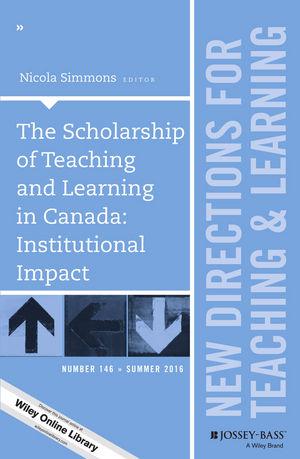
Develop effective models of practice and positively impact institutional teaching and learning quality. This volume provides examples and evidence of the ways in which post-secondary institutions in Canada have developed and sustained programs around the scholarship of teaching and learning (SoTL) that impact the institutional pedagogical climate. Topics include: - the historical development of SoTL in Canada, - institutional SoTL practices, including evidence of impact, - program design and case studies, and - continuing challenges with this work. This is the 146th volume of this Jossey-Bass higher education series. It offers a comprehensive range of ideas and techniques for improving college teaching based on the experience of seasoned instructors and the latest findings of educational and psychological researchers. (From the Publisher)