- Author
- Linder, Kathryn E.
- Publisher
- Stylus, Sterling, VA
- ISBN
- 9781620364369
- Table of Contents
-
Tables, Figures and Boxes
Acknowledgments
Introduction: Why Blended, Why Now?
ch. 1 Fundamentals of Blended Teaching and Learning
ch. 2 Writing Course Goals and Learning Objectives--With Danny Fontaine
ch. 3 Assessing Student Learning in Your Blended Course
ch. 4 Online Assessment Tools--With Linda Bruenjes
ch. 5 Designing Effective Learning Activities
ch. 6 Mapping Your Blended Course
ch. 7 Getting to Know Your Learning Management System--With Sarah Smith
ch. 8 Creating Social Presence in Your Blended Course--With Victoria Wallace
ch. 9 Finding Resources Online
ch. 10 Creating Multimedia Resources
ch. 11 Mobile Devices, Apps, and Social Media--With Victoria Wallace
ch. 12 The Blended Course Syllabus
ch. 13 Preparing Your Students for Success
Conclusion: Getting Ready to Launch
Glossary
Appendices
References
About the Contributors
Index
Click Here for Book Review
Blended (also called hybrid) classrooms, in which face-to-face interaction is intentionally combined with online activities to aid student learning, are becoming more and more common. Most recently, “flipped” classrooms have become a popular method for teaching because more time for active learning in-class can be gained by moving content delivery such as lecture to outside-of-class homework using technology tools such as video or lecture capture. The blended model is proving to be an environment that provides more self-directed, technology-mediated learning experiences for students who will be incorporating technology more and more into their professional lives post-college.
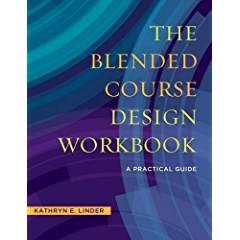
The Blended Course Design Workbook meets the need for a user-friendly resource that provides faculty members and administrators with instructions, activities, tools, templates, and deadlines to guide them through the process of revising their traditional face-to-face course into a blended format.
Providing a step-by-step course design process that emphasizes active learning and student engagement, this book will help instructors adapt traditional face-to-face courses to a blended environment by guiding them through the development of course goals and learning objectives, assignments, assessments, and student support mechanisms with technology integration in mind. It will also help instructors choose the right technologies based on an instructor’s comfort level with technology and their specific pedagogical needs. The book will help each instructor who uses the text to develop a unique course by making choices about their course design based on student learning needs for their chosen topic and discipline. Every component of the workbook has been piloted with faculty designing and implementing blended courses and then revised to better meet the needs of faculty across a range of comfort levels with technology use.
The Blended Course Design Workbook includes detailed instructions for each stage of course design alongside specific activities that the reader can complete. The book is unique because it facilitates a step-by-step process for blended course design with specific templates and tools that can be used across disciplines. (From the Publisher)
Blended (also called hybrid) classrooms, in which face-to-face interaction is intentionally combined with online activities to aid student learning, are becoming more and more common. Most recently, “flipped” classrooms have become a popular method for teaching because more time for active learning in-class can be gained by moving content delivery such as lecture to outside-of-class homework using technology tools such as video or lecture capture. The blended model is proving to be an environment that provides more self-directed, technology-mediated learning experiences for students who will be incorporating technology more and more into their professional lives post-college.
The Blended Course Design Workbook meets the need for a user-friendly resource that provides faculty members and administrators with instructions, activities, tools, templates, and deadlines to guide them through the process of revising their traditional face-to-face course into a blended format.
Providing a step-by-step course design process that emphasizes active learning and student engagement, this book will help instructors adapt traditional face-to-face courses to a blended environment by guiding them through the development of course goals and learning objectives, assignments, assessments, and student support mechanisms with technology integration in mind. It will also help instructors choose the right technologies based on an instructor’s comfort level with technology and their specific pedagogical needs. The book will help each instructor who uses the text to develop a unique course by making choices about their course design based on student learning needs for their chosen topic and discipline. Every component of the workbook has been piloted with faculty designing and implementing blended courses and then revised to better meet the needs of faculty across a range of comfort levels with technology use.
The Blended Course Design Workbook includes detailed instructions for each stage of course design alongside specific activities that the reader can complete. The book is unique because it facilitates a step-by-step process for blended course design with specific templates and tools that can be used across disciplines. (From the Publisher)