Resources
Journal Issue. Full text is available online.

Click Here for Book Review The effort made by Cunningham and his co-contributors will provoke two questions for theological educators: What is it about the concept of vocation that gives it such staying power, and why has it been relegated to the margins of the very institutions that gave birth to the vocabulary? - Frederick W. Schmidt, Garrett-Evangelical Theological Seminary Although the language of vocation was born in a religious context, the contributors in this volume demonstrate that it has now taken root within the broad framework of higher education and has become intertwined with a wide range of concerns. This volume makes a compelling case for vocational reflection and discernment in undergraduate education today, arguing that it will encourage faculty and students alike to venture out of their narrow disciplinary specializations and to reflect on larger questions of meaning and purpose. In conversation with a growing range of scholarly resources, these essays advance the cause of vocational reflection and discernment well beyond its occasional mention in general education courses and career placement offices. The book's thirteen contributors all work in higher education, but they do so as biologists and musicians, sociologists and engineers, doctors and lawyers, college presidents and deans, and scholars of history, literature, and business administration. Together, they demonstrate that vocation has an important role to play across the entire range of traditional academic disciplines and applied fields. Regardless of major, all undergraduates need to consider their current and future responsibilities, determine the stories they will live by, and discover resources for addressing the tensions that will inevitably arise among their multiple callings. Vocation across the Academy will help to reframe current debates about the purpose of higher education. It underscores the important role that colleges and universities can play in encouraging students to reflect more deeply on life's most persistent questions and to consider how they might best contribute to the common good. (From the Publisher)

Click Here for Book Review In Teaching Interreligious Encounters, Marc A. Pugliese and Alexander Y. Hwang have gathered together a multidisciplinary and international group of scholar-teachers to explore the pedagogical issues that occur at the intersection of different religious traditions. This volume is a theoretical and practical guide for new teachers as well as seasoned scholars. It breaks the pedagogy of interreligious encounters down into five distinct components. In the first part, essays explore the theory of teaching these encounters; in the second, essays discuss course design. The parts that follow engage practical ideas for teaching textual analysis, practice, and real-world application. Despite their disciplinary, contextual, and methodological diversity, these essays share a common vision for the learning goals and outcomes of teaching interreligious encounters. This is a much-needed resource for any teacher participating in these conversations in our age of globalization and migration, with its attendant hopes and fears.
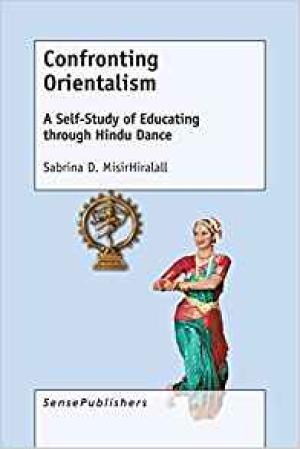
Click Here for Book Review The author aims to use Kuchipudi Indian classical Hindu dance to educate non-Hindus about Hinduism with postcolonialism in mind. This goal arises from her dance experiences and the historical era of imperialism. Colonization occurs when those in power believe there is a need to dominate in a manner that subjugates people. Colonizers created colonies as they moved into territory because they felt there was a need to “civilize” the so-called savages of the land. Postcolonialism is an intellectual discourse that confronts the legacy of colonialism and attempts to de-colonize. With the legacy of colonialism and a postcolonial lens in mind, some research questions arise. How does she, as a Kuchipudi dancer, use Hindu dance to educate non-Hindus about the Eastern literature of Hinduism? For non-Hindus, she feels the power of the exoticizing gaze when she dances, which might very well block the educational intention of the dance. This exoticizing gaze prevents the understanding of the traditional nature of the dance and the introduction to Hinduism as a world religion. The author’s problem is moving the exotic gaze of non-Hindus to an educational gaze that seeks to learn about the ethics of Hinduism in a manner that takes into consideration the multiple perspectives of the complex society we live in today.

Mr. Sosnow, my fourth-grade teacher, interrupted the class as we copied our homework assignments into our black-and-white marble composition books from the chalkboard. With a sly look in his eye, Mr. Sosnow informed the class that he had a special homework assignment for us. He instructed us that by tomorrow, we were to find out how air is made. I ran home, burst through the front door and blurted out the question as soon as I saw my mother: “Mom! Where does air come from?” She looked puzzled. She said, “You mean the air we breathe?” “Yes!,” I replied impatiently, “It’s our homework assignment.” Mom explained that the air we breathe is made by plants. I stopped in my tracks. “Made by plants?????,” I asked. She said that it is called photosynthesis. I thought for sure this was one of those rare times when my mother was mistaken. I thought for sure this could not be correct because we had lots of plants in our house and in our yard and I never once saw a plant make any oxygen. She saw my doubt, my disbelief, and my suspicion. She said, “If you don’t believe me – look it up.” In our house “look it up” meant the Oxford dictionary or our beloved set of World Book Encyclopedias. I ran to the bookshelves and returned to the dining room table with the “E-F” book of the encyclopedia – to look up fotosinthesis. My mother informed me I needed the “P” book. I thought if I needed the “P,” then surely she did not know what she was talking about. I would likely, I told myself, have to wait until my dad got home from work - he would know about oxygen since my mom was, clearly, uninformed. My mom sat at the table with me and helped me find photosynthesis in the “P” volume of the encyclopedia. I was amazed! Oxygen comes from plants – it was in the book! I wrote up the findings from my investigation. When my dad got home, I regaled him with my vast knowledge of the way green leaves take carbon dioxide, water, and sunlight and turn them into oxygen. The next morning Mr. Sosnow created a panel of students to present their findings. Each child, in turn, offered his/her explanation of the production of oxygen. I heard several creative, and one outlandish, notions. I was the final student to speak. I explained photosynthesis and showed a concept map my mom helped me copy from the encyclopedia. At the end of the panel presentations, each student in the class cast a vote for the best explanation of the origin of oxygen. Photosynthesis and I won in a landslide. The beauty of this fourth-grade learning exercise was that Mr. Sosnow knew his students did not know about photosynthesis. The aim of the assignment was discovery. So often in adult classrooms, teachers pose questions, create learning assignments, and craft assignments for grading which presuppose that our students possess certain kinds of knowledge. But what are adult students supposed to know? And if it is so clear, why do so many learners not know? So much of the ecology of higher education communicates that learning is for adults who already know. My fear is that students spend more time pretending to know than they do in discovery, investigation, encounter, and wonder. Our adult students have learned to create strategies against being blamed, punished, embarrassed, and shamed for not knowing what they are supposed to already know. Their charade comes in many forms: asking shallow questions at the beginning of the class to get air time, belligerent silence during classroom discussions, physically hiding behind computers or, to my personal annoyance, talking over people to prove they know what they do not know. Students will also filibuster or attempt to derail the conversation for a conversation set by their own agenda to exhaust the time of the session. All of these behaviors are defensive tactics to survive classrooms where the supposed-to-know knowledge is simply not known. The intense pressure to perform knowing often stifles inquiry. What knowledge should teachers of adults be able to expect? I can honestly say I do not know. It is the same “I do not know” when asked what kinds of jobs adult learners will have in a society in such flux that current jobs are folding and new jobs are not yet conceived. Education cannot meet the needs of a world that is changing at breakneck speed. The enterprise of education does not know what it is supposed to know – just like our students. I confess, when I think of what my students do not know, I am, more often than not, judging persons as remedial, mis-educated, and under-prepared. If I/we shed our arcane notions of stagnate cognitive standards which are already out-of-step with the world, focus upon the learner’s curiosity, and aim at giving the needed tools for investigation, discovery, and inquiry, perhaps we would, together, create more meaningful learning. Adults who make it into a classroom in higher education know a lot, they know enough. How much trust would it take to work with a student to find out what he/she does not know so learning would be more meaningful? How many discovery assignments are needed to support students who do not know? In the fourth-grade exercise, I experienced amazement because what I did not know was not held against me. Instead, what I did not know was my point of inquiry and consequently amazement. My successful inquiry convinced me that the world was a mysterious place and a place where the mystery could be interrogated and understood – at least a little bit. I want my adult learners to be amazed as they learn new ideas, as they encounter new perspectives, as they discover the new complexities of old thoughts, beliefs, and traditions – even if the discovery is about what I think is basic.

Change is the constant in theological education, though it may not seem so from some vantage points. Most people in an organization desire a sense of permanence. Given the nature of the day-to-day routine, most people experience on the job, it's not difficult to appreciate they are lulled into a sense of stability and immutability in their organization. From their perspective, the constancy of the job gives a sense of continuity. Even for Faculty, the annual rhythm and cycles and the academic year can give an unwarranted sense that things change slowly from year to year. From the perspective of the dean, however, change is the constant---intended or not. Deans will confront, manage, resist, hold at bay, or instigate change every year. Most deans would welcome a single year with a minimum amount of change that can provide a "breather" from the steady stream of issues, challenges, and problems that bring about some level of change at multiple levels. Unfortunately, the nature of the job means deans will work amidst a constant swirl of change. C. William Pollard, author of The Soul of the Firm, provides a perspective on change that is critical to theological education in this era. Pollard said, "Without change there is no innovation, creativity, or incentive for improvement. Those who initiate change will have a better opportunity to manage the change that is inevitable." Leaders in theological education should also take his caution to heart: "Learning and innovation go hand in hand. The arrogance of success is to think that what you did yesterday will be sufficient for tomorrow." Theological school deans, then, should embrace that change is part of their job, and accept that not everyone will like it. Deans, however, are also stewards of change in their organizations. As such, wise deans will also question change---that is, they will avail themselves of critical questions that can help them discern the purpose, necessity, and nature of the change they will lead. Questioning Change Here are sample perspectives that can help deans "question change": Do you have a legitimate rationale for the change? Can you rely on good data to inform the change? How much change do you need? What can help leverage the change? (trust, data, internal authority, external pressures?) What is the institution's capacity to absorb change? Has the institution navigated a similar change in the past? Did it succeed or fail? Why? How much risk can you absorb? What will you have to give up to realize the change? Who will you leave behind? What do you want to preserve? What will people grieve? What may be unintended consequences? What level of change is required? (Drastic or incremental?) What type of change is needed? (cultural, organizational, administrative, policy, technological, structural, programmatic, developmental, evolutionary, social?) What is your timeline for change? Is there a window of opportunity that creates urgency? Will your mission change as a result of the change? Does it need to? Will the change actually solve the problem being addressed? Who will commit to the change? Who is most invested in the change? In staying the same? Do you have the resources to make the change? How will you know the change is successful? What metrics will you use? Who will most benefit from the change? Who will be the most disadvantaged by the change? How will the change impact curriculum? Faculty? Students? Finances? The seminary culture? Administration? Can you see the changes through? (Will you leave office or the institution before the change is completed?) Abigail Brenner cautioned that "Change without transition may only serve to recreate old scenarios and reinforce old patterns of behavior. For change to have a salutary effect on us, we need to learn to effectively work with it and not to run the other way when it presents itself." ("The Nature of Change," Psychology Today. May 6, 2011).

Funded by the Ford Foundation, neighboring universities joined in a two-year partnership hoping to make the “learning climate” on each campus “more inclusive of minority voices and ways of knowing” and safer “for the free exchange of ideas” (ii). This spiral-bound handbook documents the plans and experiences of the faculty, administrators, and staff at Alaska Pacific University and the University of Alaska Anchorage who sought to deepen “civil discourse” on each campus. The project primarily focused on faculty development for “difficult dialogues” within classrooms, but also addressed broader campus atmosphere and structures of support. The volume is meant to be a “conversation-starter and field manual for [those] who want to strengthen their teaching and engage students more effectively.” The first four chapters (Ground Rules, Rhetoric/Debate, Race/Class/Culture, Science/Religion) are framed by the training faculty received as part of four day-long faculty intensives. Rather than a straight narrative, each chapter reads as both a how-to manual and an assessment of implementation – summaries of proposed pedagogical techniques are followed by faculty essays that document what happened when they applied those approaches in the classroom. A fifth topical chapter (Business/Politics) documents an additional set of teaching techniques and case studies. Brookfield and Preskill’s Discussion as a Way of Teaching served as a guiding text for the group’s work, but they also drew from the wisdom of fellow faculty. The book’s essays, by thirty-five faculty and staff involved in the initiative, make clear they found the project’s prompt to reflect and adapt teaching approaches to be helpful. The final chapters (Outcomes, Keep Talking) offer an assessment of the two-year project (successful in its deepening of the sense of each institution as a place of “profound learning, of courageous inquiry, [and] deep transformation” for “students, faculty, staff, administrators, and community partners” [247]) and brief suggestions for maintaining the project’s benefits. Every chapter includes color-coded lists, summaries, and tips, which prove useful when skimming the text for material relevant to a variety of topics and contexts. The volume closes with a list of references and readings on topics discussed in the chapters, including: academic freedom, safety, contrapower harassment, rhetoric, argument, debate, identity, privilege, culturally responsible teaching, politics, and social justice. Start Talking includes a deep storehouse of pedagogical and practical wisdom. In many ways the volume reads more like a grant proposal and summary of results than a cohesive narrative. As a result, rather than reading the text straight through, faculty members or departments facing specific issues might search the volume for targeted resources to navigate difficult conversations. Similarly, institutions hoping to shift campus climates in contentious times might identify approaches to pilot with small teams over the course of an academic year. Finally, and particularly because most of the volume’s content addresses difficult conversations around issues other than religion (such as race, class, culture, politics, and science), the book’s resources provide a useful, lower-stakes entry point for faculties at religiously-based institutions to think about how to navigate contentious theological discussions.

Is my teaching good enough? Is your teaching good enough? I believe that good enough teaching and learning are practices of radical hospitality that are needed more than ever today in a political climate of American exceptionalism, increasingly divisive civil discourse, and passionate if conflicting longings to be “great.” While I hope to promote excellence in my work, I don’t ask students for greatness over and above their peers in my classroom; rather, I aim for a learning environment in which every student believes they are good enough to be there. I believe that learning in a group is more possible and probable when the learner experiences themselves not as necessarily better or less than other learners, but rather as good enough, believing that they belong and therefore can participate in learning. However, many students and teachers do not believe they are good enough – a fear that has been communicated through previous learning experiences from pre-school to Ph.D. processes. Believing oneself to be good enough – a requirement for teaching and learning in my opinion – functions like other privileges, available to some more than others and laced with relative power and opportunity. Good Enough? What exactly is good enough? With multiple connotations, this phrase “good enough” is easily misunderstood. In my field of pastoral theology, good enough is a practice of radical hospitality that opens participants to relationships of appropriate support and challenge. D.W. Winnicott, a leading thinker in object-relations psychological theory, imagined good enough practice as responsible and responsive, neither rigidly perfectionistic not negligently unmotivated. Here’s how I explain the concept in my pastoral theology syllabus: “Pastoral theology continues to view the modern psychologies as offering tools for understanding care. One of the most helpful metaphors that pastoral theology has adopted is that of the good enough participant in caregiving. This is not to say that care involves minimal effort. Rather, pastoral theologians have recognized that it is more helpful to aspire to be a good enough pastoral caregiver than a perfect one. This stance requires more effort, attention, and courageous habits of self and communal reflection.” Good enough is also a helpful concept for pedagogical reflection beyond my academic discipline. By good enough, I mean to indicate a deep sense of value, a seat at the table, a voice considered a worthy conversation partner, a belief in oneself as belonging. Is this possible in classrooms today? For students who do not experience believing themselves to be good enough, both perfectionism and apathy are rational responses. However, neither of these responses is healthy for the learning environment not to mention for the learner. Bracketing admissions, financial aid, curricula, hiring policies, tension between institutional traditions and commitments, and more for the moment, when I focus on the students eligible to enroll in my class, if I am committed to good enough teaching, I need to ask how hospitable my teaching is to different learners—especially in this politically divisive moment. Have I designed a class in which students are able to believe they belong? Can each willing participant be good enough? What are some challenges to this kind of radical hospitality in theological education? Which boundaries are required for this kind of radical hospitality and which boundaries must be released? Three Challenges of Radical Hospitality in Theological Education: Room, Representation, and Respect In my teaching, I am confronting challenges to radical hospitality whether newly awakened in this political era, as is the case for many of my white colleagues and students in theological education, or held as longstanding concerns, as is the case for colleagues and students who represent and/or are committed to be in relationship with communities with histories of exclusion from theological education. Specific practices of radical hospitality, such as room, representation, and respect, can dismantle good enough as a privilege in order to invite all students to believe in themselves as good enough participants in learning. I think of these practices as disciplines of inquiry and courageous self and communal reflection. Room: Where is the breathing room in my course design? Is there room in my syllabus for multiple avenues of earning a course grade? Do students have an opportunity to learn how to succeed in the class through assignments that build over the semester? Have I woven enough practice into course time? Is there room in assignments for students to make connections between the course content and what matters deeply to them? Representation: What voices and epistemologies are represented in the course texts and in what order? How might different students feel invited into a conversation (imagined or real) with the authors of these texts? Will all students have to stretch in relation to some readings and feel more at home with other readings? How do I represent, include, and compensate epistemologies, voices, and communities deeply relevant to the course of study but that don’t have access to academic publishing? Respect: Does my syllabus avoid unintentional dehumanization? Do I account for the word “we” and define my authoritative access to speak for groups of people from seminary students to human beings to women? Do I coach students in accounting for their use of pronouns? What structures of accountability have I included in the planning, unfolding, and debriefing of my teaching? Now What? I need to wrestle with the limits of belonging in my pedagogy to consider how to move more deeply into good enough teaching and learning. I do not think that good enough teaching and learning ought to be a privilege restricted to a small group of learners, professors, and learning environments. Good enough teaching and learning are practices of radical hospitality that swing open wide the opportunities of learning. If I want to embrace a good enough pedagogy, I will need to become more aware of and willing to address the challenges of radical hospitality in theological education, especially in my classrooms. I believe theological educators can begin to cultivate pedagogies where all learners have access to being good enough by first recognizing challenges to radical hospitality in theological education. In my next blog, I wonder about dreams, commitments, and strategic practices that invite all learners to believe in themselves as good enough. How have you tried to embody and inspire good enough teaching and learning?
Exposing and disrupting the values which perpetuate white normativity puts a strain on the adult classroom. Individualism is a cornerstone value of whiteness and patriarchy. As persons committed to the flimsy lie of pulling oneself up by the bootstraps, too many students believe that education is best attempted alone. Conforming to the principles and practices of individualism, adult students believe that by leaving the people who formed and shaped them they can better demonstrate excellence. By denouncing accountability to and responsibility for their people, their kin, and their community, they are becoming good U.S. citizens. “To thine own self be true” is exaggerated to narcissism, isolation, and dangerous detachment. The racist values of this U.S. society teach that in order to be real you must be alone. Equally, the U.S. educational system functions to uphold the societal tenants of individualism. Higher education rewards individualism. My teaching colleagues were told that the only way to make a legitimate contribution to their scholarly field of study was to do it alone. Collaboration is cheating! We are discouraged from playing well with one another. Consequently, teachers typically insist upon and praise individualism in adult classrooms. Even for students who understand themselves to be part of a community and enabled by the sacrifices of others, adult classrooms are places of disorientation. The new perspectives, new expectations, new experiences, and new ideas challenge even the most prepared, supported and grounded student. For the student who presumes that individualism is the best way to approach study, the disorientation can become severe and can make learning terrifying. The hardcore pledge to individualism which is a hallmark of U.S. society and the academy only serves to exacerbate the student’s anxieties. Further confusing to the adult student steeped in the delusion of individualism is the classroom that values partnership, cooperation, and collaboration. Group assignments and shared projects that are designed as counterpoints or correctives to society’s hegemonic imagination dumbfound the student who believes the better way is the autonomous way. I have actually heard loud and painful groans when students, upon reading my syllabus, understand that group work is part of the course experience. Students who believe their work is best showcased in isolation resist and refuse to work on group projects. On more than one occasion, I have had to disband fighting groups. On a few occasions, groups were crippled by the logistics of when and how to meet. Repeatedly, groups will do tandem reports with each person giving individual speeches rather than working for a synergized, harmonized product. In several instances, I am certain that groups relinquished power to one student who then did most, if not all, of the work. In all of these situations, my hunch is that those students who saw no pedagogical value in collaboration sabotaged the groups. When self-reliance eclipses a sense of community, belonging, and mutuality or when self-reliance is at the expense of communal care and responsibility, then classroom spaces that affirm values of mutuality and teamwork become experiences of deep pain and confounding for the students – and the teacher. I want my students to become aware that knowing is communal and that learning is relational. Individual knowledge is a fallacy. How we make meaning depends upon the context(s) in which we find ourselves. Who we are and whose we are has direct bearing upon how we learn as well as the measure and merit of learning. Knowing and knowing better requires awareness of relationships. Individualism limits, constrains, and distorts efforts to know beyond yourself. I have over the years developed strategies to signal to students that their connection to their people while learning is paramount and that my classroom is a place to develop skills for collaboration, partnership and cooperation. The exercises are not meant to instantly dissuade students of individualism as a core value. They are meant as moments to consider that there are other, maybe more generative, values to hold dear while learning and living. One of my learning activities is a ritual of invocation. Early in the semester I ask students to consider persons, living or dead, who would be glad they are enrolled in my class. I tell them to think about persons who would support them in school when things get difficult or persons who have their best interest at heart as they move through coursework. When students are ready, I ask that each student in-turn speak aloud the full name of one of the persons. I instruct students, saying one name per turn, to exhaust their list of persons. Once all the names have been spoken, I acknowledge the ancestral and communal love in the room. This conjuring often sustains us. Another exercise is a reflection activity. I give students time to think through their answers, then instruct them to write their answers as succinct lists on the blackboard: Who are your people (describe in race, class, gender and other social location indicators)? To whom are you accountable while in this degree program? Who is praying for you while you are here? Who do you struggle not to disappoint as you study? What highest job of leadership will be afforded you once you have demonstrated reasonable mastery? What is the suffering of your people? What are their vulnerabilities? What is their trouble? Which aspects of their suffering and anguish will you bring to bear upon the conversations in this course? How will you work so that with the taking of this degree you are more informed about the needs of your people? During your studies for which systemic oppression will you become expert for the healing of your people? These kinds of learning exercises help reconnect and remind us we are not alone. At least they help me. Each time I do an exercise of this kind, I name my own ancestors and our troubles. I, too, am reminded that I do not teach alone and that I do not teach in vain.

In all of the world’s religions, one finds the notion of a “holy fool”: an individual who transcends societal conventions with his/her ridiculous behavior and unpredictable manner of revealing moral truths. For my “Religious Heritage of Islam” and “Religions and Cultures of the Middle East” courses, one of my favorite class exercises involves having students read and discuss a variety of stories and sayings about one of Islam’s most famous “holy fools,” Mullah Nasruddin. Nasruddin is a legendary 13th-century satirical figure who is claimed by many – including Afghans, Turks, Kurds, Uzbeks, and Iranians – to be their own. In Arabic contexts, this figure is often known as Joha. Thriving well along the boundaries of traditionally Muslim societies, he remains the inspiration for folklore in places as varied as Georgia, Macedonia, Bulgaria, Azerbaijan, and Sicily. Nasruddin is characterized as devout yet irreverent, unpredictable yet consistently foolish, comically inept yet clever. In this exercise, I help my students to understand how stories about Nasruddin use humor to represent and critique Islamic religious and cultural norms, customs, beliefs, and institutions, and to destabilize widespread assumptions. By presenting lessons in a humorous way, Nasruddin holds up a lens to how people flatter political and religious leaders and tell them what they wish to hear. He takes on the role of the fool, which allows him to be subversive without posing a real threat to venerated systems of authority or to pious conventions that have been dampened by empty formalism. While tales about Nasruddin defy easy classification, I work with students to explore a variety of themes that can be found in them. One theme concerns what I call the “bazaar haggling mentality,” which can be described as “outrageous reasoning” that is nonsensical yet amusing and which challenges the status quo. It also can reflect an ego-centric attitude in that the individual seems driven by his wants and idiotic yet transparent about his foolishness. Here are some examples: The Reason The Mullah went to see a rich man. ‘Give me some money.’ ‘Why?’ ‘I want to buy … an elephant.’ ‘If you have no money, you can’t afford to keep an elephant.’ ‘I came here’, said Nasruddin, ‘to get money, not advice.’(13) Tit for tat Nasruddin went into a shop to buy a pair of trousers. Then he changed his mind and chose a cloak instead, at the same price. Picking up the cloak he left the shop. ‘You have not paid,’ shouted the merchant. ‘I left you the trousers, which were of the same value as the cloak.’ ‘But you did not pay for the trousers either.’ ‘Of course not,’ said the Mulla – ‘why should I pay for something that I did not want to buy?’ (24) Another theme explored is Nasruddin’s critique of the Insha’Allah mentality found in traditional Muslim societies, which have tended to prioritize theological preoccupation with divine will over philosophical reflection on observable causes. This tendency coincides with a cultural inclination to assign a large role to chance or fate, and can involve minimizing the significance of human responsibility in relation to divine causality. Here are some examples: Assumptions ‘What is the meaning of fate, Mulla?’ ‘Assumptions.’ ‘In what way?’ ‘You assume things are going to go well, and they don’t – that you call bad luck. You assume things are going to go badly and they don’t – that you call good luck. You assume that certain things are going to happen or not happen – and you so lack intuition that you don’t know what is going to happen. You assume that the future is unknown. ‘When you are caught out – you call that Fate’. (20) If Allah wills it Nasruddin had saved up to buy a new shirt. He went to a tailor’s shop, full of excitement. The tailor measured him and said: ‘Come back in a week, and – if Allah wills – your shirt will be ready.’ The Mullah contained himself for a week and then went back to the shop. ‘There has been a delay. But – if Allah wills – your shirt will be ready tomorrow.’ The following day Nasruddin returned. ‘I am sorry,’ said the tailor, ‘but it is not quite finished. Try tomorrow, and – if Allah wills – it will be ready.’ ‘How long will it take,’ asked the exasperated Nasruddin, ‘if you leave Allah out of it?’ (29) In contrast to the previous theme, another theme is Nasruddin’s challenges to rationalism. Here we find Nasruddin keeping philosophers and worldly, rational thinkers on their toes by using inconsistent logic: Inscrutable Fate Nasrudin was walking along an alleyway when a man fell from a roof and landed on his neck. The man was unhurt; the Mullah was taken to hospital. Some disciples went to visit him. ‘What wisdom do you see in this happening, Mullah?’ ‘Avoid any belief in the inevitability of cause and effect! He falls off the roof – but my neck is broken! Shun reliance upon theoretical questions such as: “If a man falls off a roof, will his neck be broken?”’(26) Prayer Is Better Than Sleep As soon as he had intoned the Call to Prayer from his minaret, the Mulla was seen rushing away from the mosque. Someone shouted, "Where are you going, Nasruddin?" The Mulla yelled back, "That was the most penetrating call I have ever given. I’m going as far away as I can to see at what distance it can be heard." (98) The Value of Truth ‘If you want truth,’ Nasruddin told a group of Seekers who had come to hear his teachings, ‘you will have to pay for it.’ ‘But why should you have to pay for something like truth?’ asked one of the company. ‘Have you not noticed,’ said Nasruddin, ‘that it is the scarcity of a thing which determines its value?’ (90) By providing my students with handouts listing these quotes, I then ask them to work in groups to identify themes that relate in some way to larger questions of Islamic theology and philosophy (for example, traditionalist and rationalist understandings within Islam) that we have discussed in previous class sessions. We then hold a larger group discussion to discuss these themes as well as ways in which a character such as the “holy fool” can hold up a mirror to society or remind people never to be too sure about their assumptions. Lastly, I also like to project different visual representations of the Mullah, and ask the students what do they see in images such as the following miniature. As the students immediately notice, the Mulla is riding backward on a donkey I ask them why, and then I explain how this miniature depicts a well-known story of Nasruddin riding his donkey backward while leaving a village that he had visited. When asked the reason, he simply responded: “I did not want to disrespect the people by having my back to them.” In my experience, the “holy fool” offers students a fresh way of experiencing Islamic religion and culture, breaking through stereotypes to reveal humanity and humor as well as subtle wisdom and capacity for satire. Many students have testified that exercises involving stories of Mullah Nasruddin are rewarding and valuable, and allow them to think critically about larger issues even while experiencing a deeper respect for the richness of the culture from which the stories emerged. Mullah Nasruddin’s tendency to raise questions but not necessarily answer them helps to open up space for deep questioning and laughter alike. I would like to conclude with one last story, giving the Mullah the last word. The Mulla lost his key and was looking for it under a street lamp. A man noticed that the Mulla was looking for something and stopped to help him find it. After an hour of looking, the man asked the Mulla if he could remember the last time he saw the key and the Mulla replied, ‘In my bedroom.’ The man angrily responded by stating ‘Then why are you looking for it here?’ ‘Because,’ Nasruddin told the man, ‘There is much more light here.’ **All quotes in this blog post come from I. Shah (1971). The Pleasantries of the Incredible Mulla Nasrudin. New York: E. P. Dutton.