Book Reviews
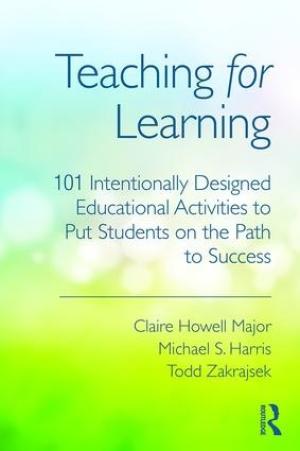
The authors of this extremely helpful book open with an observation that is often true: there is a lot of research on how to teach effectively, but “this information tends to be inaccessible to most instructors, as it has been published piecemeal in journals that instructors frequently do not read” (xi). To help remedy this lamentable situation, they have sifted through hundreds of studies in teaching and learning in order to compile a list of educational activities that both work in real world settings and are supported by research. In other words, if you have ever wondered what kinds of teaching actually lead to learning (retention, critical thinking skills, creative application), and you would like to do a better job of varying your pedagogical approaches, then this book will be of interest to you. Each of the eight chapters focus on a particular kind of teaching and learning format, including lecture, discussion, peer teaching, academic games, reading strategies, writing, graphic organizers, and metacognitive reflection. In clear prose, the authors explain the strengths and drawbacks of each kind of teaching as well as what researchers have found concerning each approach’s effectiveness. For example, lectures work better when instructors keep the lectures short, focused on essentials, and when accompanied with frequent quizzing and guides to effective note-taking. After establishing what works according to research, the authors provide detailed “Intentionally Designed Educational Activities” (IDEAs) to help instructors teach in a way that has been proven to lead to learning. Again, using lecture as an example, some of the suggested activities include guided note-taking, a “find the flaw” exercise, the Socratic seminar, and lecture bingo. The IDEAs, which are delightful and often fun, are cross-referenced with other teaching activities in the book and include helpful “pro-tips” to give additional guidance on implementation. This clear structure makes the book one that can be read cover-to-cover as well as a handy reference volume for specific classroom situations. Both seasoned and new teachers will get a lot out of this book. New instructors will find the help they need when trying to translate their graduate education into effective teaching. More seasoned teachers will find some tried-and-true methods confirmed but will also encounter new ideas to reinvigorate the classroom. While some of the 101 IDEAs in the book are clearly designed for mathematics or scientific fields, the vast majority are well-suited to humanities and social sciences and will be right at home in religious studies and theological departments at both undergraduate and graduate levels. This book has the potential to greatly improve our day-to-day teaching; our students will be grateful.

Jonathan Roach and Gricel Dominguez helpfully remind us that theological writing should be beautiful, compelling, and engaging, but I am not quite sure that I am ready to join their writing revolution. Expressing Theology addresses a broad audience. Epistles to undergraduate students in theology, graduate students, dissertation writers, and “authors in training” dot the text. And the book certainly offers sound advice to writers of theology at any stage in their careers. Chapters five through seven fill the writers toolbox. Here the reader finds the usual contents of a writing primer. Roach and Dominguez introduce the writing process and discuss each step along the way: from drafting to writing techniques, to grammar, and the all-important revision and editing stages. I like that advice from Strunk and White is mixed with wisdom from Gustavo Gutiérrez and examples come from Martin Luther King Jr. and Qoheleth. Perhaps the best things about these chapters are the pacing and style. The authors move through these technical pieces without becoming nearly as dry as many writing guides. The more expressly theological material comes in chapters one through four. I think the authors are really smart to begin talking about engaged theology with a chapter on the writer’s identity and location. Writers are encouraged to own their unique perspectives and to write out of their own experiences. The section on sources somewhat predictably uses an only slightly modified version of Wesley’s quadrilateral, but it is not unhelpful. The chapter on audience prescribes writing theology as a conversation rather than a preachment and I could not agree with this sentiment more. I am convinced! Theological writing should be beautiful and compelling. But I remain a little wary of the revolution that Roach and Dominguez have asked me to join. Throughout the text, the authors attack abstract and “boring” theology as they often repeat the mantra, “keep your feet on the ground.” The theologians among those most often cited are Anne Lamott, Kathleen Norris, and Thomas Merton, all of whom are beautiful writers to be sure and certainly theologians of a sort, but not really shapers of the history of thinking about God. Of course, I do not want to advocate that theology be ungrounded, but I repeatedly wondered if the sort of exacting, often dense, and sometimes technical theology that I read and write would be excised in this revolution. As I read Expressing Theology, I remembered myself reading Tillich and Whitehead for the first time and pondering the world anew as I read sentence by sentence at a painfully slow pace. I thought of Rosemary Radford Ruether so meticulously uprooting essentialisms and utopias, page after page. I relived the moment that tears came to my eyes, when after two hundred pages of groundwork, Jürgen Moltmann declared “Ecce Deus! Behold God on the cross!” (Moltmann, The Crucified God [Minneapolis: Fortress Press, 1993] 205) as God became the godforsaken. I hope that Roach and Dominguez would agree that these too are beautiful and compelling theologies. Perhaps their advice will lead some authors to engaging, elegant, yet complex and careful writing like these.
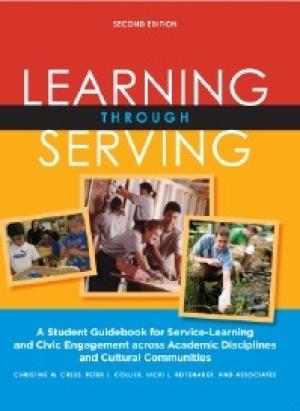
First published in 2005, Learning through Serving is a collection of critical thought on the nature of service-learning, as well as a practical field guide for educators looking to expand their skills in this arena. Cress, Collier, Reitenauer, and their colleagues at Portland State University seek to respond to the organic growth of service programs in contemporary higher education – both curricular and extracurricular. Fundamentally, the authors consider service-learning as a liberatory pedagogical tool that induces students to take control of their own learning, and deconstructs the banking model of schooling (famously attacked by Paolo Freire) that remains dominant in much contemporary education. Learning through Serving is intentionally transdisciplinary, and will certainly be helpful for religious studies or theology educators who employ community-based learning or service-learning models. The wealth of experience the authors share, their diverse voices, and lucid consideration of socially-engaged pedagogy yield great value for those seeking to deepen their practice of service-learning. The authors’ goals are to assist educators and students in thinking through their community service experiences, in the interest of holistic conscientious formation: “In sum, the book is about how to make academic sense of civic service in preparing for students’ roles as future citizen leaders” (xix). Although some readers might balk at the emphasis on “leadership” – and even the use of the term “service” itself – the authors consider a variety of leadership styles suited for different contexts, and make considerable effort to attend to questions of privilege and social justice. This is interspersed throughout the text, but the authors also dedicate a full chapter (“Creating Cultural Connections”) to addressing these issues explicitly. This guide was constructed with the intention that it would be read in the context of an academic class – thus the chapters are arranged to build on one another throughout the course of a semester. Learning through Serving is composed as a textbook, placing great emphasis on clarity and structure, without sacrificing substance for the sake of readability. The different chapters oscillate between hands-on course planning and more theoretical treatments of civic engagement and democratic philosophy. The new edition makes a particular effort to attend to the global interconnectedness that increasingly defines contemporary digital realities. Service-learning courses have traditionally cultivated porous boundaries between “town” and “gown,” but in an academic climate that increasingly embraces remote student enrollment, service-learning benefits from critically considering how it might adjust to accommodate – and even take advantage of – new developments in university structure, while empowering students to be responsible citizens. Cress and her colleagues are experienced enough to know that, in practice, service-learning courses rarely go as planned, and that for a variety of reasons, instructors may have to adjust their approach mid-semester. Ultimately, the service component of a class aspires to be interwoven into the fabric of the more formal coursework, integrating the two elements into a mutually-enhancing, symbiotic whole. Learning through Serving offers a wealth of pedagogical advice for service-learning courses, but also situates service-learning within a larger commitment to civic engagement and building a more just society. It contains invaluable nuts-and-bolts course planning assistance, and gives wise counsel on how to develop enduring, reciprocal community partnerships that build capacity for the long haul.

This is a book about teachers and not about teaching. Furthermore, it is a book about data on mass populations of teachers in higher education from ten different countries ungarnished by local anecdote or illustrative portraits of a faculty person in real working conditions. The reason this book is worth paying attention to in this forum is that it shines a comparative light on the perils and possibilities that face new entrants into the academic field – some of whom will be your colleagues. Or rather, because this book is of more interest as a reference for hiring committees and deans, it tells you of the challenges your candidate has faced to reach your attention in the first place. That is if you are open to exploring how to move from even national inbreeding to internationalization of faculty recruitment. We find here the results of a ten country participative research program into the realities of career preparation, openings and market transparency, prospects and permanence, of the academic life, individually presented and analyzed and then cumulatively assessed by the editors in the final chapter. The countries are Brazil, China, France, Germany, India, Norway, Portugal, Russia, South Africa, and the U.S. There is of course a vast difference in contexts – from massive increase of student demand and a dearth of faculty, to a tedious and precarious shuffle of young faculty into middle age before a realistic prospect of career stability and something coming close to middle class lifestyle. (This latter is an unquestioned normative standard even as it is evident that the status of the academic profession in many societies is falling.) A number of thematic emphases emerge throughout the chapters, specifically the impact of hiring practices and terms of employment on female faculty, the difficulty of inbreeding and the social burden of academic networking, as well as more common experiences of young faculty such as heavy teaching load and administrative obligations with less time for research. It is agreed that contract and temporary employment with attendant uncertainty is the newest but also most detrimental aspect of current higher education. Some gems, of course, emerge from the textual detail. Male professors can get paid more in India after undergoing a vasectomy, a PhD will get male students out of military service cheaply enough in Russia, females are in the majority of doctoral students in Portugal. As a foreign born and trained academic teaching abroad, and given the international prospectus of the book, I shall concentrate a few remarks on the international (and not just national) data. Norway is concerned that too much of its government investment in doctoral work funds foreign born scholars, Portugal experiences a brain gain and often requires doctoral students to have international experience, France is relatively closed as a system, whereas South Africa welcomes PhDs from abroad in large number. Interestingly the chapter devoted to the US paid no attention to its cohort of international faculty. Perhaps this is so because international faculty are imagined to be ubiquitous, but alongside collegial anxiety about brain drain from abroad this disregard of the good or otherwise of international recruitment was noteworthy. India and Brazil have fewer foreign imports but radical differences in conditions for young faculty in public (better) or private (worse) sectors. India has a massive teacher shortage whereas the EU experiences long waits for civil servant professors to retire, and in the US there is not even a retirement age. If teaching religion is to benefit from an international perspective, as I believe it does, it is going to mean pursuing scholars from very different educational settings and looking (for US job searches) beyond easily accessible US-based guild networks. (I leave to others the judgment, case by case, as to whether US-trained international scholars are as international as those trained abroad.) It will mean understanding different pressures faced by potential job candidates from other countries. This book is a great resource for this purpose. Its data may also facilitate the comprehension of institutional pressures that affect the success or otherwise of international scholarly networks and projects as faculty from one country interact with faculty from another. I think of my current project with colleagues from Brazil where the broad data of Elizabeth Balbachevsky's chapter contextualizes what I have picked up in conversation.
Edna Chun and Alvin Evans’ work on the department chair and diversity fills a gap in the literature on academic leadership. They argue that the academic chair is the pivot for diversity in higher education, particularly as increasing numbers of minoritized students enter the academy. Student diversity contrasts with the overwhelming white maleness of academic administrators, including 90 percent of chairs. Nevertheless, chairs are poised to enhance both the student experience of diversity and diverse faculty diversity development. The authors used an online survey and interviewed chairs across the nation to assess the current level of progress in diversity, to address barriers to diversity, to understand environmental factors that can promote or impede diversity, and to articulate strategies for developing diversity. They were particularly interested in talking with minoritized chairs and in the impact of diversity on student learning. By diversity, they mean race and ethnicity as well as gender and sexual orientation. Chun and Evans recognize that department chairs face many limitations in doing diversity work. Changing upper administrations, maintaining harmony in departments, and other issues take up much chair attention. The work begins with an overview of inequality in America, arguing that the role of higher education is to address this social landscape. They examine the challenges in higher education itself, from the impact of MOOCs to globalization and how department and institutional politics can block chairs’ diversity efforts. Serving students is key: Since minoritized students are at-risk for non-completion, campus climate, including diverse faculty and curriculum, can make a difference in those students’ lives. They also argue, in chapter 6, that interactional diversity is an essential dimension among high-impact college experiences for all student growth. Chairs, who occupy a double role as administrator and faculty, span boundaries and are potential bridge-builders. As both buffers and connections between faculty and administration, skilled chairs have the capacity to reflect on and transform these boundaries to mobilize the various stakeholders towards action. Chairs report to deans (analyzed in chapter 4), and trust in that that relationship is crucial for developing diversity, though the “revolving door” of administration in some institutions poses problems. The discussion of issues that minoritized chairs face and the voices of these persons is an important contribution of this book. These chairs are always proving their competence and may be taken less seriously than their white counterparts. A minority chair may be the only departmental voice for diversity. In terms of sexual orientation, some chairs are limited by institutions’ unwillingness to appoint or policies against appointment of LGBTQI chairs. Like minority faculty, minority chairs face lower student evaluations (see chapter 5), may be isolated and vulnerable, and are under great stress. Another key contribution is strategies, offered by chairs and the authors. Each chapter ends with strategies a chair may implement to address diversity. The final chapters offer suggestions for developing diversity plans, including helpful examples, and additional strategies for overcoming limitations. The description of higher education today, the voices of the chairs, and the multiple strategies offered create a rich study, insightful and practical, for aiding chairs to become leaders for a diverse academy in a global context.
Patricia Pérez and Miguel Ceja published Higher Education Access and Choice for Latino Students as part of the Routledge Research in Higher Education series. Grounded in sociological studies of Latino students and their educational choices, the book’s essays highlight the multitude of challenges that confront Latino students in trying to successfully complete higher education. The essays are split into three sections. The first is “Home, Elementary, and Secondary Context”, part two is “Political Context and Postsecondary Choice,” and part three is “Model College Access and Transition Programs.” This structure allows the reader to see how a variety of issues contribute to how and why Latinos make specific choices in higher education. The first section focuses on essays that examine cultural and familial context. In “Sixth-Grade Teacher’s Perceptions of the College-Bound Student” the essay’s authors point to how teachers’ perceptions of what constitutes a “college-bound” student and an emphasis on “good behavior” heavily shapes whether a Latino student is deemed to be worthy of being on the college prep track or not. In the essay “Constructing College Choice” the authors examine how Latino Catholic high school students are coached to understand their “worth” in terms of potential scholarship money, and the pitfalls as well as benefits of this approach. In the second section, the essays focus on political issues affecting Latino college choice such as gender norms and expectations in “Latino/a Students’ College Destinations” and the issues that block access for undocumented students in “Rising Voices.” In the third and final section, the focus is on college access and programs that promote it, such as summer bridge programs for Latino students as described in “Supporting the College Transition Process and Early Academic Success” and in “Community Cultural Wealth and The Latino/a College Choice.” There are fourteen essays in the book; only a few are mentioned here to highlight some of the main themes. The essays cover a wide range of issues regarding Latino student college access, and each section builds upon the previous section, starting with home life and ending with bridge programs at college itself. Overall, the essays are fairly technical, based in sociological research, and this may make it hard for some readers outside the discipline to get though them all. Yet they provide a wide-angle lens on a huge variety of issues that face Latino students in trying to even consider going to college, let alone applying to one. This book is clearly geared towards those who work in the academic field of sociology and who are exploring issues around Latino college choice, and as it is expensive, is recommended for library collections. It is an informative book for educators as it gives them a varied and broad view on all the obstacles that Latino students in higher education face and offers ideas as how to overcome those obstacles in order help more Latino students achieve success.
If teaching is an art its effectiveness rests in the work of many dedicated hands – a conviction that contributors of Coteaching and Other Collaborative Practices in the EFL/ESL Classroom unanimously share. There are many helpful books on teaching but this one is unique in its aim and concrete ways it offers “teachers to collaborate effectively” (xviii). Andrea Honigsfeld and Marla G. Dove achieve their goal of providing “an accessible resource long awaited by educators whose individual instructional practice and/or institutional paradigm shifted to a more collaborative approach to language education” (xviii). Ingeniously compiled, the twenty-six essays, divided into four parts, examine the: rationale for teacher collaboration to support ESL/EFL instruction, presenting current, classroom-based, practitioner-oriented research studies and documentary accounts related to coteaching, coplanning, coassessing, curriculum alignment, teacher professional development, and additional collaborative practices, and offering authentic teacher reflections and recommendations on collaboration and coteaching. (xviii) The authors’ objective is not only to help inquiring instructors teach English as second or foreign language, but also to become effective leaders, learners, and coteachers – a global task. The collaboration encouraged for teachers to exercise transcends teaching English to include other disciplines such as mathematics and biology. Each contributor uniquely provides evidence of how a theory about teaching might be translated into concrete and tangible outcomes. As is evident from the book’s title, collaborations extend beyond just teaching English to fruitful interdisciplinary teaching. The teamwork called for is neither utopian nor essentialist. Rather the authors highlight insights gained from their own experiences of exercising collaborative learning, teaching, and mentorship, highlighting strengths and potential weaknesses.The latter are often symptoms of a lack of deep commitment to collaborative learning and teaching. The art of becoming effective teachers rests on the participants’ willingness to develop a teachable spirit. Put differently, a good teacher is also a student in many ways – one who benefits from the wisdom and knowledge of collaborating with teachers, especially twenty-first century educators who face an overwhelming technological age with a slew of information making it very difficult for a teacher to be fully up-to-date in her or his own field of expertise, much less another field. From a linguistic perspective, to learn English as a second language is also to learn one’s native language – two languages at once. In other words, to grasp English as a foreign or second language, students actually learn more about the syntax of their native languages. As an immigrant myself, who learned to speak and write in English as a foreign language, and now teach and use ancient biblical languages in my writing projects, I treasure the insights and cogent arguments each author made in this priceless volume. In a nutshell, the contributors strongly advocate collaborative or coteaching as a practical and intellectual approach to sharpening one’s teaching pedagogy. To that end, this book enshrines the wisdom of effective learning and teaching -- an invaluable resource that will revolutionize the art of learning to teach for years to come if taken seriously.
This book contains fourteen essays written by deans of teacher education programs in Canada who are leading change initiatives in the midst of turbulent times in North-American post-secondary education. The book examines reforms in programs designed to prepare effective teachers of the future and address the challenges that deans face in leading these initiatives. A number of the essays emphasize the need for attention to diversity in teacher preparation programs. Although one essay describes diversity in language acquisition programs (25-30), more frequently authors emphasize the need to add Indigenous perspectives to curricula. One chapter examines a program designed to increase the numbers of Indigenous teachers and the awareness of Indigenous culture among non-Native students in teacher training programs, but also raises more fundamental questions about the ways that hegemonic discourses about ethnicity and gender are reproduced in education systems at large (7-12). Another chapter discusses the way that teacher education reforms need to come to grips with white privilege and racism: “Beyond ‘content’ we ask students to ask ‘what is knowledge, how is it privileged, and who does it benefit and why?’” (75). On a different front, one dean grapples with the need to add instructional technology amidst financial constraints (43-48), though another chapter promotes advances in technology use: “relational technology” for building effective bonds between teachers and learners; “cultural technology” which help students overcome the “ethnocentric monoculturalism” of education in the West; and “assessment technologies” that measure student engagement, learning attitudes, and learning strategies (55-60). Other essays focus on the dean’s role in leading effective change. One chapter describes deans as middle managers who walk a tightrope between university executives on the one hand and faculty on the other, in a context where key external constituents doubt that faculty can be trusted to change on their own initiative (61-66). Lack of good decanal leadership negatively affects faculty productivity and damages organization culture, while rapid turnover at this level is associated with increased faculty cynicism about change (31-32). Several authors note the importance of collaborative, democratic decision-making in building a common vision for reform. Some of the strategies described include restructuring departments and committees to maximize faculty participation in decision-making; appointing a faculty steering committee in order to foster widespread engagement; and maximizing faculty choice and autonomy by choosing to change an area that faculty either identify as needing reform or is widely perceived as non-threatening. One author stresses the need to establish a good case for change and the timing of the change (88), while another emphasizes collaborative scanning of the environment (34), a practice identified elsewhere as a crucial factor in building an agile organizational culture. The dean of a faith-based teacher education program advises deans to nurture the quality of their inner life during seasons of change by practicing mindfulness, humility, stillness and attentiveness, and a reorienting gratitude that focuses on abundance versus scarcity (37-42). According to these deans, greater attention to diversity in curricula, relationship-centered pedagogies, and participative, collaborative faculty-led decision-making are the mainstays of successful innovation in teacher education programs. My own experience in leading a large-scale change initiative in a seminary suggests that these same ingredients can be successfully applied in other educational contexts.
Student Motivation and Quality of Life in Higher Education provides readers a constructive overview of the relationship between student motivation and quality of life (QOL) in higher education. In five parts comprising twenty-three chapters, the book presents a wide range of topics and emphases. Part I, “Student perspectives,” offers two student case studies (one undergraduate, one graduate), relating their perspectives and experiences as to influences on personal QOL and learning motivation. These reflections set the stage for Parts II through V. Part II focuses on “Theoretical perspectives” concerned with matters of learning motivation, QOL and higher education, and applied positive psychology in higher education (chapters 3-5, respectively). Part III attends to “Diversity perspectives on motivation to learn and quality of life,” containing ten chapters encompassing wide-ranging variables such as international student well-being, higher education views among various nations and people groups, health-related and disability impact on QOL and motivation to learn, and effects of optimism and positive orientation on student well-being and learning. Part IV centers on “Promotion of motivation to learn and quality of life in higher education,” comprising six chapters examining and reflecting on improving academic QOL via counseling, resilience in students and teaching resilience skills via a computer-assisted learning website, eLearning support for mental health and perceived self-efficacy, a peer support program for student well-being, curriculum implications resulting from QOL and motivation and professionalism studies, and reclamation of light and liberty and learning related to higher education and student stress. Part V, the final chapter (23) “Synthesis of motivation to learn and quality of life,” presents the editors’ conclusion and a proposed integrative QOL and student motivation model. Evident strengths of this book include the important (and apparently original) intentional integration of QOL and student motivation, supported with substantive research, reflection, and proposals. Additional strengths of the book include the breadth of the general subject matter and variety of global perspectives. Chapters vary somewhat in terms of research, reflection, and presentation quality (not atypical of edited volumes). One apparent (and somewhat paradoxical) weakness concerns the book’s striving for – and generally achieving – various and useful diversities while also limiting its general ethos to mainly (though not exclusively) medical and health-related students, curricula, and attention. Broadening the research and application to include a wider base of students, disciplines, and curricula (more liberal arts, for instance) would foster greater connectivity within broader academia (undergraduate and graduate) – enhancing the appeal and merit of this already fine tome. Of particular importance is the dynamic “evolving model of education-related quality of life” (210), summarizing well the overall research findings and important reflective and application possibilities pertaining to student motivation and QOL in higher education. The model avoids reductionistic tendencies owing to its complex, symbiotic, and holistic orientation. I recommend this book as a constructive resource for higher education institutions (public and private): the book represents a strong effort toward advancing its stated goal of combining “the concepts of motivation and quality of life with the view to enriching the educational sector” (212).

All of higher education, with community colleges leading the way, must sense and respond to the need to evolve to serve a new and increasingly diverse student body. We live in an era where students will increasingly require myriad new approaches to higher education in order for every student to realize their potential (8). That is the central thesis of The Urgency of Now: Equity and Excellence, one volume in a series sponsored by the Association of Community College Trustees. Chapter one sets forth key arguments in favor of the need to transform community colleges in response to changing student demographics. Chapter two is concerned with the shifting role of accreditation in higher education. In chapter three, the authors address the current system’s reliance upon the credit hour as a time-based model for allocating academic course credit and implore administrators to transition to competency-based models. Chapter four offers a comprehensive blueprint for creating an innovative community college-wide outcomes assessment system. Finally, chapter five targets the critical need for administrators to engage faculty in new and meaningful ways in order to successfully implement positive change that will result in improving instructor teaching and student learning. Today there are increasing demands from public and private sector stakeholders for greater accountability and transparency by colleges and universities (19-20). Thus, “to insure equity in the form of economic opportunity for current and future generations” and to “provide demonstrable learning outcomes that position students for success,” there is an urgent need for new models. At the heart of this call for transformation is the notion that higher education must become a student-centered system rather than defaulting to the traditional faculty-centered model. Community colleges must be at the epicenter of determining what the essential ingredients of such a system should be (113). The Urgency of Now argues that higher education must not simply react to changing demographics in America but it must embrace this phenomenon. The priority for the twenty-first century community college must be student needs and student learning (113). This will require that faculty abandon the function of serving primarily as “fountains of knowledge” and instead embrace a new role as “curators of content” and “tour guides of information” (115). Understanding context is critical. America currently finds itself in the midst of the 2016 United States presidential election cycle. College affordability, rising student debt, and declining funding for public colleges and universities are issues now under debate by candidates for the nations' highest political office. The election comes at a time when the gulf that exists between those students and families who lack the economic resources needed to pay college tuition versus those who can readily afford the cost of higher education continues to rise. The Urgency of Now adds to the political discussion by identifying some of the efforts championed by U.S. president Barack Obama to increase community college enrollment and strengthen public-private partnerships that will improve employment opportunities for those who complete a certificate or degree program (5-6). One must acknowledge that, in the face of opposition from his political adversaries, Barack Obama has advanced the goal of achieving equal access to college for all Americans regardless of race, ethnicity, or socio-economic status. Readers will find that this book offers a timely contribution to public discourse on these topics of concern to many among the American electorate. An average book informs but an outstanding book sparks self-reflection and may even compel the reader to act in new and bold ways. The Urgency of Now: Equity and Excellence is an outstanding read that is recommended for anyone concerned with the plight of higher education. This book presents reasoned arguments which support the goal of reforming community colleges chiefly as a matter of sound public policy and implicitly to further the Judeo-Christian imperative which calls for social justice.