Resources
Youshaa Patel Assistant Professor of Religious Studies Lafayette College These days, Islam is no stranger to controversy. Although we may deplore the mainstream media’s deliberate sensationalization of Muslim conflicts, as professors we can also exploit conflict in the classroom to help our students achieve their learning objectives. Many of my.
Cláudio Carvalhaes Associate Professor McCormick Theological Seminary At the heart of education, the most important “instrument” of our lives, the house we inhabit, is the very core of our selves: our bodies. Fully! It is in and through our bodies that we learn and are able to unlearn. The immense.

Theological school deans are not just theological leaders for their institution, they must be EDUCATIONAL leaders. That is, they must implement sound educational practices related to curriculum, instruction, supervision, assessment, and administration. There is a variety of ways to assess...

Meena Sharify-Funk Associate Professor Wilfrid Laurier University “Women and Islam.” It is a subject that is surrounded by strongly held and divergent opinions, values, and beliefs, as well as by misconceptions, over generalizations, and yes, political agendas. In the 21st Century, there are many competing projects attempting to define who
Tat-siong Benny Liew Class of 1956 Professor in New Testament Studies College of the Holy Cross If you spend much time in the Northwest of California, especially if you are someone who likes to hike, alongside trail maps at visitor centers you will see posters that instruct you how to
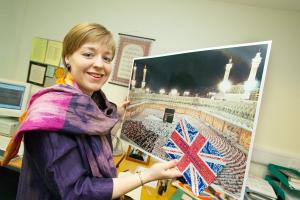
Sophie Gilliat-Ray Director Centre for the Study of Islam in the UK Cardiff University I ended my last blog entry by noting the value of inter-religious relationships formed among students learning about Islam in the higher education environment. Continuing with this theme, one of the consequences of this mixed-faith, or...

Nancy Lynne Westfield Associate Professor of Religious Education Drew Theological School Michael Callahan, brilliant Drew Theological School student, said in his response to a previous blog post, “Silence grants its own power to the one who wields it.” I love this idea! We are crisply aware of the power of..
In the classroom, faculty often rely on a singular way of knowing -- allowing minds to enter the classroom while leaving bodies, spirits, emotions, and experiences outside the doors of the lecture hall or meeting space. Professor of ethnic and women’s studies at St. Cloud State University, Beth Berila imagines something more effective and embodied. After receiving tenure, she enrolled in a yoga teacher training program. She realized the contemplative practices of yoga and meditation could better her teaching, particularly in the area of social justice. Mindfulness could create a space for interrupting oppression and begin “the dynamic process of unlearning” that which may contribute to oppression (x). In each of seven chapters, Berila presents a theoretical framework, reflection and application for classroom learning, practices to cultivate mindfulness, and extensive bibliographic references. Berila’s project aims to recognize oppression and unlearn its destructive internalization for both the oppressed and the oppressor. Mindfulness, Berila argues, can dismantle privilege as well as dislodge internalized oppression. The practices she incorporates into her teaching prompts readers to reflect on their own educational techniques as potentially contemplative and communal spaces for learning. She offers introspective activities like pranayama (a form of breathing), journaling, and mindful awareness of the body. She also offers corporate activities that invite interaction and group discussion. Through both the introverted and extroverted approaches she acknowledges the possibility of triggering dissonance, trauma, and resistance. Berila is a skilled teacher and astute author; she knows well the risk and rewards of the activities she engages. The practices she advocates are new, thought-provoking, and stimulating. Berila is not unaware of the critiques that can be made of pedagogy shaped by mindfulness. She addresses particular concerns directly and then nudges the critics to consider the positive benefits of this method: building empowered communities, fostering compassion, changing oppressive systems, claiming full human dignity and equality for all people, and prompting institutional change. Accomplishing this requires attention to the knee-jerk reaction of shenpa, the Buddhist term for “the negative gut reaction” (109) behind our charged reactions. Disrupting that shenpa is one of the aims of mindfulness and here Berila offers techniques for navigating the complexity of reactions that can occur within individuals and classrooms when that charge occurs. Integrating Mindfulness into Anti-Oppression Pedagogy would be great summer or sabbatical reading when time allows deep contemplation. Her work invites reflection on those moments we wish we had handled differently in the classroom while offering helpful steps forward for future instruction. While integrating mindfulness does not require a teacher to be a master practitioner, Berila prompts small steps we can all take toward integrating body and spirit, emotion and experience into a deeper embodiment that moves beyond our mechanized minds. Plan to read this fascinating book twice. Once in a time and space where you can “pause and breathe” (29), allowing the content to become embodied. And then second, with pen in hand and syllabus in the other, ready to take note of how to incorporate these practices into your next semester of teaching.
In The Pietist Vision of Christian Higher Education, Christopher Gehrz convenes an impressive array of scholars to offer fresh, cross-disciplinary reflections on how the Pietist mandate to form whole and holy persons can invigorate institutions of Christian higher education. Gehrz is professor of history and chair of the history department at Bethel University, and his ongoing work is focused on both tracing and promoting the Pietist impulse within Christianity. His co-authors represent a variety of disciplines, including English, theology, ethics, geography, psychology, nursing, anthropology, physics, philosophy, communication, sociology, and library sciences. The breadth of expertise serves to reinforce the underlying thesis of the book: the Pietistic traditions of seventeenth- and eighteenth-century Germany, nineteenth-century Sweden, and twentieth-century Minnesota can provide a “usable past” with which Christian colleges and universities in the twenty-first century can navigate the many challenges facing higher education. Faculty, staff, and administrators need not serve at institutions traditionally associated with the Pietist tradition to find resonance with the authors’ ideas and perspectives. While the chapters offer a healthy accounting of the influence of Pietism on Christian higher education, the calling to form “whole and holy persons” is broadly shared within the Christian tradition. To be sure, the chapters are written squarely from the Pietist perspective. However, all Christian educators can find avenues for reflection and practices for implementation within this book. The dedication to a holistic vision of student formation, mentoring, teaching, scholarship, and service is a shared and unifying value across the diversity of Christian institutions today – and even as this vision is articulated and pursued in different ways, the Pietist vision offers a unique and compelling framework for contemporary application. The Pietist Vision of Christian Higher Education is organized into four sections and includes an introduction and conclusion by Gehrz. Part one investigates the themes of teaching, scholarship, and community in the Pietist university. Part two explores how changed people change the world. Part three offers responses to the Pietist vision from the natural and health sciences. Part four then explores problems and proposals for putting the Pietist vision into practice. Each chapter is written by a different author, and this brings a refreshing collaborative tone to the entire volume. Even with seventeen different contributors, the book maintains a consistent tone and stays focused on Pietism’s unique influence on Christian higher education. The book is a testament to how the Bethel community deliberately embraces the “usable past” of their own Pietist tradition. Each author has a direct connection to the university, and this means that readers receive rare insights into the Pietist workings of an institution from many different perspectives, disciplines, and backgrounds. The downside to this institution-centric approach is that readers may be challenged by how to appropriate the uniquely-Bethel Pietist ethos to other institutional contexts. However, even though we now know what it means to foster Pietism’s usable past at Bethel, other universities can and should glean from Bethel’s insights as they explore the implications of their own usable pasts for innovation in the future.
The five essays in this volume – on outcomes-based collaborative teaching, learning, and “authentic” assessment, and “connectivist” (86-87) uses of technology and media – are written for Western educators teaching in Asian contexts, but also for teachers in U. S. higher education. The volume is beautifully organized, with short summaries before each essay, as well as strong visuals – charts and illustrations – that summarize information and suggest application. The essays are individually valuable, but they do make a whole volume. The metaphor that the editors use for teaching and learning is choreography, “the rhythmic dance evolving between instructor and learner in the educational setting within higher education” (1). The teacher is a facilitator, moving students through “challenges and uncertainties,” with an emphasis on collaboration, in the Asian classroom. Tieyuan Guo’s introductory essay sets up the discussion, as it examines learning styles of students in and from Confucian Heritage Cultures (CHC). In CHC, students tend to be pragmatic learners (7), motivated by concrete outcomes. Confucian teaching emphasized ren, the cultivation of the human person, throughout a lifetime, towards virtue. The social, practical application of ren was in examinations (keju) used to identify and to promote government officials. This resulted in CHC students’ orientation to passing examinations that led to upward social mobility. Though the Confucian system officially ended in 1905, the understanding remains. CHC students, therefore, put more effort into study than their Western peers (9), and the student persona is different than the Western student. Confucian education values active silence in the classroom, indicating reflection and attentiveness; memorization, mastery, and understanding before application and critical analysis. Silence also involves respect for authority. These may combine to create only “surface learning” (14-15), leading CHC students to so worry about understanding that they do not move to critical thinking and about “losing face” that they do not ask questions. Non-Asian instructors should develop cultural understanding and sensitivity to make sure that CHC students learn. As van Schalkwyk illustrates, in a useful chart, an Asian student raised in a CHC culture accepts rules and hierarchy and prefers high levels of structure. A CHC student may need time in learning; therefore, group discussions and in-class assignments that a non-Asian student might enjoy may generate stress for the Asian student. In the third chapter, van Schalkwyk suggests ways to construct learning activities so as to be sensitive to CHC cultural realities. The fourth essay suggests linking activities to “authentic assessment,” in performance-based, sequential, and interlinked activities that move students towards higher-order cognitive processes (75). The final chapter examines the uses of technology to meet these goals. This important volume asks us to step back from now accepted language of, for example, outcomes assessment in American teaching and learning to understand their impact on Asian students, both in Asian societies and in the U. S. We should take up this challenge and add to it, working to understand how our institutional and classroom structures affect the learning of all students from diverse backgrounds.
Wabash Center Staff Contact
Rachelle Green, Ph.D.
Associate Director
Wabash Center
greenr@wabash.edu