Resources
A 1000 word essay in response to a Call for Papers: “What do you have your students do during a class session when you cannot be present?"
A 1000 word essay in response to a Call for Papers: “What do you have your students do during a class session when you cannot be present?"
One page Teaching Tactic: students reflect on their reading practices for class.
One page Teaching Tactic: students learn about Lutheranism by doing historical research of local congregations.
One page Teaching Tactic: students reflect on the writing rubric used to grade their writing, in an online or hybrid course.
M.Div. programs sequence curriculum in order to cumulatively build competencies for wise, faithful, reflective, appropriate and effective ministerial practices. That is why the introductory preaching course typically is positioned somewhere near the middle of the program. The author of this article discovered that students who, in the semester immediately preceding the introductory preaching course, were apprenticed in the art of critical theological reflection on previously preached sermons entered the introductory course more eager, with more finely attuned expectation levels, and with anxiety levels that promoted rather than hampered learning.
This essay explores intersections among Jesuit, Quaker, and feminist theologies and pedagogies of social justice education in order to propose and elaborate an innovative theoretical and theological framework for experiential learning in religious studies that prioritizes relationality, called erotic education. This essay then applies the relational rationale of erotic education to interpret the author's design of a service or community-based learning component in a course about contemporary U.S. Christian social justice movements, offered in both religiously-affiliated and religiously-inspired liberal arts colleges. The course case study not only chronicles the author's evolving pedagogical praxis as a feminist theologian teaching in Jesuit and Quaker institutions, but also is grounded in how the author's course embodies erotic education, that is, how specific objectives, learning practices, and assignments build and bolster relationships among students (in peer-to-peer small groups inside and outside the classroom) as well as among students and their community sites. In developing this framework and implementing it within this particular course, the author argues that erotic education emphasizes the naming and training of our existential desires for interpersonal relations in order to upbuild not only the individual but also the common good.
The student dramatic performance is an effective way for undergraduates to learn biblical studies. In this article I will give an example of a dramatic performance assignment that I developed over a number of courses and used most recently and most successfully in an undergraduate course in the Hebrew Bible at a small liberal arts college in the Midwest/Appalachian region in 2008. Drawing on my own experience as a teacher, as well as on the ideas of philosophers, educators, playwrights, and biblical scholars, I will explain why such performances are effective teaching tools. I will also give guidance on how to use dramatic performances effectively. I intend to show that the success of this assignment depends on, and ultimately validates, two basic trusts: trust in the intellectual and creative capacity of students, as well as trust in the wealth of meaning in the biblical text.
This paper presents an overview of a newly developed spectrum pedagogy of Christian ethics that emerged from the authors' experience of teaching a contemporary Christian ethics course for seven years. A spectrum pedagogy is a comprehensive approach to teaching Christian ethics that combines the modeling of key dispositions using specific tools (issue-specific spectrums and ethical theories) and learning experiences (engaging multiple positions and responding to concrete situations). The pedagogy gains its name from the issue-specific spectrums used by instructors to orient students to contemporary debate on a given issue and by students in their ethical reflection. The goal of this pedagogy is to empower students to construct their own responses while respecting differing viewpoints without resorting to relativism. This article surveys the essential elements of a “spectrum pedagogy,” describes its implementation into a semester-long course, and identifies multiple benefits of using this pedagogy.
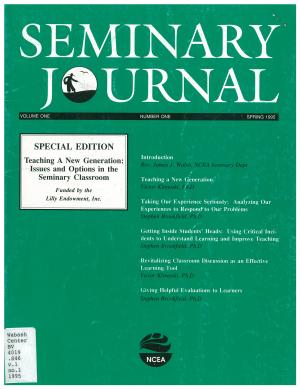
Journal Issue.
Wabash Center Staff Contact
Sarah Farmer, Ph.D.
Associate Director
Wabash Center
farmers@wabash.edu