Home » Resources » Scholarship on Teaching » Learning to Lead A Handbook for Postsecondary Administrators
Scholarship
March 29, 2017
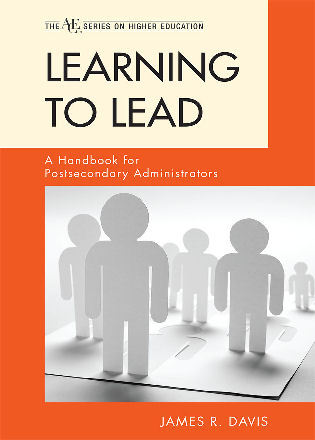
Learning to Lead A Handbook for Postsecondary Administrators
- Author
- Davis, James R.
- Publisher
- Rowman & Littlefield, Publishers, Lanham, MD
- ISBN
- 9781442210462
- Book Review Link
- http://onlinelibrary.wiley.com/doi/10.1111/teth.12119/abstract
- Table of Contents
-
Preface
Acknowledgments
Introduction: The Need for Institution-Wide Leadership
Part I. Understanding the Context for Leadership
ch. 1 Leadership and Administration: Building Practical Definitions
ch. 2 Institutional Structure and Mission: Knowing Your Place in Time and Space
Part II. Building the Skills for Leadership
ch. 3 Program Planning and Review: Exerting Influence and Maintaining Accountability
ch. 4 Meetings, Groups, and Teams: Learning to Collaborate
ch. 5 Communication and Conflict Resolution: Finding Agreement
ch. 6 Problem Solving and Decision Making: Employing Rational, Legal, and Ethical Criteria
ch. 7 Financial Management: Seeing Dollars Everywhere
ch. 8 Change: Moving Forward Gracefully
ch. 9 Positive Work Environments: Managing People and Encouraging Development
Part III. Continuing to Learn about Leadership
ch. 10 Perpetual Learning and Personal Renewal: Shaping the Leader Within
Appendix: Directory of Resources
Index
Leadership is an activity that not only manifests itself in formal positions, but also bubbles up in various places within an organization. Perhaps given the importance of leadership to any endeavor, the literature on this topic has burgeoned. Yet among these titles, Learning to Lead stands out as one of the best texts available on leadership for college and university administrators. Critical skills such as managing people, resolving conflict, and making rational (and legal) decisions are explored within the context of the campus. The book also addresses the needs of those who facilitate leadership workshops, serve as mentors to potential leaders, and teach courses on higher education leadership and administration. While presenting all sides of key issues, the author calls for the reader to define his or her own position through a series of provocative reflection questions in each chapter. Thus the book invites interaction and teaches administrators not what to think about leadership, but how to think about it. (From the Publisher)