Resources
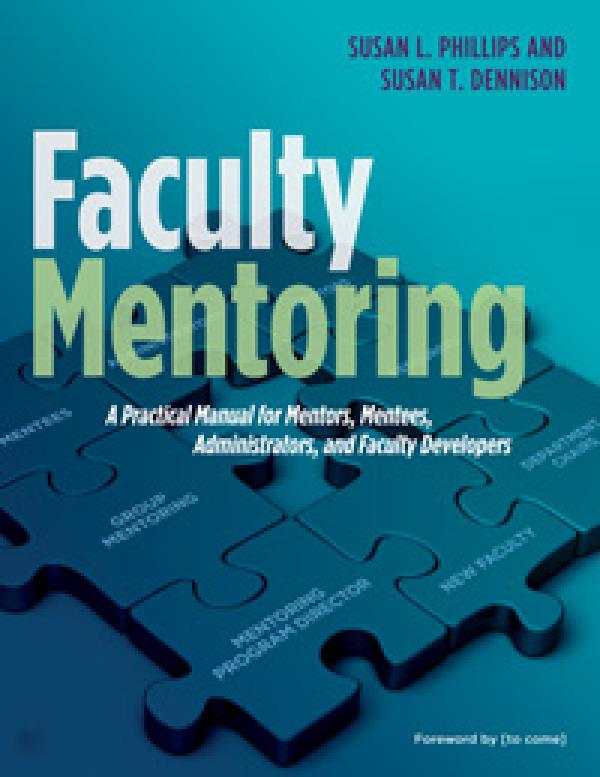
Click Here for Book Review Abstract: Faculty mentoring programs greatly benefit the institutions that have instituted them, and are effective in attracting and retaining good faculty. Prospective faculty members commonly ask about mentoring at on-campus interviews, and indicate that it is a consideration when choosing a position. Mentoring programs also increase the retention rate of junior faculty, greatly reducing recruitment costs, and particularly help integrate women, minority and international faculty members into the institution, while providing all new hires with an orientation to the culture, mission and identity of the college or university. The book provides step-by-step guidelines for setting up, planning, and facilitating mentoring programs for new faculty members, whether one-on-one, or using a successful group model developed and refined over twenty-five years by the authors. While it offers detailed guidance on instituting such programs at the departmental level, it also makes the case for establishing school or institutional level programs, and delineates the considerable benefits and economies of scale these can achieve. The authors provide guidance for mentors and mentees on developing group mentoring and individual mentor / protégé relationships – the corresponding chapters being available online for separate purchase; as well as detailed outlines and advice to department chairs, administrators and facilitators on how to establish and conduct institution-wide group mentoring programs, and apply or modify the material to meet their specific needs. For training and faculty development purposes, we also offer two chapters as individual e-booklets. Each respectively provides a succinct summary of the roles and expectations of the roles of Mentor and Mentee. Faculty Mentoring / Mentor Guide The booklets are affordably priced, and intended for individual purchase by mentors and mentees, and are only available through our Web site. (From the Publisher)
Click Here for Book Review Abstract: Experiential Education in the College Context provides college and university faculty with pedagogical approaches that engage students and support high-impact learning. Organized around four essential categories—active learning, integrated learning, project-based learning, and community-based learning—this resource offers examples from across disciplines to illustrate principles and best practices for designing and implementing experiential curriculum in the college and university setting. Framed by theory, this book provides practical guidance on a range of experiential teaching and learning approaches, including internships, civic engagement, project-based research, service learning, game-based learning, and inquiry learning. At a time when rising tuition, consumer-driven models, and e-learning have challenged the idea of traditional liberal education, this book provides a compelling discussion of the purposes of higher education and the role experiential education plays in sustaining and broadening notions of democratic citizenship. (From the Publisher)
Click Here for Book Review Abstract: Bullying Amongst University Students is a pioneering collection of knowledge and evidence exploring the under-researched phenomenon of bullying in universities. Abusive behaviour amongst young people is a serious and pervasive problem that is exacerbated by the rapid advances in electronic communication, and in this book the authors highlight the problem and proceed to facilitate new practices and policies to address it. This book brings together an international team of authors from a range of disciplines, encompassing education, psychology, criminology, law and counselling, who have carried out research in the area of university bullying. Addressing critical dialogues and debates, the authors explore peer on peer violence, intimidation and social exclusion before considering its effects on students and making recommendations for action and further research. Key topics include: • Cyberbullying and cyber aggression • Rape culture across the university • Homophobic and transphobic bullying • The impact of bullying on mental health • The role of bully and victim across the lifespan • Policies and procedures to address bullying International in authorship and scope, this book will be an invaluable resource for students and researchers in fields such as education, psychology, sociology, health studies and criminology. It is also essential reading for university policy-makers and union representatives responsible for the emotional and physical well-being of students. (From the Publisher)

Journal Issue. Full text is available online.
Click Here for Book Review Abstract: Moving beyond critique, Alternative Solutions to Higher Education’s Challenges uses an appreciative approach to highlight what is working in colleges and universities and offers an examination of how institutions can improve practice. Drawing on examples and cases from real higher education institutions, this book offers a solution-focused framework that challenges the negative assumptions that have plagued higher education. Chapters explore how current narratives have perpetuated and maintained systematic flaws in our education system and have hindered reform. This invaluable resource breaks from the substantial literature that only highlights the many problems facing higher education today, and instead provides alternative strategies and essential recommendations for moving higher education institutions forward. (From the Publisher)
Click Here for Book Review Abstract: Presents the key experiences of a diverse group of teachers and students in their journeys of becoming social justice educator/scholars. This innovative book is a collection of autoethnographies by a diverse group of contributors who describe and theorize about the critical moments in their development as social justice educator/scholars in the face of colonizing forces. Using a rhizomatic approach, the editors’ meta-analysis identifies patterns of similarity and differences and theorizes about the exercise of agency in resistance and identity formation. In our increasingly diverse society, Becoming Critical is a wonderful resource for teacher education and sociology of education as it presents an alternative methodological approach for qualitative inquiry. The book contributes to students’ understanding of the development of critical theories—especially as they pertain to identities. The contributors make use of the work of critical scholars such as Collins, hooks, Weber, Foucault, and others relevant to the lives of students and educators today. (From the Publisher)
Here for Book Review Abstract: Focuses on the opportunities and challenges of using the science of change to improve the academic enterprise. This is not another book about why higher education needs to change. This volume is about how to facilitate change. What could higher education achieve if varied stakeholders decided to work together to accomplish a shared vision by using data and scaling up evidence-based interventions? The contributors offer examples and instructions to help execute change in order to drive collective impact. When we understand large-scale change in other sectors, such as healthcare, business, and the social sector, it can help inform us of what collective impact looks like and how to get there. A deeper investigation into the science of change will enable us to work towards increasing access, overcoming racial disparities, reducing the need for remediation, and improving learning outcomes. (From the Publisher)
Click Here for Book Review Abstract: Winner of the Thurber Prize for American Humor Jason Fitger is a beleaguered professor of creative writing and literature at Payne University, a small and not very distinguished liberal arts college in the midwest. His once-promising writing career is in the doldrums, as is his romantic life, in part as the result of his unwise use of his private affairs for his novels. His life, a tale of woe, is revealed in a series of hilarious letters of recommendation that Fitger is endlessly called upon by his students and colleagues to produce, each one of which is a small masterpiece of high dudgeon, low spirits, and passive-aggressive strategies. (From the Publisher)
When five theological schools realized (a) their graduates affirmed vocation as central to their theology and practice, yet (b) the parishioners of their graduates nevertheless did not feel called, they knew they had to do something. For six years, faculty teams from these schools conducted a variety of experiments in pedagogy, curriculum reform, and program development in order to train their graduates to equip all of God's people to claim and live their vocational identity in the world. This article introduces the identified challenge and necessary theological and pedagogical shift and then describes five of those experiments in greater detail.
These three articles deal with the issue of faith in the classroom – whether one should teach “to,” “for,” or “against” faith. While their institutional settings and experiences are different, the authors all contend that more serious reflection needs to be given to the matter of how religious commitment plays out in our diverse pedagogical settings. The initial article by Carolyn Medine surveys the current climate regarding student spirituality in the classroom, the broader governmental concerns, and, the tensions that inform the choices available to a professor. Todd Penner's essay analyzes faith-as-ideology in the undergraduate classroom, and Marjorie Lehman's contribution analyzes how the issue manifests differently in Jewish Studies.