Resources

Interdisciplinary teaching, learning, and research are often heralded as necessary responses to the many pressures facing contemporary higher education. Defined as the integration of knowledge from two or more disciplines, interdisciplinary work requires a change in the boundaries and norms that have long defined the academy. Through examples from a range of disciplines and institutional types, this volume considers how successful interdisciplinary engagement necessitates a focus on the structure and rewards of academic behavior. This change is an intensely social process, involving dialogue and interation among diverse ideas, individuals, learning environments, and bodies of knowledge. It is this diversity that enables the rich potential of interdisciplinary engagement but also presents the greatest challenges for institutions. This volume considers the obstacles and opportunities inherent in interdisciplinary initiatives. Academic administrators, faculty, and graduate students interested in understanding the disciplinary norms of higher education and cultivating interdisciplinary engagement will benefit from this volume. The author provides theoretical perspectives and practical applications for advancing interdisciplinarity in the classroom, the research laboratory, across the university campus, and outside institutional boundaries. Such endeavors entail not only interaction between scholars and professionals from normally distinct disciplines but also articulation of shared problems or topics that underscore the integration of disciplinary bodies of knowledge. This is the second issue in the 35th volume of the Jossey-Bass series ASHE Higher Education Report. Each monograph in the series is the definitive analysis of a tough higher education problem, based on thorough research of pertinent literature and institutional experiences. Topics are identified by a national survey. Noted practitioners and scholars are then commissioned to write the reports, with experts providing critical reviews of each manuscript before publication. (From the Publisher)
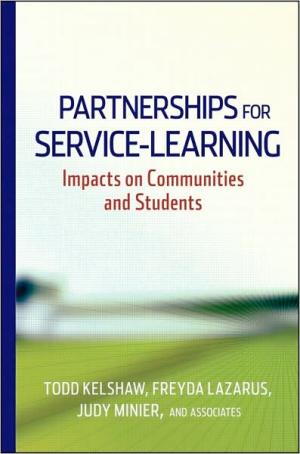
Praise for Partnerships for Service-Learning "These case studies highlight the critical importance of reciprocity in campus-community partnerships. It is through the two-way interchange of knowledge and assets that service-learning achieves its democratic potential as a pedagogy with the power to transform education, campuses, and communities. The examples provided here offer rich and sophisticated models that will be invaluable for community as well as academic leaders committed to deepening the partnering process." — John Saltmarsh, professor of higher education administration and director, New England Resource Center for Higher Education, University of Massachusetts, Boston; and Edward Zlotkowski, professor of English, Bentley University "This practical guide explores the power and pedagogy of K–12 school and university partnerships. This educational 'how-to' is a superior resource and must-read for every school and community leader across the country." — Arlene C. Ackerman, superintendent of schools, Philadelphia School District "This is a rare book about partnerships. It provides testimony to the diversity of real-world problems that can be addressed though service-learning partnerships between K–12 and higher education. Required reading for future teachers, educators, and community leaders interested in building campus-community relationships that embrace collaboration and shared decision-making." — Ramon C. Cortines, superintendent of schools, Los Angeles Unified School District "This is a terrific set of diverse yet complementary case studies illustrating the great potential of P–16 educational partnerships benefitting allparticipants. This book helps explain why service-learning works so well for so many schools, universities, and community-based organizations." — Shelley H. Billig, vice president, RMC Research Corporation?? (From the Publisher)
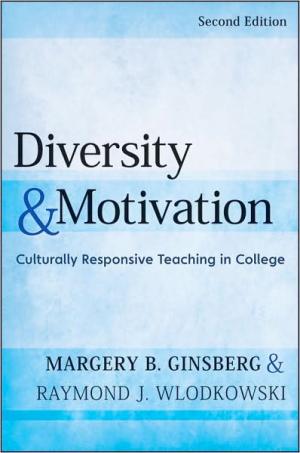
Praise for the Second Edition of Diversity and Motivation "Since the first publication of Diversity and Motivation in 1995, we have consistently used this text and its philosophy in our faculty development at Valencia Community College. I am delighted to see that this new edition focuses on college teaching. Ginsberg and Wlodkowski's approach to the diverse challenges of student motivation is authentic and transforming, and faculty respond!" —Ann E. Puyana, assistant vice president for academic affairs, Valencia Community College "There is a great need for deeper understanding and conceptualization of student motivation across diverse groups to change the consciousness of educators and, ultimately, society. For those of us who teach, and face that need daily, this work illuminates and inspires." —Ed Taylor, vice provost and dean, Undergraduate Academic Affairs, University of Washington? "No one knows more about creating intrinsically motivating classroom environments in diverse settings than Margery Ginsberg and Raymond Wlodkowski. Every educator who wants to engage students fully for success should read this book!" —Beverly Daniel Tatum, president, Spelman College (From the Publisher)

Fifteen years ago Trudy Banta and her colleagues surveyed the national landscape for the campus examples that were published in the classic work Assessment in Practice. Since then, significant advances have occurred, including the use of technology to organize and manage the assessment process and increased reliance on assessment findings to make key decisions aimed at enhancing student learning. Trudy Banta, Elizabeth Jones, and Karen Black offer 49 detailed current examples of good practice in planning, implementing, and sustaining assessment that are practical and ready to apply in new settings. This important resource can help educators put in place an effective process for determining what works and which improvements will have the most impact in improving curriculum, methods of instruction, and student services on college and university campuses. (From the Publisher)

Keeping students involved, motivated, and actively learning is challenging educators across the country,yet good advice on how to accomplish this has not been readily available. Student Engagement Techniques is a comprehensive resource that offers college teachers a dynamic model for engaging students and includes over one hundred tips, strategies, and techniques that have been proven to help teachers from a wide variety of disciplines and institutions motivate and connect with their students. The ready-to-use format shows how to apply each of the book's techniques in the classroom and includes purpose, preparation, procedures, examples, online implementation, variations and extensions, observations and advice, and key resources. "Given the current and welcome surge of interest in improving student learning and success, this guide is a timely and important tool, sharply focused on practical strategies that can really matter." Kay McClenney, director, Center for Community College Student Engagement, Community College Leadership Program, the University of Texas at Austin "This book is a 'must' for every new faculty orientation program; it not only emphasizes the importance of concentrating on what students learn but provides clear steps to prepare and execute an engagement technique. Faculty looking for ideas to heighten student engagement in their courses will find usefultechniques that can be adopted, adapted, extended, or modified."Bob Smallwood, cocreator of CLASSE (Classroom Survey of Student Engagement) and assistant to the provost for assessment, Office of Institutional Effectiveness, University of Alabama "Elizabeth Barkley'sencyclopedia of active learning techniques (here called SETs) combines both a solid discussion of the research on learning that supports the concept of engagement and real-life examples of these approaches to teaching in action." James Rhem, executive editor, The National Teaching & Learning Forum (From the Publisher)

This monograph examines the philosophy underpinning current higher education provision. Contemporary culture seems to encourage consumers to purchase products where the product is shaped by the provider and the input of the consumer is very limited. Research suggests that students, their perceptions shaped by the educational experience they have undergone, view education as a commodity and require that information be packaged for easy consumption. The purpose of this study is to examine the current situation in education against the backdrop of an emerging trend that sees education as a product and students as consumers or customers. The literature provides a basis to argue that a qualification now is frequently a simulacrum while previously it represented knowledge and competency. (From the Publisher)

Teach Them to Challenge Authority gets to the heart of what education should really be about. Drawing on decades of experience, Gregory S. Prince Jr. moves seamlessly between his experience as President of Hampshire College and the broader picture made up of national and international issues. He demonstrates that the debate between "neutral" versus "engaged" universities could have radical consequences - not just for the world of education, but for society as a whole. (From the Publisher)

Globalization is changing the face of Higher Education across the world. Academics and students today are increasingly internationally mobile and, as such, an unprecedented number of international exchanges and cross-border education projects are being developed. The implications for individual universities are significant: international students can bring much-needed revenue to boost university coffers and stimulate university classrooms but they also have high expectations and demands. This book discusses the implications for those involved in managing the organizational processes and those designing programmes and supporting the student experience. A key concern in the text is that of reciprocal internationalization - the importance for universities to develop within an internationally-integrated environment rather than as national universities which accommodate the needs of people from other countries into their pre-existing practices. The emphasis throughout the discussion is therefore on the development of intercultural competences for university staff supported by sustainable international management practices. (From the Publisher)

Love, says the apostle Paul, "does not rejoice over injustice, but rejoices in the truth" (1 Corinthians 13:6). The theological explorations undertaken here all deal in one way or another with the liberating promise and the perplexing problem of truth in Christian life and witness, and with the ways that Christian theology and theological education in their various modes struggle both to seek the truth and to foster the aptitude to honor it. (From the Publisher)

In corporate and government bureaucracies, the standard method for making a presentation is to talk about a list of points organized onto slides projected up on the wall. For many years, overhead projectors lit up transparencies, and slide projectors showed high-resolution 35mm slides. Now "slideware" computer programs for presentations are nearly everywhere. Early in the 21st century, several hundred million copies of Microsoft PowerPoint were turning out trillions of slides each year. Alas, slideware often reduces the analytical quality of presentations. In particular, the popular PowerPoint templates (ready-made designs) usually weaken verbal and spatial reasoning, and almost always corrupt statistical analysis. What is the problem with PowerPoint? And how can we improve our presentations? This slim volume from legendary "information design" guru Edward Tufte answers these questions with Tufte's usual wit, concision, and style. (From the Publisher)
Wabash Center Staff Contact
Sarah Farmer, Ph.D.
Associate Director
Wabash Center
farmers@wabash.edu