Resources
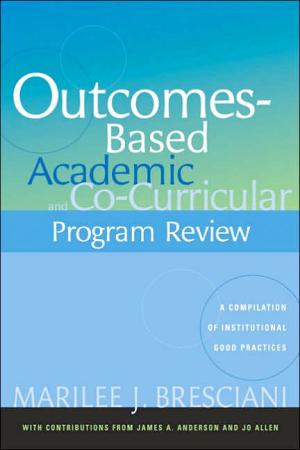
This book offers far more than an introduction to the principles of assessment of student learning outcomes in the context of program review. Within a clearly structured framework, it systematically shares the good practices of some forty institutions recognized by independent scholars for their improvements in teaching/learning, research, and service, to offer examples and ideas for others to learn from and adapt. While the book focuses on assessment of the teaching mission, these same practices apply equally to student affairs, service and research activities. This book is intended for faculty, administrators and staff responsible for implementing and sustaining outcomes-based assessment program review. It aims to help them understand the "what", "why" and "how" of outcomes-based assessment program review. Rather than adopting a prescriptive approach, it provides a rich array of case studies and ideas as a basis for reflection and discussion to help institutions develop solutions that are appropriate to their own missions and cultures. This book answers such questions as what does good outcomes-based assessment program review practice look like from an institutional perspective? How have others initiated and conducted the process? Why did they choose their particular approaches; and who is doing replicable work? It links effective assessment practices with cyclical program review so that the single process of outcomes-based assessment informs many purposes: program review, strategic planning, professional accreditation, institutional accreditation, and possibly even the assessment of general education. This book illustrates the components ofoutcomes-based assessment program review, presents the criteria for identifying good practices and suggests steps for implementing a sustainable outcomes-based assessment program—and does so in a way that will engage readers in critical inquiry about what works well and what needs to be improved. (From the Publisher)
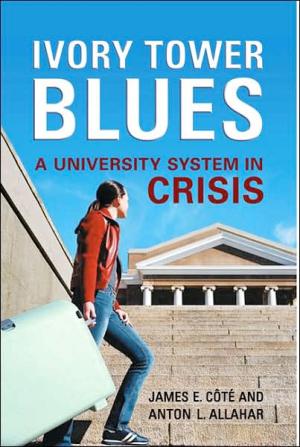
The present state of the university is a difficult issue to comprehend for anyone outside of the education system. If we are to believe common government reports that changes in policy are somehow making life easier for university graduates, we cannot help but believe that things are going right and are getting better in our universities. Ivory Tower Blues gives a decidedly different picture, examining this optimistic attitude as it impacts upon professors, students, and administrators in charge of the education system. Ivory Tower Blues is a frank account of the contemporary university, drawing on the authors' own research and personal experiences, as well as on input from students, colleagues, and administrators. James E. Côté and Anton L. Allahar offer an insider's account of the university system, an accurate, alternative view to that overwhelmingly presented to the general public. Throughout, the authors argue that fewer and fewer students are experiencing their university education in ways expected by their parents and the public. The majority of students are hampered by insufficient preparation at the secondary school level, lack of personal motivation, and disillusionment. Contrary to popular opinion, there is no administrative or governmental procedure in place to maintain standards of education. Ivory Tower Blues is an in-depth look at the crisis facing Canadian and American universities, the factors that are precipitating the situation, and the long-term impact this crisis will have on the quality of higher education. (From the Publisher)

They’re not the students strolling across the bucolic liberal arts campuses where their grandfathers played football. They are first-generation college students—children of immigrants and blue-collar workers—who know that their hopes for success hinge on a degree. But college is expensive, unfamiliar, and intimidating. Inexperienced students expect tough classes and demanding, remote faculty. They may not know what an assignment means, what a score indicates, or that a single grade is not a definitive measure of ability. And they certainly don’t feel entitled to be there. They do not presume success, and if they have a problem, they don’t expect to receive help or even a second chance. Rebecca D. Cox draws on five years of interviews and observations at community colleges. She shows how students and their instructors misunderstand and ultimately fail one another, despite good intentions. Most memorably, she describes how easily students can feel defeated—by their real-world responsibilities and by the demands of college—and come to conclude that they just don’t belong there after all. Eye-opening even for experienced faculty and administrators, The College Fear Factor reveals how the traditional college culture can actually pose obstacles to students’ success, and suggests strategies for effectively explaining academic expectations. (From the Publisher)
The Human Timeline invites students to physically re-create biblical history. Each student holds a card that denotes an event randomly selected from the biblical timeline. They then arrange themselves chronologically to learn the correct flow of biblical history. Because of the movement involved and the arbitrary layout of the cards among their classmates, learners engage their spatial-kinesthetic intelligences through this activity. The exercise proves popular among students who identify themselves as "visual" learners, and ultimately serves the biblical studies classroom by reinforcing biblical history as a necessary framework for understanding the biblical text.
A 1000 word essay on using textbooks in introductory courses (or not).
A 1000 word essay on using textbooks in introductory courses (or not).
“Teaching the Facts, Inculcating Knowledge, or Instilling Wisdom? Rationale for a Textbook in BS101”
A 1000 word essay on using textbooks in introductory courses (or not).
One page Teaching Tactic: students learn theology by working in pairs through the semester.
One page Teaching Tactic: creating a safe context to discuss race, ethnicity, and language.
Wabash Center Staff Contact
Sarah Farmer, Ph.D.
Associate Director
Wabash Center
farmers@wabash.edu