Resources

Roger S. Nam I’m a bit annoyed at the professorial mantra of “teaching, scholarship, and service.” I understand that categories are needed for the various steps of promotion, but I think that this grouping unnecessarily promotes an adversarial relationship between “teaching and scholarship.” The pairing feels analogous to such opposites...
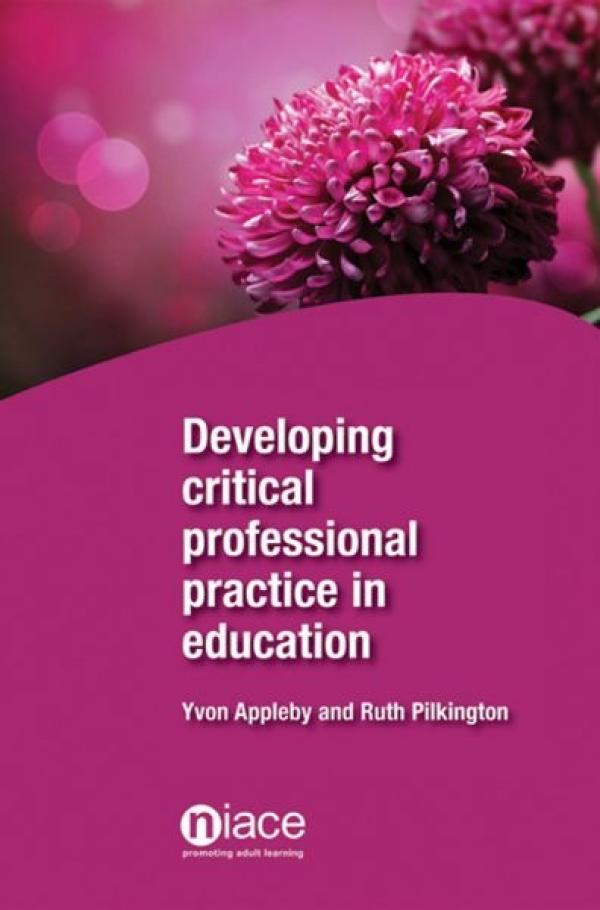
The authors of this volume are intent on promoting the advancement of critical professional development in higher education. They seek to accomplish this by highlighting existing practices and proposing a new model of professional development that is “critical, pragmatic, informed, and flexible” (2). The merits of this new model are said to be its nuance and its attention to the complex and constantly changing landscape of education, particularly higher education. The volume is divided into three parts. Part One focuses on what it means to be a professional, how this term is shaped, and how the discussion surfaces in education. The authors introduce critical professional development as the places where individual growth is shown as a collaboration of individual activity, policy, and institutional and organizational reforms. In support of this model, they advocate the establishment of institutional learning spaces and support structures to achieve their goal. Part Two explores the model’s validity through four case studies. In this section Lynne Barnes and Christine Hough join Appleby and Pilkington in providing examples of the proposed model to enhance teaching and other professional practices. Barnes discusses a training program for deaf teachers, Pilkington explores a framework for professional development, Hough describes her experience in engendering critical thinking in higher education underclassmen, and Appleby discusses her use of writing for professional development. Part Three reflects on these case studies and how they relate to the proposed model. This section also provides recommendations for the implementation of the model and its practice in various organizations. The exploration of professionalism in Part One is dense and jargon heavy, but in this case it is a welcome exception as much of the literature on teaching and learning is filled with clichés and buzz words. The text as a whole is starkly realistic, scholarly, and pragmatic rather than idealistic. As the authors concede, the definition of critical professionalism does not contain any original components; however, it is original in its holistic and practical conceptualization of professionalism in higher education. One limit to the text’s usefulness might be its aim to address both institutional and individual practices. It seems better suited for implementation at an institutional level. Individuals without institutional influence might struggle to implement the model. The text succeeds in providing a model that is not limited by discipline. It provides such a variety of “structures and spaces” (63) that anyone could achieve some benefit from reading the book, while a full implementation of this critical professional practice may be limited. The theory proposed in this volume has wide applicability, and is worthwhile in the fields of theology and religion. Hough’s case study was particularly insightful for those teaching theology and religion. In addition, the entire buffet of professional practices recommended in this text may not be accessible to every reader, but there is certain to be something here for the entire range of practitioners in higher education.
Roger Nam This morning, I received an email concerning course schedule decisions for Spring 2016. It seemed so far away until I realized that it is already 2015. Unbelievably, seven years have passed since I finished my degree and entered my first full time appointment. For most of us, the...
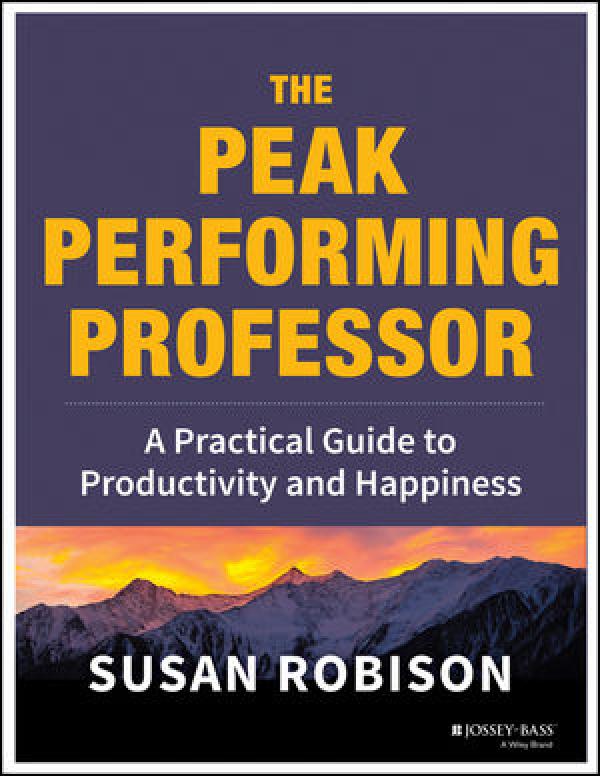
Today the question of how to manage the three dimensions of a professor’s work – teaching, writing, and institutional citizenship – in ways that are satisfying, sustainable, have integrity, and allow for other dimensions of “having a life,” is increasingly fraught. Multiple contextual factors contribute to this state of affairs, from economic conditions that result in fewer tenure-stream positions to demands for greater accountability and the questioning of the value of a baccalaureate degree. The contemporary situation creates uncertainty for faculty, most of whom have made significant investments to become professors. Uncertainty feeds anxiety that grows into distraction that saps energy and enjoyment in the work. This is bad for professors and for their universities. Enter Susan Robison, psychologist, former full professor, and faculty development expert. Hardly naïve about larger contextual factors impinging on the professorate, Robison offers a way forward: teaching faculty practices of self-regulation that “increase their own productivity and satisfaction in areas over which they have control” – their own lives and work (xv). Robison presumes that faculty become professors motivated by deep purposes to which they are committed. Purpose grounds aspirations and commitments. It anchors internal coherence to satisfying lives in which professors accomplish good work as teachers, scholars, and university citizens. From this basic assumption flows Robison’s framework: (1) capture the energy or “power” of one’s deep purpose and articulate that purpose and the mission, vision, and goals that flow from it; (2) establish priorities, organize projects, and cultivate work habits that align with purpose; (3) develop interpersonal skills and cultivate mutually supportive relationships; and, (4) engage in the self-care essential to long-term health. After explaining and providing both reflective exercises and concrete strategies for each element in the first four parts of the book, Robison applies her framework very explicitly to the roles that professors occupy – professor, teacher, scholar, servant leader, and human being – in part five. Her claim: when individual faculty “define productivity and happiness for themselves with a view to their own long-range success,” the results will benefit both faculty and institutions (11). Composed in a workbook format, readers can turn to the sections of the volume that most interest them, or read from beginning to end. The volume employs theories and strategies from a range of fields, selected, conceptualized and presented specifically for faculty. This is one of its strengths. It also has an extensive bibliography for those wishing to pursue a particular topic. Robison’s positive tone and direct, uncomplicated approach likely will lead some readers to dismiss The Peak Performing Professor as too simple, too normal. And the workbook format leads to some repetition. But for those trying to compose lives and careers, those looking to find a way to retrieve the lost pleasure of being a professor, and those charged with supporting others to do good work, this is a book worth reading
Kate Blanchard It's late January in Michigan and I'm in a certain mood. So here for your mid-winter schadenfreude are eight (click-baity) things I hate right now, in no particular order. Perhaps many of you can relate. Teaching requires me to dress like a grown-up. While I have male friends...
Eric D. Barreto I love the holiday season, but I think I loved it more as a student than as a teacher. The Christmas season was usually a clear barrier, a distinct break. Finals were done. There was no more work to do. The weeks of Christmas and New Year’s...
Eric Barreto, Kate Blanchard and Roger Nam This holiday week, we thought we’d share some of our favorite places where we get stuff done: grading, class prep, research, administrative tasks, service projects, grants and even some occasional writing! Roger: Back home at George Fox University, I rarely do more than grab a book or journal in the...
Eric Barreto, Kate Blanchard and Roger Nam I’ve started wondering recently if scholarship boils down to the courage to say something aloud, the courage to say something in the midst of a chorus full of others saying similar or different things. This same description could well be applied to...
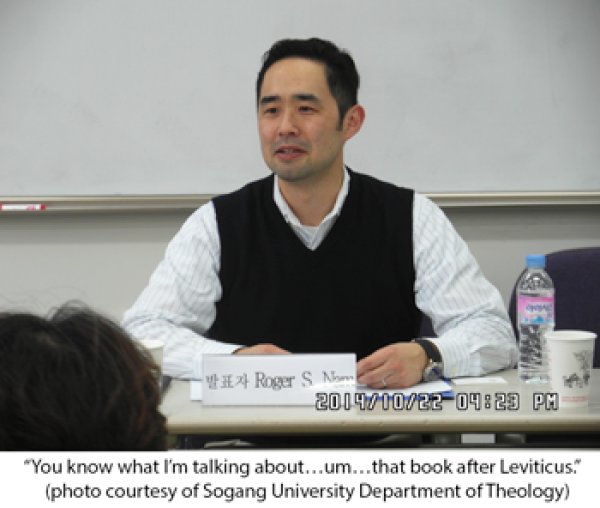
Roger Nam Full disclosure: I struggle with the Korean language. Although I completed an M.Div. degree in Seoul, Korean is still a second language to me. Through an odd combination of reading Korean theology books and listening to 1990s K-pop, I have a decent, albeit strange, vocabulary. But my Korean sentence construction...
Eric D. Barreto On the eve of my doctoral comprehensive exams, I felt like the smartest person in the world. I had drunk deeply from the well of New Testament scholarship over several months. From Origen to Bultmann, I had read and digested texts, ancient and modern. My stack of...