Resources
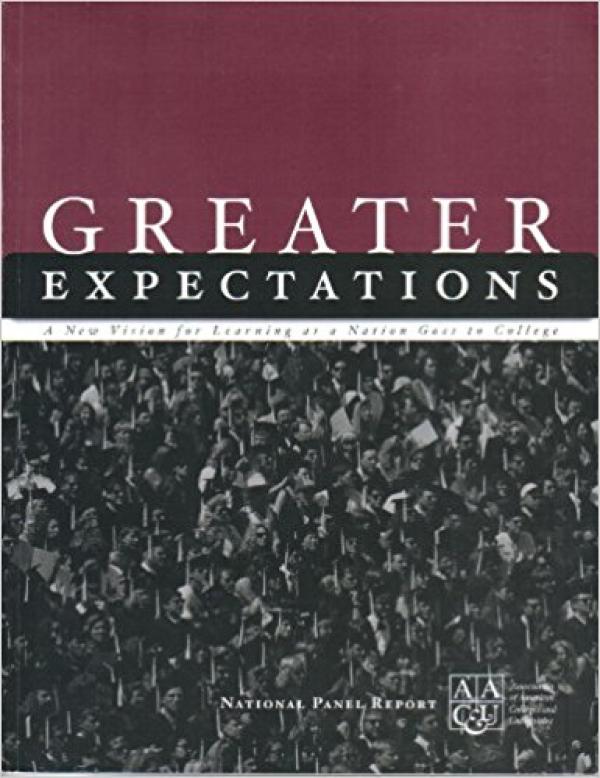
This report of the Greater Expectations National Panel calls for a new focus on excellence to better prepare students for the 21st century world. The report recommends the creation of a New Academy characterized by high expectations, a focus on learning, commitment to demonstrated achievement, intentional practices, and an engaged, practical liberal education for all students. (From the publisher)
In October 2008 The American Academy of Religion published the findings of an eighteen month study (conducted with funding from the Teagle Foundation) on “The Religious Studies Major in a Post–9/11World: New Challenges, New Opportunities.” Re-published here, this AAR-Teagle White Paper provides the opportunity for four respondents to raise issues and questions about the teaching of religion in their own institutional contexts. First, Jane Webster describes how the White Paper's “five characteristics of the religion major” find expression in her biblical literature course. Then James Buckley suggests some of the general level teaching issues provoked by the study and analyzes how well the White Paper aligns with how the teaching of religion is conceived in his Catholic university context. Tim Jensen draws comparisons between the White Paper and the higher education structures and goals from his university context in Denmark, raising questions about what motivates students to major in religious studies, the “utility” of a religious studies major, and whether students' religious and spiritual concerns ought to enter the classroom. And finally Stacey Floyd-Thomas finds surprising similarities between the state of the religion major and the various crises facing contemporary North American theological education.
This essay presents educational principles of Mahatma Gandhi, specifically principles of character education, as a model for strengthening non-violence in students. Its major concern is to show that Gandhi's ideal of non-violent character education is important for university teaching in disciplines including religious studies, and that Gandhi offers methods for fostering non-violent character, namely the teaching of world religions, service learning, and setting an example. The effectiveness of Gandhi's views, moreover, finds some support in contemporary teaching practices, including my own experiences in the classroom.
Teaching Tactic: allowing students to establish parts of the curriculum of a course.
This article describes and analyzes controversies in Japan brought about by an intercollegiate educational project on religion. The project team, consisting of selected members of the Japanese Association for Religious Studies and the Japanese Association for the Study of Religion and Society, has been planning a new system for qualifying undergraduates as "specialists in religious cultures" (sh ky -bunkasi). It is anticipated that students with this qualification will be engaged in various occupations that require knowledge of different cultures. The project reflects an increased awareness that the academic study of religion should play a social role and be recognized as worthwhile by the public. This article will focus upon the academic and pedagogical challenges that the project members faced in the process of planning a system to assess and qualify students' literacy in religious traditions. It will argue that religious literacy involves the dynamic ability to put knowledge into practice as well as to reflect continuously upon previously acquired knowledge.
The dissimilarity that exists between the historical and cultural situation of North American college students and the world described by the biblical authors poses a problem for theological and religious education. While the biblical authors tell fantastic stories of miracle and magic, the scientific and technological paradigm prevalent in western culture emphasizes the gathering of objective facts in the name of efficiency and pragmatism. Theological education tends to respond to this situation by embracing either a program of historical criticism or a form of Biblicism, both of which reinforce an objectivist approach to education. What is needed in theological education is an approach that "re-mythologizes" the Bible, enabling students to hear the theological message of the text addressed to their cultural and historical situation. One way this approach can be encouraged is through the teaching of the biblical text in conversation with the contemporary stories found in popular culture.
Stephen Prothero's Religious Literacy makes a strong case that minimal religious literacy is an essential requirement for contemporary U. S. citizens. He argues further that high schools and colleges should offer required courses in the study of religion in order to help students reach that baseline literacy. Beyond the general recommendation that such courses focus on biblical literacy and the history of Christianity, however, Prothero does not sketch out his proposal for teaching religious literacy. This essay argues that in addition to providing factual knowledge, teaching for religious literacy needs to involve sustained attention to how religious people use that factual information to orient themselves in the world, express their individual and group self-understanding, and give their lives direction and meaning. Such attention to the dynamics of religious life can also help students understand why human beings have persisted in this mode of behavior.
This manuscript is an edited transcript of a panel discussion held at a Society of Biblical Literature conference (Boston, Massachusetts, November 22 to 24, 2008). Alice Hunt begins the discussion by summarizing the content and significance of a new book by Dale Martin, The Pedagogy of The Bible (Westminster John Knox Press, 2008) in which he argues that biblical studies in seminaries and divinity schools give too much emphasis to teaching the historical critical method and not enough to preparing students for ministry by teaching them to be self-reflective practioners of the improvisational skills of interpreting scripture. Then a panel of bible scholars, including the author, conduct a wide-ranging discussion that raises questions about how biblical studies might better prepare students for ministry, as well as the proper role and appropriate pedagogies for introducing biblical studies in the undergraduate liberal arts curriculum.
Can one uphold a call from an ecclesiastical body while teaching in a college classroom? This paper will argue that the dual roles of pastor and professor can be integrated by the adoption of faith development as a learning goal. This goal seems to stand at odds with three important aspects of academic teaching: the demographic reality of religious pluralism, the ethical requirement to preserve student autonomy, and the overarching goal of a university education to promote critical thinking. My argument will be that, far from violating these three areas, faith development as a broad learning goal can actually provide a valuable deepening of pluralism, autonomy, and critical thought in the educational experience of students. The method of exploration will be autobiographical. I will show how it is that in my dual roles as an ELCA pastor called to a faculty post I articulate and use faith development as an overarching learning goal in the context of (1) a theological pedagogy based on an interfaith logos theology, (2) a value-laden pedagogy vis-à-vis consumerist self-formation, and (3) an adaptation of stages of faith development to the classroom.
The proliferation of methods of literary criticism in biblical studies raises the question of how to introduce students to the field. This article argues that the work of Northrop Frye is useful for teaching the existential meaning and social impact of the Bible. The first section introduces relevant aspects of Frye's literary theory. The second presents the author's teaching as a case study. The third section concludes with implications for a philosophy of theological education.