Resources
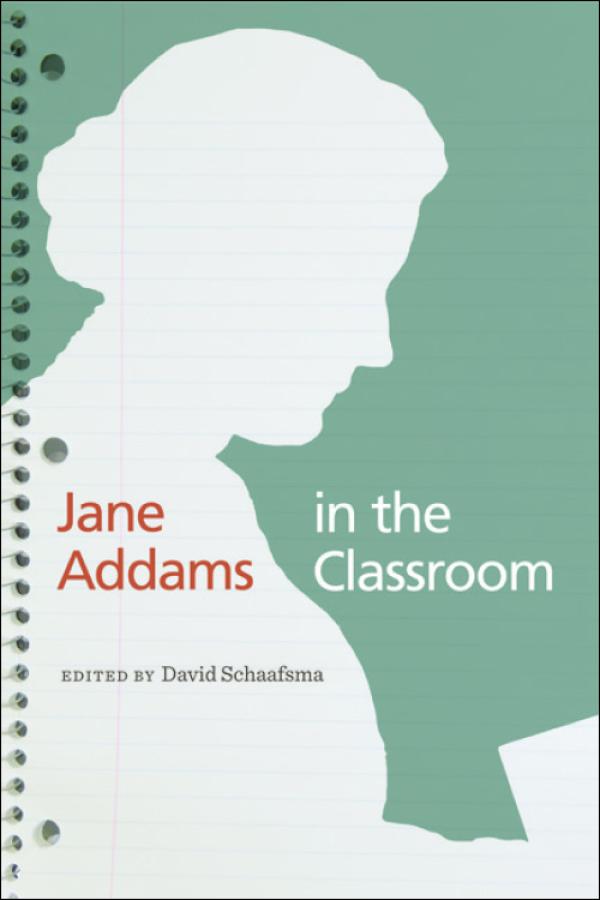
Click Here for Book Review Abstract: Once intent on being good to people, Jane Addams later dedicated herself to the idea of being good with people, establishing mutually-responsive and reciprocal relationships with those she served at Hull House. The essays in Jane Addams in the Classroom explore how Addams's life, work, and philosophy provide invaluable lessons for teachers seeking connection with their students. Balancing theoretical and practical considerations, the collection examines Addams's emphasis on listening to and learning from those around her and encourages contemporary educators to connect with students through innovative projects and teaching methods. In the first essays, Addams scholars lay out how her narratives drew on experience, history, and story to explicate theories she intended as guides to practice. Six teacher-scholars then establish Addams's ongoing relevance by connecting her principles to exciting events in their own classrooms. An examination of the Jane Addams Children's Book Award and a fictional essay on Addams's work and ideas round out the volume. Accessible and wide-ranging, Jane Addams in the Classroom offers inspiration for educators while adding to the ongoing reconsideration of Addams's contributions to American thought. Contributors include Todd DeStigter, Lanette Grate, Susan Griffith, Lisa Junkin, Jennifer Krikava, Lisa Lee, Petra Munro, Bridget O'Rourke, David Schaafsma, Beth Steffen, Darren Tuggle, Erin Vail, and Ruth Vinz. "These well-crafted essays continue the conversation about Jane Addams as a distinctive voice in American letters, one that appeals to scholars across academic disciplines. David Schaafsma's collection speaks to a wide variety of readers, particularly those who are themselves teachers."--Katherine Joslin, author of Jane Addams: A Writer's Life "Jane Addams in the Classroom makes major contributions to scholarship on Jane Addams--but also, more broadly, to educational leadership models and teachers’ own individual avenues to social activism. By connecting with Addams as a theorizing story-teller, as well as with scholarship on Dewey, Freire, and other advocates for progressive pedagogy, this collection provides a useful lens for educators seeking to examine their own teaching practices critically. Given the pivotal role that Addams played in community-based education promoting sustained civic engagement, this book is long overdue."--Sarah R. Robbins, author of Managing Literacy, Mothering America (From the Publisher)
This graphic, with relevant links to Wikipedia, attempts to briefly describe all the established learning theories. It also maps the theories graphically 1) to one another, 2) to their key concepts and "world views," 3) to the learning theorists that developed them, and 4) to the scientific disciplines from which they arise.
Article by James M. Lang in the Chronicle of Higher Education. Suggestions ways to create a teaching philosophy that will be remembered by a search committee or a tenure and promotion committee. Recommends: thinking about end goals; distinguishing general and specialized courses; giving specific examples; and citing influential sources.
Article by James M. Lang in the Chronicle of Higher Education. Suggestions ways to create a teaching philosophy that will be remembered by a search committee or a tenure and promotion committee. Recommends: thinking about end goals; distinguishing general and specialized courses; giving specific examples; and citing influential sources.
Link from Vanderbilt University, Center for Teaching. Describes purpose and elements of portfolio as well as general guidelines. Includes reflection questions on teaching to jump-start the writer. Has links to other websites with resources and exercises to help with drafting the portfolio.
Link from University of Michigan, Center for Research on Learning and Teaching. Provides suggestions on how to begin drafting document. Includes characteristics of effective statements. Has a rubric with elements that search committee may consider. Addresses questions that job candidates may face relating to the teaching philosophy.
Link from Washington University in St. Louis, The Teaching Center. Suggests four questions to consider: 1) Why do you teach? 2) What do you teach? 3) How do you teach? 4) How do you measure your effectiveness?. Offers formatting tips and strategies for beginning the first draft of the document.
Link from Ohio State University, University Center for the Advancement of Teaching. Describes purpose and components of a philosophy of teaching statement. Gives formatting suggestions and includes examples from humanities, sciences, and social sciences. Provides links to other sites and hard copy references.
If you're willing to move outside your familiar and comfortable way of teaching and try team teaching, you'll find many challenges but also many rewards.
The discovery that students don't love the new teacher's content area is one of those school of hard knock lessons.