Resources
The monographs collected in this volume are based on research into the role of chief academic officers in North American theological schools. (From the Publisher)

Presents the results of a research study which surveyed the state of the deans of 75 percent of North American theological schools. The study profiles, who the deans are the types of work that they due, and their role in the administration and governance of schools. Reasons for high turnover are explored and recommendations are made to help schools encourage and develop leadership qualities in academic deans. (From the Publisher)

A really thoughtful and skillful examination (based on two research projects conducted between 1978 and 1987 which involved fifteen institutions) of the ways in which faculty and students think and learn, offering a concept of undergraduate teaching as a lifelong art that involves the continuous interaction of professors and students. (From the Publisher)
"This handbook provides essential information on regulations and procedures. It is a compilation of policy and procedure statements from a variety of the Department, College of Arts and Science, and the University Graduate School documents. It is intended as a guide to fulfilling the responsibilities associated with an appointment as an Associate Instructure"

Describes strategies through which faculty can document and "go public" with their teaching - be it for purposes of improvement or evaluation. Each of nine chapters features a different strategy - from the fairly simple, low-risk "teaching circle," to "course portfolios," to more formal departmental occasions such as faculty hiring - with reports by faculty who have actually tried each strategy, guidelines for good practice, and an annotated list of resources. Offers lessons campuses can use to create more effective systems for the formal evaluation and reward of teaching. (From the Publisher)
Presenting numerous activities--for both individuals and groups--designed to foster self-knowledge and growth in teaching, the authors examine the primary elements of the teaching-learning exchange. Valuable special resources, including scales for measuring beliefs and values about teaching describes individual teaching styles. (From the Publisher)

This important new work will help department chairs, faculty, and administrators understand and address the increasing complexity of relationships within higher education, as well as the growing influence of external factors. The Department Chair as Academic Leader is a completely updated revision of Allan Tucker's seminal contribution, Chairing the Academic Department, last published in 1992. This work reflects the approach used in the ACE Workshops for Division and Department Chairs and Deans. (From the Publisher)
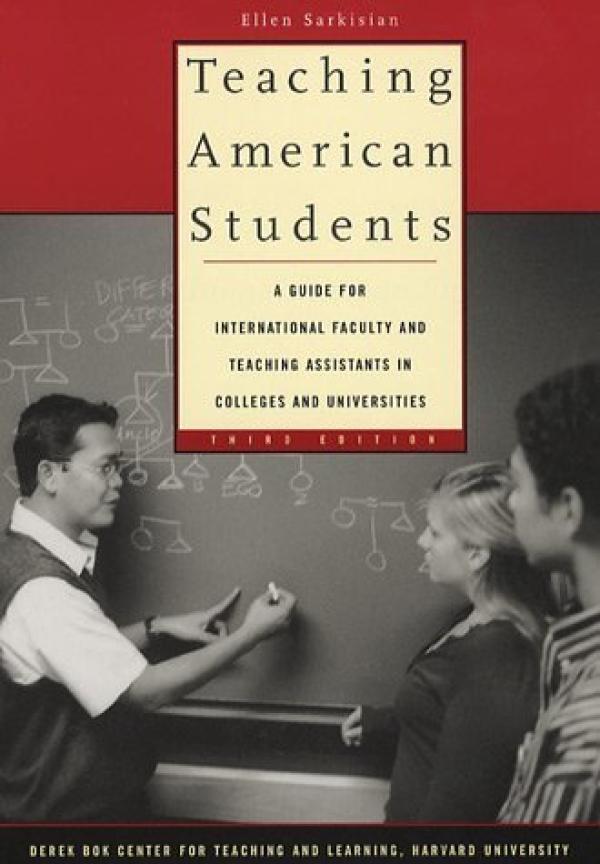
Many faculty and graduate students from other countries expect language difficulties when they teach, but are unprepared for other surprises: different cultures make different assumptions about the academic background of college students, how students learn, the appropriate roles of teachers and students, and even the fundamental purpose of a college education. The third edition of Teaching American Students explains the expectations of undergraduates at American colleges and universities and offers practical strategies for teaching, including how to give clear presentations, how to teach interactively, and how to communicate effectively. Also included are illustrative examples as well as advice from international faculty and teaching assistants. Appendices offer concrete suggestions on topics from planning the first day of class to grading papers and problem sets. (From the Publisher)
This sourcebook provides workshop leaders and designers with the information necessary to hone their skills in everything from planning and instructional design to delivery and evaluation. The authors are seasoned workshop veterans who give practical suggestions grounded in both experience and theory. This volume will help professionals navigate the challenges and exploit the potential of distance learning; effectively use technology and the media to enhance their workshops; and negotiate power dynamics in the intensity of the workshop atmosphere. This is the 76th issue of the quarterly journal New Directions for Adult and Continuing Education. For more information on the series, please see the Journals and Periodicals page. (From the Publisher)
Colleges and universities in the United States are experiencing a major shift: while their student bodies change, their faculties remain largely the same--at least in the short run. The student body grows increasingly diverse in terms of ethnicity, economic status, and academic preparedness, with more and more students coming from the groups that have been least-well-served by higher education in the past. Student retention and ultimate success depends, in part, on the ability of professors--most of whom have been teaching for many years--to provide appropriate classroom experiences and learning assistance. Faculty demographics present a start contrast: the professoriate, mostly white and male, will continue to age as the large faculty cohort hired in the 1960s and early 1970s reaches mid- and late career. More than half of all full-time faculty members in 1988 were over forty-five, nearly two-thirds had tenure, and relatively few between the ages of forty-five and sixty anticipated leaving their current position. The faculty members who face the challenges and opportunities of the college classroom in the 1990s are a seasoned, stable, and job-secure group. Happily for students and for institutions, faculty members frequently focus their energies on teaching in their later decades of their careers; to date, institutions seeking to support this crucial refocusing have not had resources or models to draw upon. If senior faculty in their last decades of professional service do, in fact, turn their collective energies to improving teaching and learning, the potential for long-term impact on collegiate education is tremendous. Engaging senior faculty, who control the reward structure, in reflection on how excellent teaching is best supported can fundamentally alter institutional priorities toward a more appropriate balance between teaching and research--and create a better teaching environment. (From the Publisher)