Resources
This study replicated and extended Wanzer et al.'s (2006) typology of appropriate and inappropriate teacher humor and advanced explanations for student interpretations of teacher humor. Three explanations were advanced for why teacher humor may be perceived as inappropriate by students. First, disposition and incongruity-resolution theories were used to explain the cognitive and affective elements of teacher humor, second, student communication predispositions were advanced as an explanation, and the third explanation was teacher communication predispositions. ..PAT.-Unpublished Manuscript
The purpose of this study was to examine the gender bias in student ratings of effective teaching. Students in five colleges were invited to rate instructors on three factors: interpersonal characteristics, pedagogical characteristics, and course content characteristics. We analyzed group differences based on student gender, instructor gender, and student level. Ratings of pedagogical characteristics and course content characteristics yielded significant interactions between student gender and instructor gender, but no differences were found among groups on interpersonal characteristics. We concluded that gender bias plays a role in students’ views of effective teaching in terms of how students evaluate pedagogical and content characteristics and that this bias generalizes across student levels.
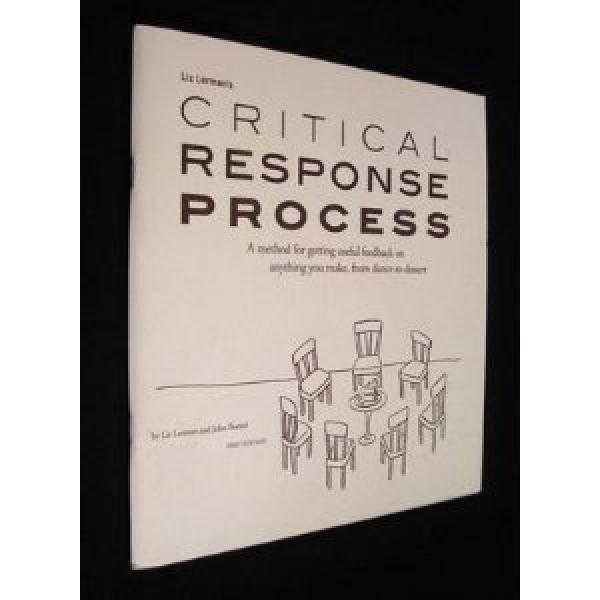
Liz Lerman's Critical Response Process is a multi-step, group system for giving and receiving useful feedback on creative processes and artistic work-in-progress. Originated in the early 1990's by choreographer and MacArthur "Genius Grant" Fellow Liz Lerman, the Process has been widely embraced by artists, educators, and administrators. It has been applied in such diverse contexts as choreography classes, post-performance discussions, actor/playwright collaborations, curatorial decision-making, and university level curriculum assessment. In addition to reflection on the work at hand, the Critical Response Process affords artists a voice and a degree of control within the critique of their work promoting dialogue with audiences, fellow artists, students, mentors, and other colleagues. This book, Liz Lerman's Critical Response Process, offers a detailed introduction to the Process, beginning with its three roles and four core steps. With particular emphasis on the role of the facilitator, this illustrated publication offers guidance on how artists and participants can get the most out of the Process and the opportunities it offers to ask question, give answers, and voice opinions. A final chapter discusses adaptations and variations. Charts and annotated sample dialogues demonstrate the inner workings of the Process. (From the Publisher)
Student evaluations of teaching are a common fixture at American law schools, but they harbor surprising biases. Extensive psychology research demonstrates that these assessments respond overwhelmingly to a professor’s appearance and nonverbal behavior; ratings based on just thirty seconds of silent videotape correlate strongly with end-of-semester evaluations. The nonverbal behaviors that influence teaching evaluations are rooted in physiology, culture, and habit, allowing characteristics like race and gender to affect evaluations. The current process of gathering evaluations, moreover, allows social stereotypes to filter students’ perceptions, increasing risks of bias. These distortions are inevitable products of the intuitive, “system one” cognitive processes that the present process taps. The cure for these biases requires schools to design new student evaluation systems, such as ones based on facilitated group discussion, that enable more reflective, deliberative judgments. This article draws upon research in cognitive decision making, both to present the compelling case for reforming the current system of evaluating classroom performance and to illuminate the cognitive processes that underlie many facets of the legal system.
Informal student evaluations of faculty were started in the 1960's by enterprising college students.(1) Since then, their use has spread so that now they are administered in almost all American colleges and universities and are probably the main source of information used for evaluating faculty teaching performance.(2) There is an enormous literature on the subject of student evaluations of faculty (SEF).(3) The following is a summary of some developments in that literature that should be of special interest to faculty, with particular emphasis on criticisms of SEF that have emerged recently. But I begin with the arguments in favor of the use of SEF.

In university teachers’ hectic lives, finding space to reflect, restore, renew, and recommit can seem impossible. Jean Koh Peters and Mark Weisberg believe regular reflection is critical and have designed A Teacher’s Reflection Book to help teachers and other professionals find that space. Growing out of the authors’ extensive experience facilitating retreats and leading teaching and learning workshops, the book builds on their discoveries in those settings, supporting and promoting teachers’ self-directed development. Inviting that development, A Teacher’s Reflection Book is a cornucopia of stories, exercises, and examples that will inspire teachers to make reflection a cornerstone of their daily lives. With its multiple suggestions and strategies, it offers something for every reader, and is responsive to teachers’ needs at all stages of their careers. The book’s six chapters offer readers several perspectives from which to reflect. Some sections offer glimpses of teachers in the midst of their daily teaching lives, while others step away, inviting readers to reflect on what it means to have a vocation as a teacher. The book explores how we listen, a crucial yet rarely taught skill, essential for reflecting, as well as for learning and teaching. And it invites teachers to reflect on their students: who they are, and what and how they learn. For those latter reflections, the authors turn the focus on fear, which so pervades university life and which can distort learners’ and teachers’ perspectives and responses. Throughout this book, readers will visit several classrooms and listen to the evocative voices of several thoughtful students. (From the Publisher)
One page Teaching Tactic: take home writing prompts to get mid-semester feedback on the course while simultaneously helping students to make connections to their other courses.