Resources

Over the last two months, my partner and I have had many discussions about how Covid-19 has affected our relationship with our students. My partner teaches a generally underserved population of students at a CUNY school in the Bronx, Lehman College, whereas my students are mostly well-off undergraduates and graduate students at a small, religiously-affiliated institution. Nonetheless, the pandemic has taught us similar lessons about how we ought to be thinking about our students, and what they need from us and our institutions—not just during a time of crisis, but all of the time. What follows are the main lessons that I hope to carry forward from this challenging time. None of the insights I’ve had into my students are new to me, and they may not be to you either, but the pandemic has brought their importance home to me much more clearly. Students face mental and physical health challenges. Since we transitioned to online learning, students have let me know that they would have to miss class because of flu, coronavirus, insomnia, and OCD flareups. They have also told me that they may need to stand up and stretch during class, and that they are fine but experiencing stress because of ongoing health concerns that would make the virus more dangerous to them if they caught it. While some of these factors are situational, others are part of the students’ ongoing physical and mental lives, and I wonder if they would feel as comfortable sharing their challenges with me at a time when they had less expectation of support. What can we do under normal circumstances to make clear to students that we do not see them as a (neurotypical) brain in a vat, and that their education can accommodate care for their health? Can we be more thoughtful about language on the syllabus, more empathic in how we treat deadlines and absences? Students find grades stressful. My students took midterms shortly before my school’s transition to Zoom. As I was working on grading them, the school announced that all courses for the semester would be default pass/fail unless the student explicitly requested a letter grade. Realizing that thinking about grades could be an unnecessary additional source of stress, I gave my students three options: they could get feedback with a grade; they could get feedback with no grade; or I could just tell them whether or not they passed. I had takers for all three choices. What would it look like to come up with evaluation and feedback systems that keep students apprised of how they are doing in the course, while accounting for the fact that grades can carry unhelpful emotional weight and even detract from their’ ability to take in feedback? Can we grant students more agency in how and when they receive feedback from us? Students get the most out of active learning. I am teaching two classes this semester. One is a seminar with 18 students, and the other is a course built around hevruta, a Jewish practice of reading and discussing texts aloud in pairs. Of the two, the hevruta course has been vastly more successful over Zoom. The students were already spending more than 50% of in-class time in paired group work, and when they transitioned to doing so online, they remained engaged and active. What would it be like post-pandemic to consider what keeps students engaged during class time, whether it is happening online or not? My institution, like most others, does not yet know what classes will look like in September. As I begin to think about my fall courses, my intention is that my increased awareness of student needs will continue to inform my pedagogy—regardless of whether I will be teaching virtually or in a physical classroom.
Professors know a lot, but they are rarely taught how to teach. The author of the Chronicle of Higher Education’s popular “Pedagogy Unbound” column explains everything you need to know to be a successful college instructor. College is changing, but the way we train academics is not. Most professors are still trained to be researchers first and teachers a distant second, even as scholars are increasingly expected to excel in the classroom. There has been a revolution in teaching and learning over the past generation, and we now have a whole new understanding of how the brain works and how students learn. But most academics have neither the time nor the resources to catch up to the latest research or train themselves to be excellent teachers. The Missing Course offers scholars at all levels a field guide to the state of the art in teaching and learning and is packed with invaluable insights to help students learn in any discipline. Wary of the folk wisdom of the faculty lounge, David Gooblar builds his lessons on the newest findings and years of experience. From active-learning strategies to course design to getting students talking, The Missing Course walks you through the fundamentals of the student-centered classroom, one in which the measure of success is not how well you lecture but how much students learn. Along the way, readers will find ideas and tips they can use in their classrooms right away. (From the Publisher)
Actions of Their Own to Learn: Studies in Knowing, Acting, and Being is an edited volume of fourteen essays which explore the question of what it means to take actions of one’s own to learn. Taking action to learn happens within both formal and informal settings; it also happens during the process of building new knowledge as learners pose questions about the world and design new ways to collect and analyze information to answer those questions (4).The researchers argue that “a conception of what it means to learn must be framed as part of a larger process of building understanding that involves more than the mind” (4). In this constructivist worldview, learning “is a process in which learners are actively involved in the mental construction of ideas using prior knowledge and experiences as a foundation” (6). Building understanding (can) include participants working simultaneously as researchers, teachers, and learners (5). The book is divided into three sections: (1) the power and agency of the learner, (2) active learning with others to build knowledge and community, and (3) the environments that support active learning. In section one, through the use of a mutual learning process, researchers themselves take action to learn and understand the emerging values of the communities they study. For example, White uses autoethnography (and a carbon footprint calculator) to document changes needed to reduce her carbon footprint. She then uses her learning to design a curriculum to help her students take action to reduce their own carbon footprints. As a Provincial Parks educator, Den Hoed challenged “top-down, political, disciplined” educational processes by using Mezirow’s basic theory of transformative learning to “teach for change.” In so doing, he helps his students transform sets of fixed assumptions and expectations to be more “inclusive, discriminating, open, reflective, and emotionally able to change” (63, quoting Cranton [Understanding and Promoting Transformative Learning, 2006]). In section two, scholars who construct knowledge-building communities among disparate groups of learners (grade-school children, physics teachers, math students) have discovered that improvisational co-action, in which ideas “become taken up, built upon, developed, reworked, and elaborated upon by others,” enables shared understandings and learnings that are collectively determined: the class as a whole becomes “the body that learns” (138-140). Towers and Martin discover that improvisational learning, listening authentically to children’s ideas, and building trust helps both teachers and students evolve to see themselves as collaborators rather than competitors (12-13). Finally, section three describes environments that support active learning, including classrooms where students are in control of decisions about how scientific inquiries will proceed, and another, where people come together and create film and photographs (photovoice) to educate, build awareness, and encourage political action. These processes help students develop a deeper connection with course content (208). This book presents a variety of qualitative approaches (narrative, interviews, autoethnography, case study) to activist learning in multiple and variegated learning environments. The scholarship affirms teaching that is firmly student-centered, where teacherly authority is decentered, and power between students and teacher is shared throughout the life of the learning cycle.
Cathy N. Davidson’s The New Education: How to Revolutionize the University to Prepare Students for a World in Flux is an engaging, enlightening, and empowering call to action. Though its focus is on why and how to transform higher education to meet the needs of today’s students and society, it offers commentary on innovative and effective pedagogy that will be of special interest to Wabash Center readers. If you only have time for a condensed version of Davidson’s recommendations for improving college teaching, read the “Ten Tips for Transforming Any Classroom for Active Student-Centered Learning” (263-67). Davidson lauds 10 techniques: Think-Pair-Share, Question Stacking, Everybody Raise Your Hand, Interview, Class Constitution, Collective Syllabus Design, Collaborative Note Taking, Collaborative Projects with Peer Assessment, Exit Tickets, and Public Contribution to Knowledge. In keeping with Davidson’s central thesis, these techniques serve to invigorate learning in college courses, but their ultimate value is that they best prepare students for life beyond the college gates. Indeed, it is the demands of modern life that prompts Davidson to argue for radically revising the university. America’s system of higher education has reified, she argues, the vision of Charles Eliot, president of Harvard in the late 1800s. Eliot sought (most notably in his essay entitled “The New Education” from which Davidson takes her title) to transform America’s colleges from seminary systems to institutions designed “to train farmers and shopkeepers to be factory workers and office managers” (3). In pursuit of this goal, Eliot, and fellow educational reformers, established the university as we know it: majors, minors, divisions (humanities, social sciences, natural and biological sciences), credit hours, degree requirements, grades, the bell curve . . . class rankings, certification, general education, upper-division electives, . . . professionalization (credentials, accreditation), graduate schools . . . financial aid, college entrance exams . . . tenure . . . school rankings . . . (35-36) and more. By 1925, Eliot’s vision (shaped by his study of German and French models) dominated the landscape of American higher education. Not much has changed, Davidson laments. These features continue to define the college experience for most Americans. But now, they come with anemic “teaching to the test” at all levels of education, crushing student debt, and graduates narrowly trained for specialties that are fast disappearing in the technology-laden world in which we live. Against the current state of affairs, Davidson argues for pedagogy and universities to center on students and aim at preparation for life, not just careers. Davidson documents how the shift from the Industrial Age to our current age (which she dates at 1993 with the dawn of the Internet) has yet to be taken seriously by academics. Doing so, she insists, demands radical rethinking of the college experience. To illustrate the types of changes she advocates as proper responses to the technological age, Davidson points to community colleges and initiatives at universities. LaGuardia Community College in NYC, Arizona State University, and The Red House at Georgetown University receive the lion’s share of her attention. And for good reason. Education at these schools is being rethought and retooled to serve the student and his/her future needs. Actually, as Davidson notes, community colleges have been doing this all along. Founded to serve non-elite students, community colleges succeed by proceeding “from a pedagogy of acceptance. Any growth constitutes success. The student is at the center” (57). Although active learning and student-centered pedagogy benefit students, it is not risk-free. Fear of “losing status” causes many professors and institutions to shy away from adopting the mindset and support systems community colleges embrace. To illustrate the risks, Davidson recounts the story of Alexander Coward, formerly of Berkeley . . . formerly because allegedly his student-centered pedagogy did not sit well with his colleagues (208-210). In addition to the aforementioned “Ten Tips,” those primarily interested in pedagogical issues should read Chapter 3, “Against Technophobia,” and Chapter 4, “Against Technophilia.” Within these two chapters, Davidson offers many, many helpful hints for how to use technology imaginatively and effectively in the classroom.

For the faculty member transitioning a course from face-to-face (F2F) to an online or blended learning environment, Kathryn Linder’s workbook is a wonderful resource. After opening with a couple chapters reviewing the key components of backward course design, developing appropriate course learning objectives, and assessment, the remaining chapters provide a step-by-step guide for an instructor to convert a course from a physical to a virtual teaching space. The chapters cover a variety of topics including effective learning activities, assessment methods, creating a social presence, using and creating multimedia, and social media engagement. Each chapter contains a short introduction to the pedagogical theory behind the topic (What Do We Know About…) followed by a series of guiding questions, worksheets, and templates for incorporating the theory into course development (A Step-by-Step Guide to…). After a summary of the key ideas, there are questions for faculty and administrators, followed by a graphic that illustrates course design steps and additions. Online resources are often noted for additional planning. An instructor or administrator is provided with all the tools and resources necessary for working through the process in a hands-on, orderly fashion. The book’s main strength is its highly practical nature, highlighted by the ready-to-use worksheets, templates, and checklists for every step in the process. Not only does it explain the desired resources, it usually gives real-life examples of how the tool was used in a blended classroom effectively. Another strength of this book is Linder’s ability to translate and explain technological tasks reasonably for the technophobe. Without talking down, she methodically explains technical components in understandable and achievable action steps for readers. Equally important, she recognizes that schools use different types of technology (for example, Learning Management System), and identifies the major software, programs, and platforms available, accounting for this variety in her instructions. There is little to offer by way of criticism of the book. More than adequate appendices and glossaries complete an already copious amount of resources. The solid reference section supports the extensive research, clearly supporting the material. Given the practical nature of this workbook and its many ready-to-copy worksheets, it is strongly recommended for faculty members transitioning a classroom course to a blended or online delivery format. Likewise, academic deans leading a group of faculty through a similar transition process will find this a one-stop resource, especially if they are able to partner with an educational technologist.
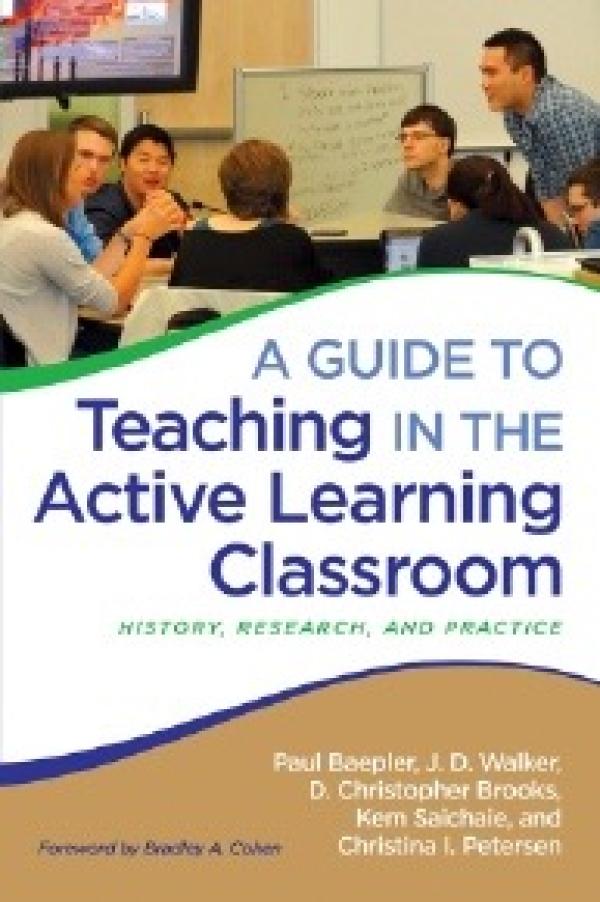
This book examines a particular type of classroom organization known as the “active learning classroom.” This type of classroom is not a lecture hall, but rather, is a room where there is no clear front or back, where students sit in movable chairs around round tables that facilitate group work shared with the larger group via screens. The very organization of the classroom forces the professor to have their back to at least some of the students all the time. This type of classroom interaction seems to be designed for larger class sizes, helping to transform a large lecture hall of students into a classroom where teacher and student interaction, as well as student-to-student interaction, is maximized. These types of classrooms have been shown to have a positive impact on students’ grades, which could be attributed to the room configuration inhibiting certain negative activities while encouraging positive ones. Active learning classrooms provide four main advantages: “immersion learning, the social dimension of learning, collaborative learning, and the performance aspect of teaching and learning” (16). Teaching in an active learning classroom is no longer just transmission of knowledge but a collaborative effort engaging the students for better and more long-term retention of knowledge. The subtitle of the book is “History, Research, and Practice.” The history of this method of teaching is covered in chapter one. The research that supports the practice is the focus of chapters two and three. Chapter two focuses more on the research aspects while chapter three focuses on the role that social interactions have in learning. The core of the book, chapters three through eight, gives practical suggestions on how to implement the teaching method, and presents common difficulties and how to overcome them. The last three chapters focus on how to help professors learn this method of teaching, a suggested methodology on how to study whether the change of teaching method had a positive impact on student learning, and what the future might hold for this teaching method. The book advocates a particular physical organization of the classroom. This is not up to the individual professors, but to the institutions in which they work. Even if one does not have the particular physical layout advocated in this book, there are a number of helpful tips for professors who seek to more actively engage their students. With chapters titled, “Assignments and Activities,” “Managing Student Groups,” and “Assessment and Feedback,” it is easy to find practical suggestions on how to make the classroom less didactic and more engaged. Each chapter has helpful and clear subheadings that make it easy to scan for the topic that one needs. Many of these methods are helpful in the religious studies classroom to help engage the student for a greater learning outcome. The examples in the book range from the sciences through to the humanities, helping a humanities professor get ideas on means of implementing the method in their own classroom.

My teacher training focused on goals and assessment. When I conduct workshops on teaching and whenever I am asked for advice on teaching, I tell instructors to clarify goals and work backward. Two years ago I gave a presentation on technology in the classroom. I included a laundry list of gadgets and apps—absolutely. “Check this out!” “Look at what this website can do.” “Flip your classroom.” But behind all of the gee-whiz fascination of tech, we still had to start with goals. I believe in this approach and I believe in measuring student outcomes. But even when I was starting out as a teacher, I focused on more ambiguous questions as well. How can I build a stronger classroom community? How can I help students develop a deeper appreciation for mystical literature like The Conference of the Birds? Barbara Walvoord reports that half of public and over two-thirds of private university students identify “spiritual and religious development” as an essential goal in the religion classroom. Do I have a responsibility in this regard? How can any of this be assessed? For this blog, I want to touch on a question implied at the end of my last post: How can we teach tolerance while teaching about Islam? Such a question might fall under the broader rubric of anti-bias education. There are many resources on these topics and even though it focuses on K-12, I highly recommend the Teaching Tolerance Project of the Southern Poverty Law Center to all educators. Searching for “Islam” on their website will bring up dozens of resources and activities that can be modified for the college environment. My newest approach for cultivating compassion in the classroom comes out of the contemplative pedagogy movement. I have been recently introduced to contemplative teaching through a program sponsored by the Teaching and Learning Center at Wake Forest University. Contemplative pedagogy is contemplation in action aimed at educating the whole person with much of the same spirit as the Jesuit education I have benefitted from. It seems to me that there is often a disconnect between the abiding mission of a university and the more narrow goals alluded to above. Contemplative pedagogy aims to help educators reflect more deeply on the purposes of their teaching and it aims to help students become similarly self-aware through a range of practices including meditation, reflective journaling, deeper reading, and attentive listening. To some extent, I have always used these practices in my teaching. Respecting silence in the classroom and becoming comfortable with long pauses or “wait time” after asking a question has always been important to me. Developing an awareness of purpose in connection with goals that is transparent to students is a fundamental practice. There is no radical separation between contemplative pedagogy and what is being taught in all education programs. I do, however, believe that my new focus on contemplative pedagogy is helping me to think more holistically about such practices. I am better able to draw a connection between my approach to teaching and the moral and perceptive qualities I want to cultivate in my students. In Contemplative Practices in Higher Education Daniel Barbezat and Mirabai Bush explain, “What distinguishes the experience and integration discussed in this book is that the experience is focused on students’ introspection and their cultivation of awareness of themselves and relationship to others.” There are many ways to teach compassion through Islam. It is a central theme to Islam itself; God is compassionate and merciful. The Qur’an tells us, “What will explain to you what the steep path is? It is to free a slave, to feed at a time of hunger an orphaned relative or a poor person in distress, and to be one of those who believes and urges one another to steadfastness and compassion. Those who do this will be on the right-hand side. (Qur’an 90:12-18).” Our teaching can help students to better appreciate the vision of Islam and how it operates as a way of life for adherents. We can improve student awareness of false media representations of Muslims, help them to understand everyday prejudice faced by American Muslims, and encourage them to look at Islam from a nuanced rather than essentializing perspective. To all of this, we can add meditative exercises of care and concern meant to awaken students to their own compassion and the relationship between their learning and social responsibility. Such exercises encourage students to quiet their minds and envision the shared desire for love and kindness among human beings. The spirit of practices like this can be built into the architecture of a class. In Meditation and the Classroom, Bridget Blomfield describes how she encourages students to develop their own sense of adab in the learning environment. Translated in a variety of ways, she is using adab as “virtuous behavior” or “good manners” meant to develop the practitioner “spiritually, emotionally, physically, and intellectually.” She writes, “The practice of adab is used in the learning environment to initiate the students into a new understanding of themselves and a way to relate to others with attentive compassion.” It is an attitude of graciousness and humility that appears conspicuously absent from much of our public discourse, especially in an election year. But who bears the responsibility for answering this deficit? A share of that burden must fall on the shoulders of university educators. Returning us to the reflection on measurable goals I used to start this entry, Blomfield offers, “Educational environments often value the putting forth of more information, not the personal meaning underneath that information. I believe that intellect and spirituality are complementary, permitting students to write in a scholarly fashion while maintaining a personal and heartfelt understanding.” If we can understand ourselves, we will better understand others. If we can better understand others, we can be compassionate toward them as well. The achievement of such a goal cannot be measured out on a sheet of paper but neither can its value.

This book is pitched to college and university faculty at all career stages, and it stands out from other books in this category because of its research-based findings and its thoughtful case studies. The authors based their guidance on a year-long research study of 688 faculty from a wide range of institutions as well as on years of personal professional experience. The book covers the major aspects of an academic career: effective teaching and promoting student success, defining and facilitating collegiality and positive relationships within departments and with administration, conducting research, performing effective service to the institution or guild, and moving through the ranks to tenure and beyond. This book’s strengths include the liberal use of longer case studies and shorter scenarios, each of which works through a series of questions and proposed resolutions (for case studies) and a challenge question and outcome (for scenarios). The initial warm-up questions are often quite broad (for example, “Is there any general advice you think might be helpful to your friend?” [6]) while later questions tend to be more specific and thoughtful, requiring the reader to consider multiple factors and angles within one scenario. These vignettes were well written and thoughtfully prepared, and on the whole they engage the reader quite effectively. That the scenarios are so clearly taken from actual experience makes them more valuable, especially to newer faculty members who haven’t yet seen it all. Two chapters of this guide focus specifically on teaching. The first, titled “Teaching Effectively in the Classroom,” strongly promotes active learning over lecturing. The case studies in this section deal with common problems, such as how to respond to poor results in student evaluations and what to do when the entire class fails an exam. This chapter emphasizes the importance of learning how to teach large courses effectively, although the authors do include a section at the end of the chapter on “teachniques” for teaching smaller courses. Many new faculty and older faculty who are retooling will find this chapter a useful primer. The second chapter focuses on “Promoting Student Success and Engagement,” with a focus on developing friendly but not-too-familiar relationships with students. Using research and experience, the authors explain the pivotal importance of faculty in shaping students’ lives and ways of thinking well beyond the classroom. Taken together, these two chapters address many issues of interest to readers of this journal, and the remainder of the book is equally valuable for those looking for guidance and food for thought. As a guide designed for all faculty, this book necessarily elides issues of race and gender, for instance, that significantly shape faculty experience. That said, the book accomplishes much in a short space, and each chapter of the book is short and well-structured. Above all, this book uses the very techniques it suggests for effective teaching, and new faculty members in particular will find themselves better prepared for everyday faculty life after thinking through these realistic case studies.
Sumka, Porter, and Piacitelli offer both the history and strategy of an emerging educational model that crosses borders between disciplines to develop competencies and leadership characteristics for social change. The authors document “short-term, student-run immersion service trips” designed to sharpen critical thinking and deepen commitment to future action for social justice (8). In this study their primary example of the alternative break movement is an organization called Break Away that grew out of Vanderbilt University. This and other new programs like the Alternative Break Citizenship school (ABCs) are rooted in efforts from the 1960s that experimented in transformational learning experiences combining travel, intercultural dialogue, collective action, and critical theorizing. A common denominator of these programs is the goal of social justice education. One theoretical framework undergirding these programs is an “active citizen continuum” pointing the way toward authentic relationships for life-long reflection, action, and community enrichment (10). The integration of critical theory and practice moves participants beyond charity and critical theorizing to active citizenship and intercultural competence. A key component of these programs is student leadership. By practicing the actual implementation of the model from the planning and training stages, students gain confidence and facility with each step of the work. In addition to providing the history and theory behind the programs, this book offers practical details contributing to the success of the learning. Readers find pointers on working relationships between staff and students as organizers and leaders of the trips, the alcohol and drug free policy, clarification of the roles of staff versus student leaders, as well as ideas about training, assessing, and fund-raising. The study would be strengthened by further development of the concept of justice. Despite the significance of social justice to this work, little attention is given to making explicit what is meant by justice. Similarly, the concept of global learning could be explored in relationship to literature on intercultural dialogue, collective action, and transcending political borders. Although this book provides an introductory discussion of what community means, contrasting communities of affinity versus communities of geography, the extensive body of work in philosophical and critical theory developing that distinction is not acknowledged (351). In other words, the academic and intellectual strands contributing to this model are not noted with as much care as the recent history of the particular program. This is a compelling read for anyone interested in learning that fosters authentic relationships rooted in “values of social justice, dignity, empowerment, and capacity building” (33). Although religious and theological frameworks are not discussed directly, schools or educators who offer immersion or intercultural learning experiences will benefit from reading this research. The authors’ caution about the tendency to slip toward do-gooder tourism, poverty tourism, and forms of educational travel where privileged students unwittingly perpetuate legacies of colonialism is timely and relevant.The conclusion of this book includes observations about the “need for inspiration and collective action” (359). If faith communities hope to be known as sources of inspiration and collective action in the future, this book offers potential for fertile common ground.
The goal of the contributors to Critical Approaches to the Study of Higher Education is to apply critical theories to the study of higher education which, they insist, “has only begun to develop research using such essential approaches as critical feminist theories, critical race theories, critical discourse analysis, state theoretical approaches, or theories of power and marginalization.” Added to this genuine concern is the scarcity of published material “addressing key topics in higher education that are central to critical work elsewhere in the social sciences” (5). To meet this need, they marshal “critical theories, models, and research tools with a critical vision of the central challenges facing postsecondary researchers” hoping to shape future “scholars and scholarship in higher education” (5). They are convinced that these critical tools will “provide policymakers, the public, and institutional actors clear, reasonable, and authoritative information about higher education as it is experienced in a democracy” (1). The result is a fine compilation of well-written essays for teachers and researchers to adopt and exercise their critical edge with a view to innovating their teaching pedagogies and research. The vision Mertínez-Ahlemán, Pusser, and Bensimon have is to ensure a sustained exercise of critical theory in the service of humanity, namely “for understanding politics and policy making in higher education” (5). They carry their readers through fifteen intriguing arguments critically testing theory against lived experiences filled with autobiographical elements that share the same thread – an abiding concern and determination to ensure that justice and equity are exercised in higher education. After all, critical theory came into being for this purpose as exemplified in feminist criticism, critical race theory, and other critical studies dealing with various dimensions of human life such as marginalization, economic disparity, and power differential. Simply stated, things are not the way they seem and something must be done even if it might be subversive. This volume is, indeed, “long overdue” (5) as it provides salient insights on how to critically navigate the host of complex and challenging issues facing higher education. These dynamic tensions inherent in higher education include: areas of scholarship and lived experience, power differential, critical historiography, the making of globalization, policymaking, race, equity, opportunities, and institutional change, and so on. Quite frankly, this book is a gem with a delicate vision to motivate scholars and teachers alike to engage in the noble – yet difficult – task of effecting change, especially the kind of transformation that advocates justice and nurtures equity in higher education. Educators and researchers may strive to embody and diligently exercise its content in their classrooms or writing projects because of its timely and urgent call for action. In other words, justice and equity matter (311).