Resources
Seminary education requires that students learn a complex body of theological knowledge, engage in the practices of ministry, and develop as persons of faith and vocation. Utilizing the six aspects of significant learning experiences defined by L. Dee Fink – foundational knowledge, application, integration, the human dimension, caring, and learning how to learn – the author explores teaching practices that reframe knowing, doing, and being in seminary classrooms.
How do seminarians move from imagining ministry to embodying pastoral imagination? Stories gathered from seminarians in their final year of study show the complexity of shifting from classroom work, which foregrounds theory and intellectual imagination, to more embodied, relational, and emotionally intense engagements of ministry. Stories about learning ministry articulate a process we call the birth of pastoral imagination. New ministers test their use of knowledge acquired in classroom and books within the limits of actual ministry situations. They become overwhelmed by multiple variables in situations where they must make choices and act. These moments of action are fraught with risk and responsibility for the outcomes. Articulation and theological reflection are formative for students learning the practice of ministry. Implications for theological education include making greater “use of knowledge” in ministry practice and “use of practice” in classrooms. Points of crisis in the student stories raise additional questions about how some complications and interruptions to the “birth process” may present tragic consequences.
Recent research by Barbara Walvoord suggests a perceived disparity between faculty learning objectives and students' desire to engage “big questions” in the introductory religion classroom. Faculty opinions of such questions are varied, ranging from a refusal to employ any approach that diverts attention away from critical thinking, to a willingness to integrate personal questions of meaning and purpose into the introductory religion course. This essay argues that, in light of work currently being done by such developmental theorists as Sharon Daloz Parks and Marcia Baxter Magolda, the integrative approach has much to commend it. It concludes with suggestions for how religion faculty can expand this approach through learning covenants, service learning, and seeing the religion classroom as a gateway to various mentoring communities on campus.
The word stewardship comes across as stale and mildly distasteful to many in the church today — as a term limited in its scope to euphemistic conversations about financial giving. Yet, as Ronald Vallet points out, when the apostle Paul refers to “stewards of the mysteries of God” (1 Cor. 4:1), he’s talking about something much deeper and richer than fund-raising. (From the Publisher)
Transforming Classroom Culture is an anthology of original work authored by diverse faculty who work in a variety of New England college and university settings--private and public, racially homogeneous and diverse. The authors focus on institutional contexts that promote innovation in teaching practice, faculty identity as a resource for effective pedagogy, and dilemmas and outcomes of student-faculty engagement in the classroom. (From the Publisher)
Journal Issue.

Learning Theory and Online Technologies offers a powerful overview of the current state of elearning, a foundation of its historical roots and growth, and a framework for distinguishing among the major approaches to elearning. It effectively addresses pedagogy (how to design an effective online environment for learning), evaluation (how to know that students are learning), and history (how past research can guide successful online teaching and learning outcomes). An ideal textbook for undergraduate education and communication programs, and Educational Technology Masters, PhD, and Certificate programs, readers will find Learning Theory and Online Technologies provides a synthesis of the key advances in elearning theory, the key frameworks of research, and clearly links theory and research to successful learning practice. (From the Publisher)
How can the average educator who teaches online, without experience in evaluating emerging technologies, build on what is successful and modify what is not? Written for educators who feel ill-prepared when required to evaluate e-learning initiatives, Evaluating e-Learning offers step-by-step guidance for conducting an evaluation plan of e-learning technologies. It builds on and adapts familiar research methodology to offer a robust and accessible approach to effectively evaluate a range of innovative initiatives, including those covered in other books in the connecting with e-learning series. This useful guide offers a multi-level approach that allows both beginners and experienced professionals to follow the level of text that suits their current needs. Practical applications discussed include: • how to develop broad evaluation questions • how to use an evaluation framework • how to determine the sources of data to be used • how to develop an evaluation matrix • how to collect, analyze and interpret the data. Readers will find this jargon-free guide is a must-have resource that provides the proper tools for evaluating their own e-learning practices with ease. (From the Publisher)
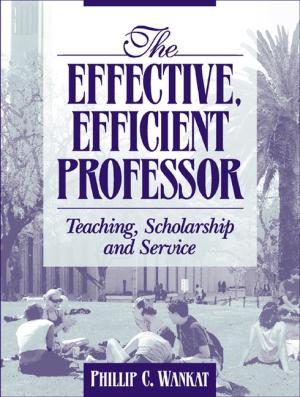
The Effective, Efficient Professor: Teaching, Scholarship and Service develops methods to improve the proficiency and time management skills of faculty in all areas of their careers. Most faculty are discipline experts but have not studied methods to improve their teaching, scholarship or service. This book applies efficiency and time management methods to academe. Throughout the book, the author shows how student learning and academic productivity can be improved by being aware of effective time management techniques. A variety of efficient and effective teaching methods are explored. Scholarship, service, and working with graduate students are also discussed. This book will help college faculty at all levels of instruction take charge of their careers! For college professors in all disciplines. (From the Publisher)

Drawing on the experience with the individuals, campuses, and professional associations associated with the Carnegie Academy for the Scholarship of Teaching and Learning and the Institutional Leadership Program, this important resource examines four critical areas where engagement with the scholarship of teaching and learning can have a significant effect. This book is intended for a broad audience of campus leaders, faculty, and people in foundations and other education associations with an interest in supporting new directions in teaching and learning. (From the Publisher)
Wabash Center Staff Contact
Sarah Farmer, Ph.D.
Associate Director
Wabash Center
farmers@wabash.edu