Resources
The day before we were told to go online, rumors that we would transition were flying think and fast. It was a Tuesday. I was supposed to head to Vanderbilt that evening to give a talk on Wednesday, but the night before, it had been canceled. Given this, I suspected that we (CU Boulder) would be going online soon. Earlier in the day when I met with my seminar (a class that, despite being label a seminar, had over 30 people), I told them that I thought online was coming. The entire room burst into conversation, much of it unease, some of it amusement, most of it because they knew I was barely managing our minimalist Canvas site. We had already experienced some small adaptations together. A week or two before, a student who was experiencing back spasms asked if she could lie on the floor during the class. I said yes, and she participated while lying flat on her back. Prior to our last in-person session, a student had emailed me to say that he thought he had Covid-19 and asked if he could attend via FaceTime, on a classmate’s computer. I said yes, and he participated from his screen. Using that flexibility as our foundation, we spent 30 minutes planning our online transition together. In the end, I am responsible for the decisions that were made, but I am very glad that my students and I worked through the plans together. We discussed the possibility of meeting over Zoom. While people really liked our classroom community, we had concerns about trying to have a 34-person conversation over the computer. (At this time, I had never used Zoom and did not realize that I could break the class into small groups with the push of a button.) In addition to questions about the feasibility of the Zoom platform, students were anxious about internet access, changing work schedules, and responsibility for younger siblings. So, we decided that we would have discussion boards. I asked them if they thought that it would be fair to have everyone post one initial thought and two comments on existing posts per day. We agreed, as a group, that one comment could be part of an ongoing conversation on your own post, but that the other comment had to be on someone else’s. We discussed what they wanted and needed in order to make this plan work. Deadlines. They wanted clear deadlines and they wanted me to promise that I would not move things around on them. As the semester would wear on, one by one, they would repeatedly thank me for never moving anything around. We agreed that the initial post needed to be up by the start of class time, and that they had 25 hours to post responses. I talked about what I wanted in the discussion boards: for them to try not to repeat each other, and to make sure that someone commented on almost everyone’s post. When I brought up that second concern, one student nodded. I knew she would monitor our inclusivity. I was delighted, and feel that I can take very little credit, for what happened on our discussion boards over the following weeks. I posted questions to get them going; one of which was always, “Share a quote that struck you as interesting and tell us why you were intrigued by it.” They answered. They picked quotes they liked, they picked quotes that they did not understand, they picked quotes for which they needed more context. They brought their confusion to each other. Frequently, I would log in to discover that a question posed late at night, and probably aimed at me, had been answered by a student before I woke up. But maybe more impressive than their willingness to share their vulnerability, to share their “I do not knows,” they were willing, firmly and politely, to disagree with each other. They challenged each other repeatedly. They debated interpretations of texts, but they also called each other on more charged issues, like failures to see structural racism. Each time, I was struck by the fact that they did so without pointing fingers or descending into accusation. They remained firmly in intellectual community with each other. To be clear, some of these things had been happening in the classroom all along, but most were not, or at least included only the most talkative of the class. These discussion boards were very surprising to me, and upon reflection, I think this kind of connection occurred because I let them choose a format. I did not let them chose the format because I knew that it would lead to these conversations—I did it because I have never taught online, did not know what to do, and wanted to get buy-in for my plan. Wonderfully, my students responded by taking ownership of the space. They had been asked what they wanted to do, and with that freedom they went ahead and did it.
When teaching on issues of social justice, a faculty’s posture can foster or impede the students’ ability to learn and engage fully in the process. I teach Biblical Interpretation. One of the favorite courses that I have designed and taught is “Hermeneutics for Ministry”. This is a graduate course offered to students who are preparing for full time ministry. I challenge the students in the class not only to learn about the art of interpretation, but also to wrestle with why they interpret a certain way. For example, we talk about reading locations, biases and presuppositions. We discuss how a person’s cultural background affects/colors their reading lenses. We watch the movie Arrival and discuss the dynamics of language and prejudice, and the interplay between space/boundary maintenance and reconciliation. In other words, how we use our space and maintain boundaries, who we let in, and the willingness to enter another’s space affect our ability to engage the other in constructive ways. We examine what makes Dr. Louise Banks a character that is worth emulating. We read Emmanuel Levinas’ Otherwise than Being and discuss what it means for come face to face with the other, and to take on their plight. The final project for the course asks students to write a sermon series or develop curriculum that addresses issues on immigration or racial reconciliation; or design a pastoral care plan that addresses Teenage Suicide or Aging and Dying Well. I go to great length to challenge their assumptions and encourage them to think holistically about social justice; namely, to attend to the theological, spiritual, cultural, social, emotional, and financial aspect of the issue. The goal is not only their formation, but also the formation of their congregation’s hermeneutics (the way they view) and attitude (the way they behave) toward immigrants, members of a different race, the elderly, and the memory of those who commit suicide and toward their families. In the Fall 2016, I found myself struggling to communicate with the students. Many of the issues that were central to the course had taken center stage in the political rhetoric of the election. As a Haitian, and an immigrant, I wanted to be cautious. This posture created a lack of authenticity that hindered my ability to challenge the students. Our class met at 8:55am on Mondays, Wednesdays, and Fridays. The morning after the election, I went to class and started with prayers as was customary. No sooner had I said Amen, that one student asked, “What are your thoughts on last night’s election?” I replied immediately, “I am not from around here; I am not sure what to say.” I proceeded to start my presentation, when the silence that fell on the class caught my attention. I looked up from my computer and saw the students’ eyes fixed on me. It was a look that I had not seen before. They wanted to hear from me on this particular issue, and they were not willing to let me off the hook. I quickly realized that if I was going to be successful in my endeavor to challenge their own presuppositions on other social justice and civic engagement issues, I needed to be vulnerable on this one. To be vulnerable is to open oneself to the possibility of being wounded, of being harmed. It comes at a great risk. It is a risk worth taking if the telos of theological education is the transformation of the individual. We have to be willing to open up ourselves to the students, so that they can see our hearts and in order to be convinced of the lessons we want them to learn. That November morning, I took the risk and told the students what was on my heart. Among other things, I pointed out that the popular vote suggested that we were dealing with a divided country. I urged them to be ready to shoulder the responsibility and burden of bringing healing to a nation, a society, and a church that have lost the art of dialoging with others who hold diverging opinions. Little did I know that the divide would become so entrenched. Little did I know that their burden would become so heavy. Today more than ever we need to let our guard down and teach with vulnerability. We need to empower our students by acknowledging our own shortcomings. What would it take to invite them to our space and let them see our pain, our doubts, our struggles?
As the Covid-19 pandemic unfolded, I was wrestling with how to teach a rather unpopular class on “just war theory.” For so many of my students, who have lived through unending conflicts, the reasons to go into battle are unclear. A good number of them reject the distinction between justifiable and unjustifiable wars; for them, all wars are unjust. Many believe that political grandstanding and neo-colonial campaigns have been the cause of military interventions, and that peaceful negotiations could have resolved international conflicts. In the classroom, with its dynamic back-and-forth of questions and answers, discussion of just war theory was engaging. Tension could be thick at times, and the lack of any clear resolution problematic for some, but that is the energy of active learning! The pivot to online asynchronous teaching and learning has made engagement more of a challenge. Yet the pandemic provides a context on which to build a rich discussion of this ancient concept. The “War” Against the Coronavirus Political and health leaders throughout the world have used the metaphor of “war” to describe the global village’s fight against the novel coronavirus. It seemed appropriate then to ask students to consider how the criteria of just war theory illuminate the reality in which we find ourselves. Jus in Bellum The architects of the just war theory imagined that both sides would engage in reasonable behavior and proposed standards for activity in war. For its part, the virus does not abide by any standards. This reality, however, should not preclude us from acting justly. To get at this, students examined two jus in bellum criteria: “distinction” and “proportionality.” Distinction involves a clear focus on the enemy combatant. In this case, as students noted, all efforts should target the virus. The war on the novel coronavirus was not a time for playing politics among civic or religious leaders, or promoting personal or party agendas. Distinction obligates citizens to play their part and stay at home, wear protective personal equipment when necessary, and abide by social distancing rules. The principle of proportionality focuses on ensuring that combatants are respectful of the other side’s citizens and their property. No unwarranted destruction should accompany military action. Students observed that the virus violates this principle, but that should not preclude the human community’s commitment. Some questioned whether the economic shutdown, closing of nation-state borders, migration of schools to remote learning, and enforced lockdowns were evidence of a violation of this principle. These defensive measures have resulted in a rate of unemployment not seen since the Great Depression, disproportionate impact on vulnerable populations, particularly communities of color, the hoarding of an array of products, and increased incidences of mental health issues and domestic abuse, to name a few. I was struck that a handful of students also pointed to price gouging and rise in the number of scams associated with Covid-19. They saw these criminal actions as evidence of “internally” violating proportionality. Jus Post Bellum In their assessment of jus post bellum, students considered measures that would need to be implemented as we moved out of “shelter in place.” As I imagined, students’ responses were filled with frustration about how long they would have to be on lockdown in their homes. For graduating students, anxiety about their futures was palpable. According to jus post bellum, legitimate authorities must be the ones to set the conditions of peace. Students recognized the legitimate power of authority to safeguard its citizenry, but also realized the frustration of waiting. Out of abundant caution, political leadership had to exercise “just cause for the termination” of this campaign against the virus. As they see the number of infections decrease, a plan can be put in place to open gradually. “Proportionality” must also inform during this post-war period. While there exists impatience to learn the origins of this virus and whether persons bear responsibility, the dictates of just war theory hold that there can be no revenge. Efforts post-war should be concerned with reconstruction, remediation, and reparations. This aspect of jus post bello did not sit well with my exasperated and exhausted students. Answers and accountability were fine, I let them know, but retribution was not. In the past, most of my students would dismiss my teaching on just war theory as irrelevant. But, making a link to our present-day war on Covid-19 helped them understand and appreciate the theory.
Drastic shifts causing de-centering Theological Education calls for more than managerial responses. This project promotes ways of surfacing and exploring different ideas, different voices, and justice-minded changes. Dr. Nancy Lynne Westfield hosts Dr. Ted Smith (Candler School of Theology - Emory University).
Teaching that prioritizes inclusion and equity is an essential task for instructors. However, teaching remotely due to the Covid-19 pandemic presents unique questions that faculty should address to support their students’ emotional and cognitive well-being. Below, I present six tips to promote an inclusive and equitable remote learning space for this moment. Acknowledge your own and students’ emotions Given the current moment, many students are experiencing stress and trauma. A trauma-informed pedagogy asks instructors to acknowledge and reflect on their own emotions as they prepare to enter this new learning space. Similarly, provide a space for students to process their own emotions as well. This can be done through individual reflection prompts, asynchronous discussion boards, or a guided discussion in a synchronous space. Consider if you can give students agency in the course Since we know students may be experiencing additional burdens and stress, consider ways that you may be able to provide students flexibility in the remainder of the course. A first step is to allow students to help shape the learning environment, including considerations for engagement and their expectations for themselves and others in the course. Additionally, it may be beneficial to give students choice in the types of assignments or tasks remaining in the course. Giving students some agency will allow them to feel some sense of control in a time of great uncertainty. Understand students’ unequal access to technology in determining how to run your course A recent post from PhysPort, a blog about teaching in physics provides considerations for what faculty should consider when thinking about students ability to access the course: Recognize that not all your students will be able to attend synchronous online classes due to internet access, connectivity, scheduling, health, and family situations. Some platforms allow participants to call in via phone, which allow them to hear and participate in audio conversations, but not see slides, screenshare, or video. Find ways for students who can't connect in real time to still participate (e.g. by making recordings available after class), or consider not running synchronous classes at all: asynchronous learning can be much more equitable for students with different levels of access, health and privilege. These are also good things to keep in mind when you are teaching in-person classes. Consider available grading options This may be difficult for some faculty in professional schools and in some undergraduate programs, but I encourage instructors to be open to new ideas for grading. For example, some have suggested that you tell students that they cannot receive a grade lower than what they currently have in the class. Such an approach will help deescalate student stress levels and acknowledge that not all students will have equal opportunities or access to complete the rest of the work for the course. Ensure your materials and technology are accessible As you integrate new ways to engage students and access materials for your course, ensure that these new platforms and methods are accessible. You should consider how students who use assistive technologies can engage the course as well as best ways to students with accommodations. Do what you can to promote your own self-care We recognize that this is a difficult time for you as instructors as well. For some, this new reality may mean balancing professional and personal responsibilities in unique ways. For others, this can heighten feelings of loneliness and isolation. Regardless, of your situation, it is important to do what you need to do to take care of yourself. It is though caring for our own well-being that we can best support our students. These six steps are only a beginning for how to foster inclusion and equity in your remote course. I recognize that this moment presents many challenges. I also recognize that others may have ideas to promote an inclusive and equitable course environment. If you have additional ideas, feel free to leave them in the comments for others to read. Additional Resources “As Human as Possible” by Colleen Flaherty, Inside Higher Ed “Hope Matters” by Mays Imad, Inside Higher Ed “Inclusion, Equity, and Access While Teaching Remotely” from Rice University Center for Teaching Excellence “Maintaining Equity and Inclusion in Virtual Learning Environments” from san Diego State University “Please Do a Bad Job of Putting Your Courses Online” by Rebecca Barrett-Fox

Over the last two months, my partner and I have had many discussions about how Covid-19 has affected our relationship with our students. My partner teaches a generally underserved population of students at a CUNY school in the Bronx, Lehman College, whereas my students are mostly well-off undergraduates and graduate students at a small, religiously-affiliated institution. Nonetheless, the pandemic has taught us similar lessons about how we ought to be thinking about our students, and what they need from us and our institutions—not just during a time of crisis, but all of the time. What follows are the main lessons that I hope to carry forward from this challenging time. None of the insights I’ve had into my students are new to me, and they may not be to you either, but the pandemic has brought their importance home to me much more clearly. Students face mental and physical health challenges. Since we transitioned to online learning, students have let me know that they would have to miss class because of flu, coronavirus, insomnia, and OCD flareups. They have also told me that they may need to stand up and stretch during class, and that they are fine but experiencing stress because of ongoing health concerns that would make the virus more dangerous to them if they caught it. While some of these factors are situational, others are part of the students’ ongoing physical and mental lives, and I wonder if they would feel as comfortable sharing their challenges with me at a time when they had less expectation of support. What can we do under normal circumstances to make clear to students that we do not see them as a (neurotypical) brain in a vat, and that their education can accommodate care for their health? Can we be more thoughtful about language on the syllabus, more empathic in how we treat deadlines and absences? Students find grades stressful. My students took midterms shortly before my school’s transition to Zoom. As I was working on grading them, the school announced that all courses for the semester would be default pass/fail unless the student explicitly requested a letter grade. Realizing that thinking about grades could be an unnecessary additional source of stress, I gave my students three options: they could get feedback with a grade; they could get feedback with no grade; or I could just tell them whether or not they passed. I had takers for all three choices. What would it look like to come up with evaluation and feedback systems that keep students apprised of how they are doing in the course, while accounting for the fact that grades can carry unhelpful emotional weight and even detract from their’ ability to take in feedback? Can we grant students more agency in how and when they receive feedback from us? Students get the most out of active learning. I am teaching two classes this semester. One is a seminar with 18 students, and the other is a course built around hevruta, a Jewish practice of reading and discussing texts aloud in pairs. Of the two, the hevruta course has been vastly more successful over Zoom. The students were already spending more than 50% of in-class time in paired group work, and when they transitioned to doing so online, they remained engaged and active. What would it be like post-pandemic to consider what keeps students engaged during class time, whether it is happening online or not? My institution, like most others, does not yet know what classes will look like in September. As I begin to think about my fall courses, my intention is that my increased awareness of student needs will continue to inform my pedagogy—regardless of whether I will be teaching virtually or in a physical classroom.
The necessity of faith formation through public ministry is underscored now during the rebellions, pandemic and US economic uncertainty. Showcasing a new text: From Lament to Advocacy: Black Religious Education and Public Ministry (2020) for use by faculty, staff, and students. Dr. Nancy Lynne Westfield hosts Dr. Annie Lockhart-Gilroy (Phillips Theological Seminary).
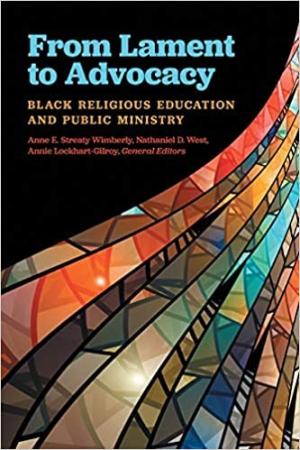
This resource sets forth the cultural imperatives of ministry and the contextual nature of a public theology of religious education that connects faith formation and action in addressing profoundly difficult, unjust, and wounding experiences of Black people in society. The book begins with the, often neglected, practice of lament as a necessary first step in vital public theological reflection and action. The book proceeds with meanings and ways of equipping persons within and beyond church settings to critically reflect on life and leadership in the throes of present-day social and political realities. It further provides practices for forming skills and shows how to partner with the spiritual guides needed to shape a just public arena and fruitful individual lives. (From the Publisher)
After a lecture in my introductory European course about a year ago, a student who had fallen asleep in the back row remained behind. I had come to notice him: a young man who came to class early, always sat in the back row, was always prepared with the reading, and almost always fell asleep. I asked him about his torpor, which seemed incongruous with the rest of his habits as a learner. He apologized, explaining that before class he worked a night shift at his full-time job as an aide in an elder care facility. As an educator, my hope and expectation had been for students to view my class as a top priority, imagining that my passion for history should be universal. When they don’t, I often feel offended and humbled. Exposure to the lived experience of this student, and many of his peers, has cultivated an empathy towards those students with schedules and attentions divided between their curricular duties and other aspects of their lives. The ongoing public health crisis, and the shift to online learning, has pushed me even further on this. It leads me to think differently about how we can accomodate in the classroom not only around skill level, but also around the room a student has for school in their lives. My partner and I teach in very different institutions. Lately we’ve tried to identify commonalities and differences in what we’ve learned about how best to serve our respective students. Sarah’s focus has been on providing an emotionally responsive environment and one that embraces neurodiversity. I continue to examine how to make classrooms that enable part-time students to grow in their skills and knowledge, while minimizing the conflict between their academics and their priorities as wage earners and caretakers. We agree that these different areas of focus are a product of the very different populations that we teach. Of the fourteen-thousand undergraduates at Lehman College, 48% are part-time students. Many part-time students have scheduling and attentional conflicts that include full-time work, childcare, and running a household. Covid-19 has increased these demands and forced educators to reimagine their classrooms so they can better meet students where they are. This challenge presents an opportunity to improve our abilities to differentiate by career stage. Asynchronous learning allows our less traditional students to complete assignments and access material around their own schedule. Imagine modular history curricula in which student-led activities, done with teacher facilitation, bring students into contact with content that would otherwise be communicated via lecture, build skills necessary to be a strong undergraduate history student, and interact with her teacher and her peers around the major tensions and themes of the period. Take, for example, a module on 19th-century German society. I imagine our student, sitting at home, accessing a short lecture designed to orient her and then directing her to short textbook readings to glean basic information about the period. Following this, our student accesses four or five important chapters or articles on the period, curated—and if necessary scaffolded—by the professor to ensure she is exposed to multiple arguments about the period. To end the module, students prepare a short formative assessment that they bring to a single class meeting where the instructor leads a conversation about the nature of the 19th-century German middle class. Such a blended synchronous/asynchronous module would accomplish the same learning goals as a series of lectures in an introductory class and allow our student to learn on her own schedule. In this model, the professor serves as a facilitator of learning as opposed to the source of information. But, the more independence students have, the more responsibility educators have to build skills that allow them to work independently. Schedule setting, advance preparation, and attentiveness to one’s own work habits can be taught, and they translate beyond the history classroom. Right now, circumstance forces us to consign ourselves to distance learning and asynchronicity. But asynchronous and blended models are well suited for a community of part-time learners. I hope that we can take lessons learned during this crisis to help all of our students, no matter their status.
In teaching undergraduates about social justice, I have found that the concept of the common good is both the most foundational and difficult one for students to learn. According to Catholic social teaching, the perspective from which I teach my theology and justice courses, the concept is defined as such: every individual person should have sufficient access to the resources of the society that they need to completely and easily live fulfilling lives; therefore, the rights of the individual to personal possessions and community resources must be balanced with the needs of the disadvantaged and dispossessed. My students are able to memorize this definition for exams, but when asked to apply this principle to everyday life and current events, they struggle. I recently discovered, however, that tethering the abstract concept to the concrete circumstances of their lives, as with most things, is the key to their learning. I made this discovery in mid-March during the abrupt transition of my classes from face-to-face to online format due to the COVID-19 pandemic. With only a few panic-filled days to reformat my classes, I sought help from my “squad”—i.e., my group of justice-seeking colleagues and friends that I trust for advice on how to care for students. Over phone-calls and group social media chat, we shared ideas about how we could ascertain and meet our students’ needs during this unprecedented time. I decided to send out a survey worth enough points to insure that every student would fill it out, quickly. This enabled me to assess whether every student had sufficient access to the resources they needed to live their lives and continue their education. I was worried about the safety and health of my students—particularly those in possible situations of intimate partner-violence, LGBTQ+ identified students who were returning to live with unsupportive families, international students who could not return home, students who lost their jobs or were now working more now than ever in healthcare, grocery stores, or family businesses, and students who had contracted or been exposed to the coronavirus. Of course, I also needed to know about Wi-Fi and computer access, since without these necessities any online learning would be impossible. I was sure there were also student issues that I had not thought of yet. So, I created and distributed a simple survey. I asked students about: Their concerns about safety, health, Covid-19, and current living conditions Wi-Fi availability Access to a computer Access to course textbooks (since some had not been able to return to campus after Spring Break, before moving home) Preferences for online class sessions and office hours to supplement asynchronous lectures and discussion boards--e.g., optional groups hangouts; open office hours? (Accounting for abrupt schedule changes and heeding advice from my “squad,” I made all of my classes asynchronous) Concerns they had about online learning and completing coursework What support they needed from me Other concerns I told the students that the questions I asked them on the survey were “no-brainers.” I needed this information, first, to connect them to resources for their safety and health, if necessary, and then to re-construct course syllabi that were fair and manageable during this time of upheaval and crisis. I told them that these are the questions that the principle of the common good asks and that the responses the questions generate often demands a restructuring of the community. They got it, because it related to their lives directly. I also discovered two things: I should be explicitly asking every semester, even outsides of crisis, about student needs and access to resources. Responsible pedagogy demands upholding the common good principle. And effective teaching about this foundational social justice principle requires the instructor to model it by applying it to students’ immediate situations and experiences. This application, in my experience, proved to be the bridge necessary for students to transverse the gap between memorizing a definition to rooting it in their lives with meaning. As I write this blog, the recent murders of African Americans Ahmaud Arbery, Breonna Taylor, and George Floyd, and the ensuing outrage and protests over their murders, demand me again to consider the common good outside and inside of the classroom. The fact that black lives do not yet matter in our country and world is a clear illustration of the common good failing to be met in our nation. I should be teaching content like this in my classes, while at the same time being cognizant in my pedagogical practice of the heightened needs of my students, particularly those of color. If you are teaching this summer, how have you restructured your content and pedagogy to account for how the basic needs of your students have changed, due to the global Covid-19 pandemic and the continued outright disregard for black and brown lives?
Wabash Center Staff Contact
Rachelle Green, Ph.D.
Associate Director
Wabash Center
greenr@wabash.edu