Scholarship on Teaching
This paper reflects upon the collaborative work between a professor and a librarian who constructed a course on religious communes in the United States implementing the seven elements of metaliteracy as put forth by Jacobson and Mackey (2013). The shifting terrain of information literacy is hard enough for librarians to traverse, but it can feel insurmountable for professors in the classroom. Working side by side with a librarian can be one of the most fruitful ways for professors to advance in this field. The seed for this project was a collective intent to create lifelong learners with strong habits of inquiry rather than merely teaching students discrete search strategies and skills. By using technology and team-based learning, the collaborators hoped to open up the students to a critical yet empathetic understanding of religion and to help them develop as informed users and creators on the internet.
History simulations have been shown to promote student learning in classrooms throughout higher education. In an undergraduate course on the New Testament and early Christianity, we sought to foster student learning by having students participate in history simulations that involved the use of fictitious personas known as avatars. In this paper we describe the avatar activities in these simulations, and we examine the effects of our simulations on students' abilities in “historical thinking”: that is, engaging in the interpretive practices that historians use to reconstruct the past. We argue that our avatar simulations helped our students build upon, refine, and deepen their abilities in historical thinking in small but perceptible ways. We end by noting the extent to which our findings align with research on the use of history simulations and by identifying ways to develop our project moving forward.

Now more than ever, we must abandon the performative and embrace the authentic. Our essential mental shifts require humility and patience. Focus on real internal change. These human transformations will be honest, raw, ugly, hopeful, frustrated, beautiful, and divine. And they will be slower than keener academics are used to. Be slow. Let this distract you. Let it change how you think and how you see the world. Because the world is our work. And so, may this tragedy tear down all our faulty assumptions and give us the courage of bold new ideas.
This case study explores the learning experiences of three international students who were enrolled in an online master’s program offered by a large university in Canada. The aim of the study was to understand the international students’ experiences with, and perspectives on, the online learning environment. Findings indicate that previous education and especially language proficiency strongly impacted the learning of these students in this environment. Non-native English speakers required considerably more time to process readings and postings and to make postings themselves. Their lack of familiarity with the details of North American culture and colloquial language made it difficult to follow much of the course discussions. They also tended to avoid socializing in the course, which left them at the periphery of course activities. Based on these findings, the authors make the following recommendations for designers and instructors of online courses: 1) Raise the English language proficiency requirement for graduate admissions into online programs because the text-based communication in a CMC space requires interpreting messages without non-verbal cues; 2) Ensure that online distance education course designers are aware of the needs and expectations of international students; and 3) Combine the design principles from both traditional and constructivism theories.
Culturally responsive teaching and design practices flip the online classroom by creating an environment that acknowledges, celebrates, and builds upon the cultural capital that learners and teachers bring to the online classroom. Challenges exist in all phases of online course design, including the ability to create online courses that reflect the instructor’s commitment to inclusive excellence, diversity, and social justice. Designing an online environment that supports all learners regardless of their backgrounds is important in their future success as professionals; thus, it is important for faculty to design courses with all students in mind. The purpose of this article is to share best practices in the design of culturally and linguistically responsive online courses that support the culturally and linguistically diverse (CLD) students we serve. Based on Gay’s (2010) culturally responsive teaching practices, this article provides examples of online activities that are validating; comprehensive; multi-dimensional; empowering; transformative, and emancipatory.
This article reports the findings of a case study that investigated the perceptions of international students regarding the impact of cultural differences on their learning experiences in an online MBA program. The study also revealed that online instructors need to design courses in such a way as to remove potential cultural barriers, including language, communication tool use, plagiarism, time zone differences and a lack of multicultural content, which may affect international students’ learning performances. The study indicates that a culturally inclusive learning environment needs to consider diversity in course design in order to ensure full participation by international students.
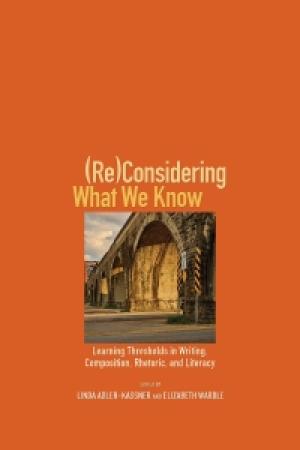
Naming What We Know: Threshold Concepts of Writing Studies, published in 2015, contributed to a discussion about the relevance of identifying key concepts and ideas of writing studies. (Re)Considering What We Know continues that conversation while simultaneously raising questions about the ideas around threshold concepts. Contributions introduce new concepts, investigate threshold concepts as a framework, and explore their use within and beyond writing. Part 1 raises questions about the ideologies of consensus that are associated with naming threshold concepts of a discipline. Contributions challenge the idea of consensus and seek to expand both the threshold concepts framework and the concepts themselves. Part 2 focuses on threshold concepts in action and practice, demonstrating the innovative ways threshold concepts and a threshold concepts framework have been used in writing courses and programs. Part 3 shows how a threshold concepts framework can help us engage in conversations beyond writing studies. (Re)Considering What We Know raises new questions and offers new ideas that can help to advance the discussion and use of threshold concepts in the field of writing studies. It will be of great interest to scholars and graduate students in writing studies, especially those who have previously engaged with Naming What We Know. (From the Publisher)
A tool used for implementation of Universal Design for Learning, a framework to improve and optimize teaching and learning for all people based on scientific insights into how humans learn, from CAST (a nonprofit education research and development organization that works to expand learning opportunities for all individuals through Universal Design for Learning). These guidelines offer a set of concrete suggestions that can be applied to any discipline or domain to ensure that all learners can access and participate in meaningful, challenging learning opportunities.
From Pen America, a resource for faculty, staff, and students providing practical, principled guidance for how campuses can best remain open to all voices. Sections on resources and the law, on such issues as: Academic Freedom, Campus Climate, Discrimination & Harassment, Diversity & Inclusion, Hateful expression, Invited Speakers, and Protests on Campus.