Scholarship on Teaching

This book explores the impact of eLearning on the quality of teaching in higher education, focusing on three main issues: university teachers’ perception of quality teaching, their strategies for achieving quality teaching in practice, and interventions that design and implement online collaborative activities in a large class. The book argues that if eLearning targets the real problems in practice and is appropriately designed and implemented, it can improve the teaching quality at universities. It also demonstrates the complexity of teachers’ perception of quality teaching and contextual factors that affect teaching practice and quality. Further, it explores university teachers’ perception of quality teaching in Italy, the UK and China – an aspect that is rarely addressed in the literature – and reveals why the impact of ICTs on university teaching is not as great as in other fields by explaining the issues that threaten the quality of day-to-day teaching. Lastly, it confirms that traditional lecturing, combined with online collaborative activities, improves the quality of teaching compared to traditional lecturing alone. As such, this book is a necessary and important resource for the research community. (From the Publisher)

An important backdrop to the achievement of the Millennium Development Goals involves consideration of the impact of a ‘new demographics’ derived from the interaction of two global developments. First, high levels of internal and cross-border mass migration, stimulated by climate change, violence and disparities in wealth and social stability within and between different countries and the global South and North. Second, the phenomenon of increasing longevity and rapidly ageing populations, especially in the developed world. This book explores the central role that socially engaged higher education might potentially play in helping address these challenges, enhancing lifelong learning opportunities and facilitating more positive outcomes for both individuals and societies. The contributors to this book are scholars of higher education and lifelong learning based in twelve countries from Europe (Germany, Ireland, Slovenia, Sweden and the United Kingdom), the Americas (Brazil, Canada, Mexico and the USA), Japan, Australia and New Zealand. (From the Publisher)
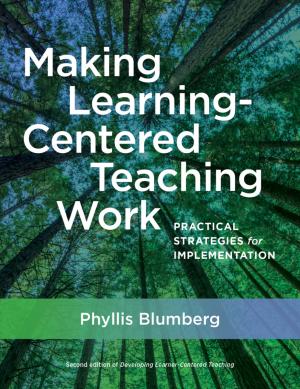
This is a substantially expanded and enhanced revision of Phyllis Blumberg’s acclaimed and bestselling book, Developing Learner-Centered Teaching: A Practical Guide for Faculty (Jossey-Bass, 2009). This easy to follow how-to-guide provides faculty with both a thorough introduction to this evidence-based approach to teaching and practical guidance on how to progressively implement it to strengthen the impact of their teaching. It demonstrates how they can integrate learning-centered teaching into their classroom practice without sacrificing content and rigor, and how to positively engage students in the process by demonstrating its impact on their mastery and recall of key concepts and knowledge. An added outcome, given that learning-centered teaching is correlated with improved student learning, is the resulting assessment data that it provides faculty with the measures to meet the increased demands by accreditors, legislators and society for evidence of improved teaching and learning outcomes. Phyllis Blumberg demonstrates how to use rubrics to not only satisfy outside requirements and accreditation self-studies but, more importantly, for faculty to use for the purposes of self-improvement or their teaching portfolios. She provides examples of how the rubrics can be used to ascertain whether college-wide strategic plans for teaching excellence are being met, for program review, and to determine the effectiveness of faculty development efforts. The book includes the following features: - Boxes with easy-to-implement and adaptable examples, covering applications across disciplines and course types - Worksheets that foster easy implementation of concepts Rubrics for self- assessment and peer assessment of learning-centered teaching - Detailed directions on how to use the rubrics as a teaching assessment tool for individuals, courses, and programs - List of examples of use classified by discipline and type of course Phyllis Blumberg offers Making Learning Centered Teaching Course Design Institutes and workshops on this and other teaching and assessment topics. Half day to multiple day modules. (From the Publisher)

Research shows that online education, when designed and facilitated well, is as effective as traditional campus-based instruction. Despite the evidence, many faculty perceive online education as inferior to traditional instruction—and are often quite vocal in their skepticism. Simultaneously, however, more and more students are seeking online courses and degree programs. Thrive Online: A New Approach to Building Expertise and Confidence as an Online Educator is an invitation for the rising tide of online educators who are relatively new to teaching online, and also for those more experienced instructors who are increasingly frustrated by the dominant bias against online education. Readers will find: • An approach that empowers online educators to thrive professionally using a set of specific agentic behaviors • Strategies for approaching conversations about online learning in new ways that inform the skeptics and critics • Strategies that celebrate the additional skills and proficiencies developed by successful online educators • Guidance for educators who want to feel natural and fluent in the online learning environment • Guidance for enhancing the user-centered nature of online spaces to create student-centered learning environments • Encouragement for online educators to pursue leadership opportunities The internet is changing how people communicate and learn. Thrive Online: A New Approach to Building Expertise and Confidence as an Online Educator offers guidance, inspiration and strategies required to adapt and lead higher education through this change. This book is for higher education instructors who are seeking community, a sense of belonging, and the professional respect they deserve. Thriving is not a reaction to our environment, but rather a state of being we can create intentionally for ourselves. The time has come to change the conversation about online education. Add your voice – join the community and #ThriveOnline. (From the Publisher)

What does it mean to be a productive professor in higher education? What would it feel like to have more peace and productivity? To have nothing fall through the cracks? The Productive Online and Offline Professor is written for today’s busy higher education professional. Through an exploration of what it means to make work meaningful, this book offers practical strategies and tips to support higher education professionals in efficiently managing and effectively using a wide range of technologies and productivity tools. Higher education instructors will find this guide helps them to fulfill their teaching roles with excellence and to build engaging relationships with students while also successfully managing other priorities in their professional and personal lives. The Productive Online Professor assists those who teach online and blended courses with managing their personal productivity. Faculty are often expected to provide support and feedback to learners outside of normal work hours in non-traditional classes. Programs that are designed with more asynchronous content may cause faculty to perceive that it is difficult to ever press the “off button” on their teaching.The author offers guidance and suggests software tools for streamlining communication and productivity that enable faculty to better balance their lives while giving rich feedback to students. Part 1 addresses the challenges in defining productivity and presents a working definition for the text. Part 2 describes the ability to communicate using both synchronous and asynchronous methods, along with ways of enriching such communication. Part 3 describes methods for finding, curating, and sharing relevant knowledge both within one’s courses and to a broader personal learning network (PLN). Part 4 examines specific tools for navigating the unique challenges of productivity while teaching online. It includes ways to grade more productively while still providing rich feedback to students. Part 5 shares techniques for keeping one’s course materials current and relevant in the most efficient ways possible. The Productive Online Professor is a practical guide for how to provide high quality online classes to diverse students. This book shares specific technology and other tools that may be used in charting a course toward greater productivity. It is intended to be a professional resource for fulfilling our roles with excellence and joy, while managing other priorities in our personal and professional lives.(From the Publisher)
A curated collection of reusable resources for teaching and research. Organized by keyword, each annotated artifact (teaching strategy) can be saved, shared, and downloaded.
One page Teaching Tactic designed for a medical ethics class from a Christian, theological perspective. A learning outcome for this course involves moral reasoning from a range of different ethical systems.
One page Teaching developed to address the dissatisfaction students have experienced with one familiar approach—parsing a pregiven list of popular or academic definitions of religion for their shortcomings.
A one-page Teaching Tactic developed at a large public research university for students in lower-level introductory courses like “Introduction to Western Religions” and “Scriptures of the Near East.” It has also been used effectively in upper-level New Testament courses.
In his work as a scholar and educator, James Cone developed leaders. He built a network of scholars, clergy, and activists committed to the power of God in history and to the role of the poor and dispossessed in realizing earthly freedom. Cone’s courses began with the situatedness of the theologians being studied and always returned to the problems of the world that theologians sought to answer. He challenged his students to do the same, identifying and answering the crises of our communities, doing theology in the struggle for justice and liberation. This is one of several short essays presented by recent students at a public forum at Union Theological Seminary after his death in 2018.