Resources
This bibliography lists articles and books on teaching produced by workshop participants and grant recipients of the Wabash Center. It updates a similar list produced in 2007 and published in volume 10 number 3 of this journal.
There has been significant and growing interest in teaching religious studies, and specifically world religions, in a “global” context. Bringing globalization into the classroom as a specific theoretical and pedagogical tool, however, requires not just an awareness that religions exist in an ever-globalizing environment, but a willingness to engage with globalization as a cultural, spatial, and theoretical arena within which religions interact. This article is concerned with the ways that those of us interested in religion employ globalization in the classroom conceptually and pedagogically, and argues that “lived religion” provides a useful model for incorporating globalization into religious studies settings.
During my career, I have regularly taught a survey course on the history of Jews and Judaism in the Persian, Greek, and early Roman periods (ca. 520 BCE – 70 CE). Student performance in the course has long concerned and puzzled me. By the end of the course students demonstrated familiarity with the narratives and concepts we covered, but most did not really “think historically.” They had great difficulties using and applying the historical tools they learned to new situations and evidence. In 2006 and again in 2010 I overhauled the course not only to improve it, but also to figure out how my students learned history. Using a wiki exercise, I traced how students learned and then applied these insights the next time I taught the course. In this essay I report on what I learned.
One page Teaching Tactic: using debate to introduce a topic.
One page Teaching Tactic: students increase comprehension of reading by learning to analyze the structure of a text.

AAR Teaching Religious Studies Series (Oxford University Press)s The term ''mysticism'' has never been consistently defined or employed, either in religious traditions or in academic discourse. The essays in this volume offer ways of defining what mysticism is, as well as methods for grappling with its complexity in a classroom. This volume addresses the diverse literature surrounding mysticism in four interrelated parts. The first part includes essays on the tradition and context of mysticism, devoted to drawing out and examining the mystical element in many religious traditions. The second part engages traditions and religio-cultural strands in which ''mysticism'' is linked to other terms, such as shamanism, esotericism, and Gnosticism. The volume's third part focuses on methodological strategies for defining ''mysticism,'' with respect to varying social spaces. The final essays show how contemporary social issues and movements have impacted the meaning, study, and pedagogy of mysticism. Teaching Mysticism presents pedagogical reflections on how best to communicate mysticism from a variety of institutional spaces. It surveys the broad range of meanings of mysticism, its utilization in the traditions, the theories and methods that have been used to understand it, and provides critical insight into the resulting controversies. (From the Publisher)
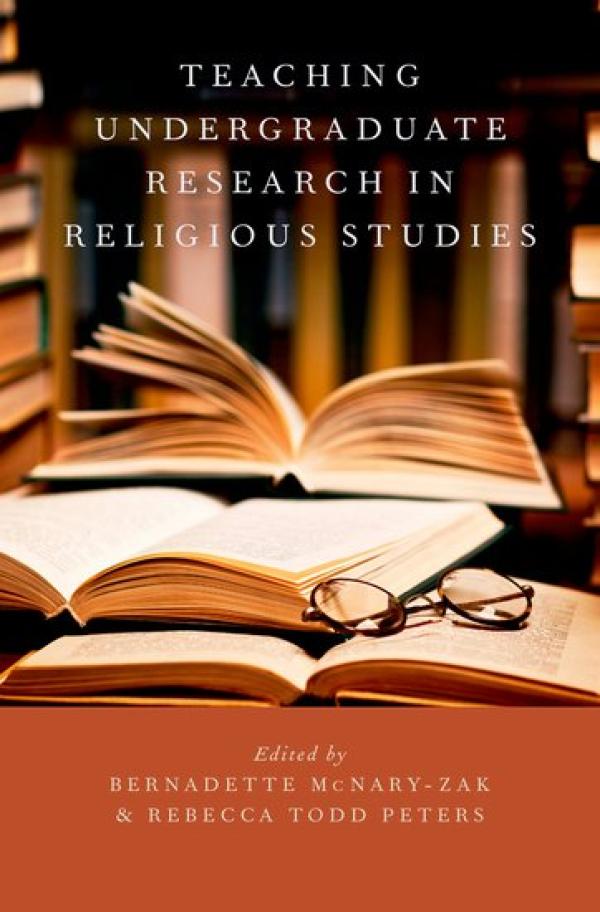
AAR Teaching Religious Studies Series (Oxford University Press) Teaching Undergraduate Research in Religious Studies offers an introduction to the philosophy and practice of Undergraduate Research in Religious Studies and takes up several significant ongoing questions related to it. This volume emerges from sustained conversations about the pedagogy of Undergraduate Research by a group of teacher-scholars in the discipline, and it seeks to extend those conversations. For those new to Undergraduate Research, this book provides an overview of fundamental issues and pedagogical questions and practical models for application in the classroom. For seasoned mentors, it acts as a dialogue partner on emerging issues and offers insight into pertinent questions in the field based on the experience of recognized experts. Individual chapters focus on select theoretical and practical topics including the nature of collaboration between faculty and students, what it means for undergraduate students to make an "original contribution" in their research, how to identify and shape a research project that is appropriate and manageable, the types of institutional and professional support systems needed to adequately support and reward faculty who participate in this kind of pedagogy, and procedures for adequate and appropriate assessment. Student perspectives highlight the importance of Undergraduate Research to student learning. (From the Publisher)
One page Teaching Tactic: to introduce and discuss course content on the first day of class, students work in groups to list what they know about the topic.