Resources
A project team developing resources for teaching Biblical languages using methods borrowed from the field of Second Language Acquisition used for modern languages. 
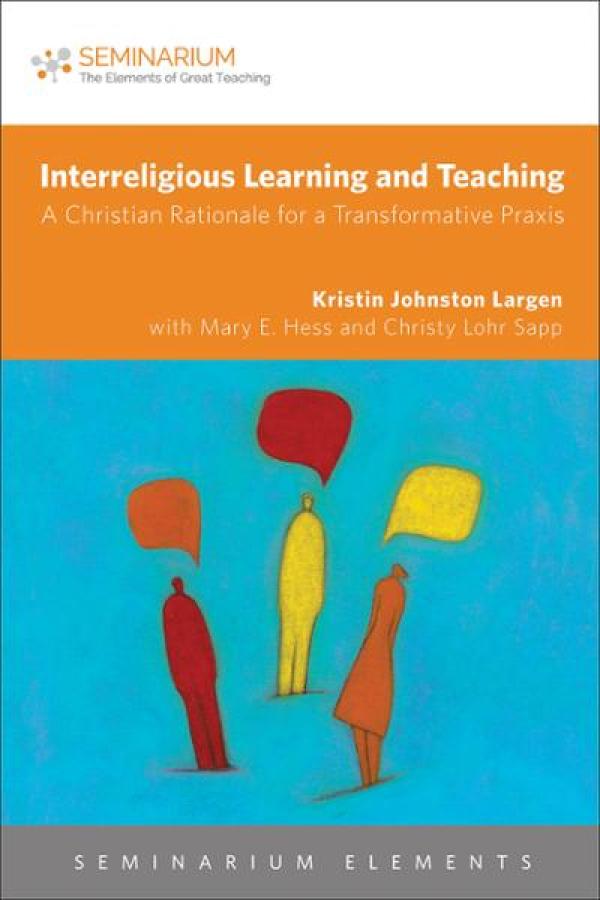
Click Here for Book Review Abstract: There is still resistance in Christian institutions to interreligious dialogue. Many feel that such a practice weakens Christian faith, and promotes the idea that Christianity is merely one among many different religious options. When it comes to higher education, there is the fear that both college and seminary students will “lose their faith” if they are invited to study other religious traditions from a positive perspective. Unfortunately, this attitude belies the current culture in which we live, which constantly exposes us to the beliefs and practices of others. Kristin Johnston Largen sees this setting as an opportunity and seeks to provide not only the theological grounding for such a position but also some practical advice on how both to teach and live out this conviction in a way that promotes greater understanding and respect for others and engenders a deeper appreciation of one’s own faith tradition. Largen’s synopsis of interreligious education and suggested action includes contributions by Mary E. Hess and Christy Lohr Sapp. Hess and Sapp provide practical commentary regarding the successful implementation of Largen’s proposed approach. As a group, Largen, Hess, and Sapp create a text that extends pedagogical innovation in inspiring but practical ways. (From the Publisher)
Is it feasible for nonfluent instructors to teach Biblical Hebrew by communicative principles? If it is feasible, will communicative instruction enhance postsecondary learning of a classical language? To begin answering these questions, two consultants representing second language acquisition (SLA) and technology-assisted language learning led 8 Biblical Hebrew instructors and a graduate assistant through a 3-year process involving study of SLA principles, development of Biblical Hebrew classroom manuals, training of teachers, and field-testing of materials with more than 90 students in 7 institutions. More than two-thirds of the students and all instructors found the communicative approach both effective and preferable to grammar-translation and audiolingual methods customarily employed for learning classical languages.
Journal Issue. In this issue of Spotlight, contributors suggest that the shift to online education involves a complex process of translation. Not unlike language translation, translation from traditional educational models to online environments requires a greater or lesser reconceptualization of education itself. Full text is available online.
Journal Issue. Full text is available online.
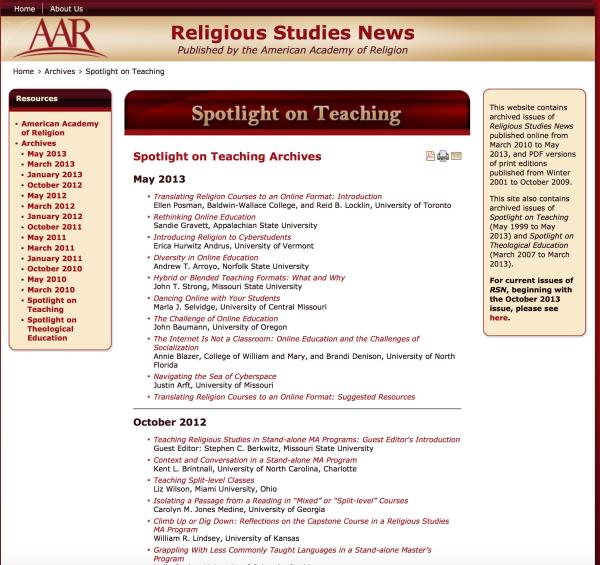
Journal Issue. Full text is available online.
Journal Issue.
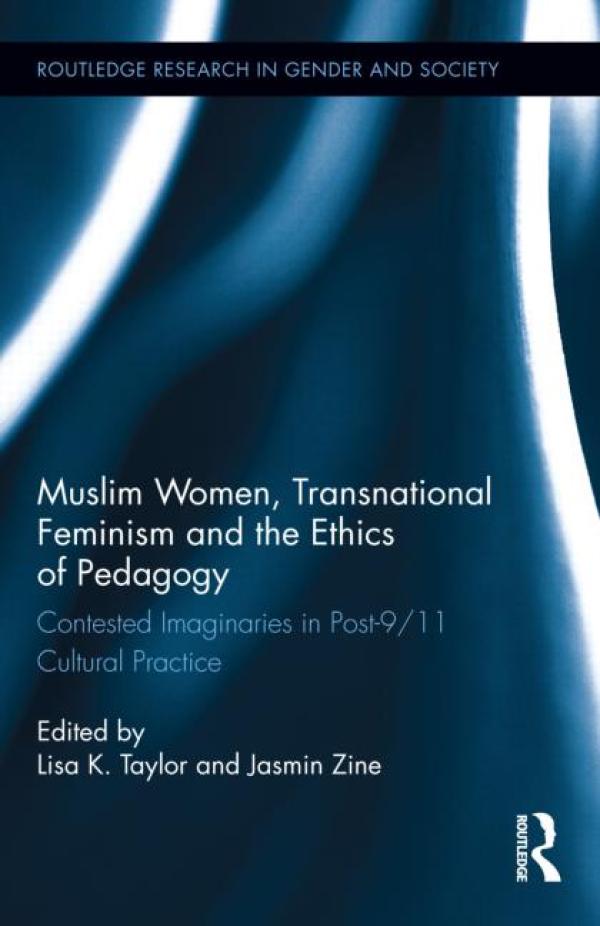
Click Here for Book Review Abstract: Following a long historical legacy, Muslim women’s lives continue to be represented and circulate widely as a vehicle of intercultural understanding within a context of the "war on terror." Following Edward Said’s thesis that these cultural forms reflect and participate in the power plays of empire, this volume examines the popular and widespread production and reception of Muslim women’s lives and narratives in literature, poetry, cinema, television and popular culture within the politics of a post-9/11 world. This edited collection provides a timely exploration into the pedagogical and ethical possibilities opened up by transnational, feminist, and anti-colonial readings that can work against sensationalized and stereotypical representations of Muslim women. It addresses the gap in contemporary theoretical discourse amongst educators teaching literary and cultural texts by and about Muslim Women, and brings scholars from the fields of education, literary and cultural studies, and Muslim women’s studies to examine the politics and ethics of transnational anti-colonial reading practices and pedagogy. The book features interviews with Muslim women artists and cultural producers who provide engaging reflections on the transformative role of the arts as a form of critical public pedagogy. (From the Publisher)
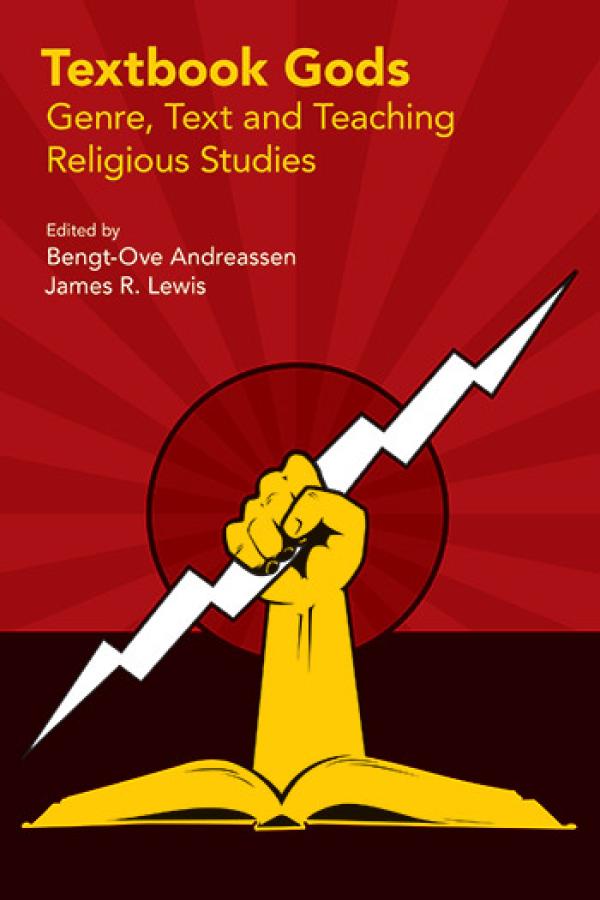
Click Here for Book Review Abstract: In recent years there has been a renewed interest in textbooks, partly because they have maintained their position as an important genre. Not too many years ago – and perhaps currently as well – many considered textbooks outdated or archaic compared with technological advances such as the Internet and different kinds of educational software. Despite these changes, textbooks for school subjects and for academic studies continue to be in demand. Textbooks seem to constitute a genre in which established truths are conveyed, and may thus represent stable forces in a world of flux and rapid changes. Textbook Gods offers perspectives on representations of religion and religions in textbooks. The contributions emerge from different contexts, ranging from European countries, to North America, Japan and Australia. (From the Publisher)
Although comparative theology is a continuously growing method in the study of religion, it is still relatively new and not widely accepted in either confessional or secular institutions. Scholars may face difficulty when seeking their institutions' acceptance for a comparative theology course. One way of generating interest and approval for such a course is by designing it from the center of the institution's mission. Professors can look to the institution's mission as a resource for teaching comparatively. We offer four examples from Catholic institutions of how this might be done. Reid Locklin offers further insights in his response to our explorations.